Category: Musings
A Not Unfortunate Event
One of the most satisfying book series I’ve read is Lemony Snicket’s magnum opus (ostensibly for children), A Series of Unfortunate Events. A verbose, witty look at the unceasingly unfortunate lives of the Baudelaire Orphans, it was the brainchild of San Franciscan (and fellow Lowellite) Daniel Handler, the author of such grown-up books as Adverbs and The Basic Eight - the latter being set at a thinly disguised version of Lowell High. The subject of Handler came up when I was out with friends Saturday night. One of the friends went to Lowell with me, while another is a fellow fan of The Magnetic Fields, a band with whom Handler has played (accordion). With the one friend I discussed The Basic Eight and its portrayal of our high school, and with the latter I discussed the upcoming Magnetic Fields tour and their shows in San Francisco and Oakland.
I openly wondered if Handler would be playing his accordion live with the band.
Lo and behold, today I ran into no less an authority on the subject than Mr. Handler himself, apparently taking a stroll in a Victorian neighborhood near one of San Francisco’s hilltop parks. It must have been a strange encounter for him - it was a chilly day, and I was on my bicycle with my three-year-old daughter, who was clad in a rainbow of colors, with silver sequined shoes and a shimmery silver scarf, sitting in her rear-mounted seat. I suddenly stopped mid-street, just ahead of him, and waited for him to catch up before disrupting his reverie. After verifying his identity (needlessly; I was certain it was him), I said I had just one question - would he be playing with The Magnetic Fields during their upcoming local shows?
I suppose it might have seemed less odd if I explained that I had just been asking that question (to people of lesser expertise) in a bar the prior night. Or, perhaps, that would have made it more odd.
In any case, he graciously said yes, he would, and that he was excited about the new album they were releasing. In fact, he didn’t seem startled by my shock assault at all.
I didn’t bother him for an autograph. I was on my bike, already confusing my daughter with my bizarre behavior, and without a pen or paper. That, and I already have his signature. I let him return to his brisk walk, and resumed our brisk ride.
When we got home I introduced Mather to the music of the Magnetic Fields, to which she responded, predictably, by dancing. A few years down the line she’ll no doubt be introduced to Violet, Klaus and Sunny Baudelaire. Hopefully she can one day mirror their ingenuity, but hopefully without a series of unfortunate events.
Playing Dress-up
I’ve been remiss on recapping the card catalog cocktail party! Some two-dozen current or recent SLIS graduates assembled at our house a few weeks ago to celebrate the newest set of MLIS-degree recipients. And to put an entertaining twist on things, we all (well, most of us) dressed up in our best stereotypical librarian garb for the occasion.
My attempt to go a more formal route was undone by Tom and his husband Mike, who forced me to wear Dame Edna-esque cat-eye glasses, but I was impressed by the efforts of many of my peers. Of course, at least two party-goers declined to participate in the official costume contest on the basis that that’s exactly how they usually dress. Of course, I’m equally guilty. In the run-up to the party, my wife was surprised to see me changing clothes - since I had been already wearing an argyle sweater.
Here’s an assorted few photos:
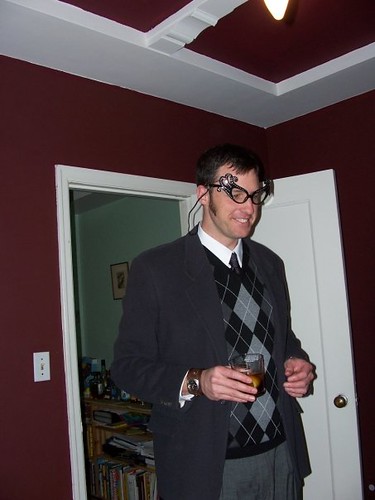 Not actually prescription glasses.
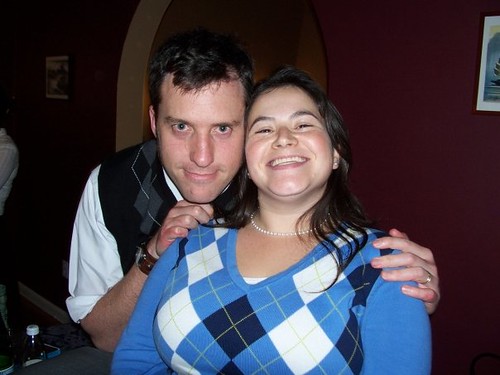 Yes, that’s exactly how Adina usually dresses.
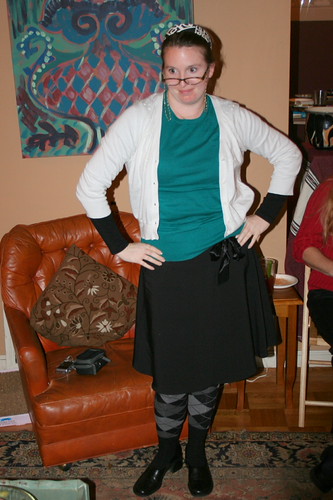 I wouldn’t dare complain about my overdue fines to Carolyn.
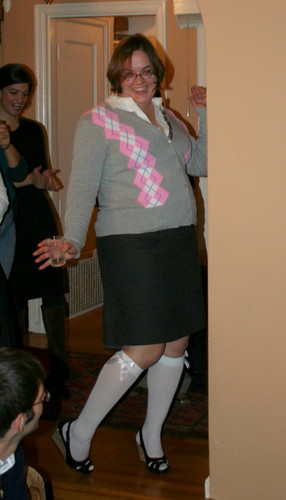 Tawnie went with pink argyle and knee-high stockings.
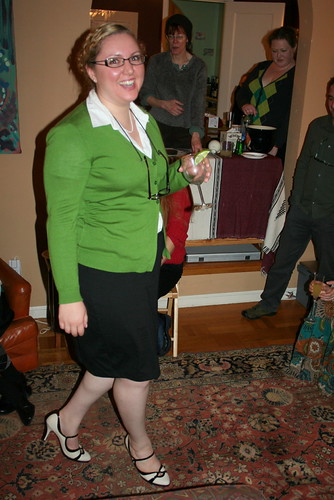 Sjuli went classy with fancy footwear and a pearl necklace.
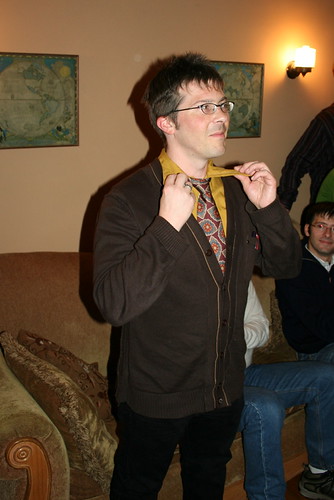 Greg stepped up as resident guybrarian.
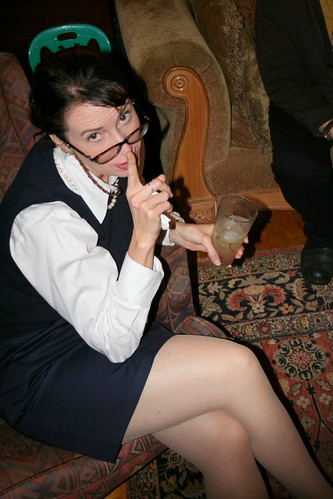
Ironically, with all those MLIS-holders present, the winner isn’t a librarian at all, but rather my wife’s co-worker and best friend Anastasia, who came as an austere, stern shusher:
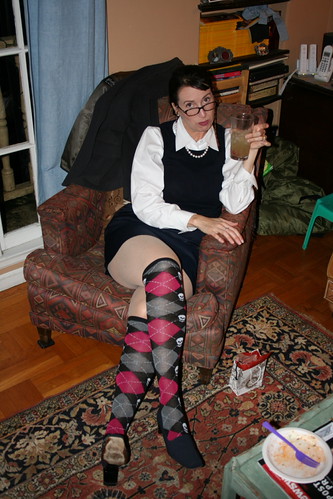
Her grand prize was a set of argyle-and-skull stockings, which she promptly added to her look:
The runners-up each won their very own stub-length pencil. To which Tom (a page at an SFPL branch) responded, “It’s my job to stock those!”.
Happy New Year’s, by the way…
iMUSÉE?
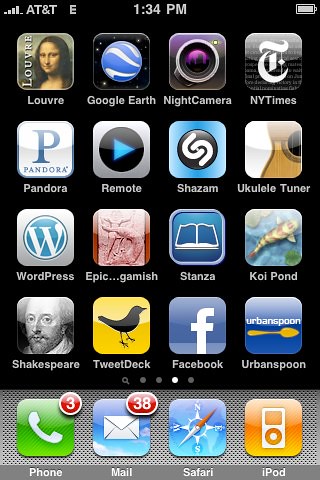
Shortly after writing about “Digital Museums“, I came across a curious iPhone app called “Musée du Louvre“. Officially produced by the namesake majestic Parisian palace (the most visited museum in the world) it bills itself as a virtual tour and information source. Now, it hardly replaces a visit to France on your itinerary. It features text, videos, and photos of only a handful of the museum’s most famous works of art (such as the Venus de Milo, the Law Code of Hammurabi, Winged Victory, the Coronation of Napoleon, and of course the Mona Lisa). Still, since it includes floor plans, museum hours and historical information on each wing, it could make a nice companion to a physical tour.
While it’s ambition may be limited, it’s certainly a highbrow app to carry on your phone - it certainly looks better than the latest “Blond Jokes App” if you loan your phone to a friend (make sure to place it on the same screen as the Works of Shakespeare and New York Times for extra snob appeal). The price is also right - it’s free.
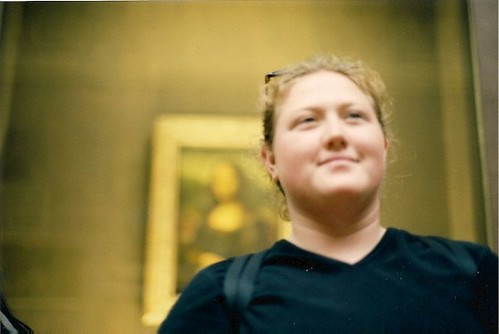
And of course I’d be remiss if I didn’t toss in this decade old photo of my wife doing her best Mona Lisa impression during our real life trip to the Louvre…
I do think this app shows a certain potential for individual institutions. Since programming applications for iPhones and Google Android products is relatively simple, many information institutions - museums and libraries - have the capability of designing their own apps.
Should larger public and academic library systems take the time to design and publish dedicated smart phone applications? What tools and capabilities might a library’s app feature? Are there existing examples?
Be a Flâneur
Someone scrawled the phrase “Be a Flâneur” into wet sidewalk cement near my parents’ house. I’m not sure how long it has been encased in concrete, but I know I passed it many times before my curiosity got the best of me, and I googled the word “flâneur“.
I was more than a little enchanted by what I discovered. Adapted from a French noun for “stroller”, it was coined by the poet and writer Charles Baudelaire to mean “a person who walks the city in order to experience it”. Magic. I’ve loved walking cities my whole life; growing up I frequently walked home from elementary school via increasingly crooked routes that I called my “AdventureWALKS” (which I then wrote stories about after arriving home; I wonder if my mother saved any of these infantile attempts at literature?).
Now, my preferred form of transit is the bicycle, and I frequently carry my daughter to her preschool in a childseat. But yesterday threatened rain, so we took the train to school. I had an appointment downtown, so after leaving her behind, I hustled on to the financial district via subway. When I was done (getting a filling and finding out my new crown didn’t fit), I was downtown, a few miles from her school with a few hours to spare. And the promised rain was nowhere in sight. So I wandered back via streets big and little, boulevards and alleyways, as big as Market Street and as small as Maiden Lane - I became a flâneur, and lived the City.
As much as I love the bicycle, you see more on foot, moving a little slower, stopping when you want, and not having to dodge taxis and busses. Since I didn’t have my usually ubiquitous headphones, I was especially plugged into my environment - sights, sounds, and all the other senses mixed and mingled to let me know where I was. Thoughts both deep and fleeting get to mingle and float as you walk, slowly turning over and developing into something bigger. Blood flows through your veins a little quicker. Crisp December air refreshes the lungs. Long strides stretch tired legs.
My walk started in the heart of the Financial district, close to where the concrete canyons of Sansome and Montgomery originate off the diagonal slash of Market Street. I walked by the venerable and beloved Mechanics’ Institute Library, on Post Street (the City’s oldest library, predating San Francisco’s public library by more than a quarter century) before ducking into a store on Maiden Lane (Christmas shopping is upon us, after all). After shopping, I walked up Geary past (not into) Union Square. I still think the new design is unfortunate and uninviting, with an intimidating front face of concrete facing Geary. Then I followed the cable car path back down to Market Street.
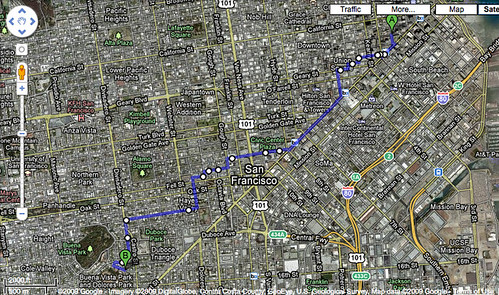
My walking route
Mid-Market remains a troubled area for San Francisco, but it makes a fascinating walk nonetheless, particularly with the current “Art in Storefronts” program adding color to the scene. Of course, I also had to trot into the Main Library on my way through - there is always something to look up or look for!
Walking through Hayes Valley after that was something of a revelation. It’s not an area I’m in very often, and even less often on foot. Now, the area has had cute boutiques and upscale restaurants for quite a while now (ever since the tear-down of the Central Freeway overpass that blighted the area), but it seems to have reached a critical mass in which the variety of stores and eateries both on and off of Hayes Street are feeding off of each other’s success in drawing foot traffic to the area. It was midday on a Tuesday and the sidewalks were busy. I spent a few minutes sitting on a bright green bench studying a bright green door in an otherwise gray storefront. I felt simply enchanted by the addition of color to gray.
Taking in the contrast of color I had a mini-epiphany - part of the reason that San Francisco’s Victorians and Edwardians are so lively and lovely is the contrast between the rich colors in which they are painted and the frequently silver-gray sky settled in above our heads. Civic Center is a collection of handsome, gray beaux-arts beauties, from City Hall to the Old Main Library (now the Asian Art Museum) and the War Memorial Opera House. But the European-style boulevards and open areas of Civic Center often seem lifeless, and it is because the opulent stone buildings look drab when matched with our gray sky. But our Victorians, our wonderful, colorful, bursting Victorians - even the modest ones, the slightly faded ones - sing out under our silver sphere.
I got to enjoy many of those Victorians in my remaining walk up from Hayes Valley into the Haight and Castro, with little surprises and architectural novelties along the way. Walking on little streets you see also unexpected glimpses of art and ideas shared with passers-by.
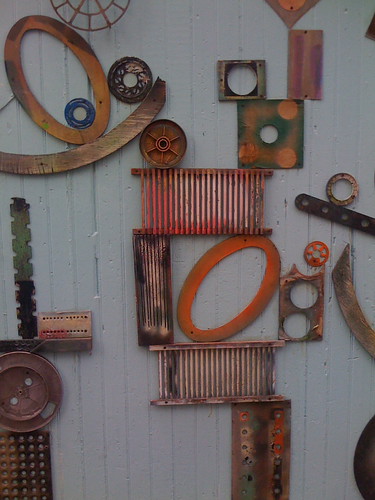
A decorated garage in an alley near Hayes Street
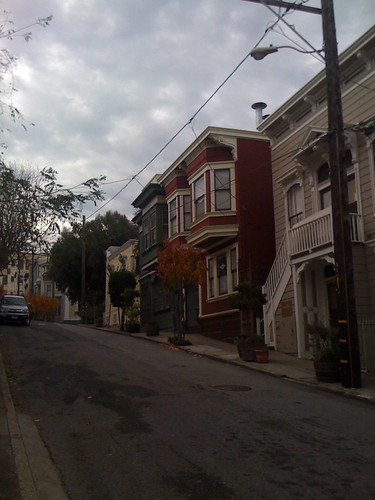
Small, colorful Victorians on Linden
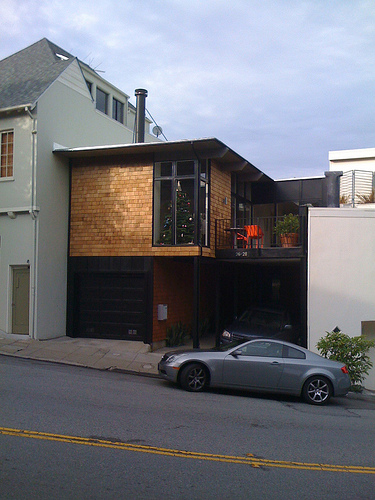
A modern house spiked with color
And of course, from downtown to uptown the best part of the walk was always the people-watching. I won’t elaborate except to say it is delightful to see how meaningless stereotypes can be - you get little windows into other people’s worlds as you walk, snippets of conversations, glimpses of activity and you’re reminded of the infinite possibilities in life and how rarely anyone fits into a singular box - even in just a moment of time.
Near the end of my walk was one of my favorite San Francisco features - obscure public stairs. A hilly city, San Francisco has many shortcuts cut between houses, stone and wood stairways, some with their own street names and addresses (there is something wonderfully romantic and old-fashioned about a street that can only be traversed by foot - no cars, no exhaust, only hustle). Someday I hope to have find and walk them all (this website should help me locate them).
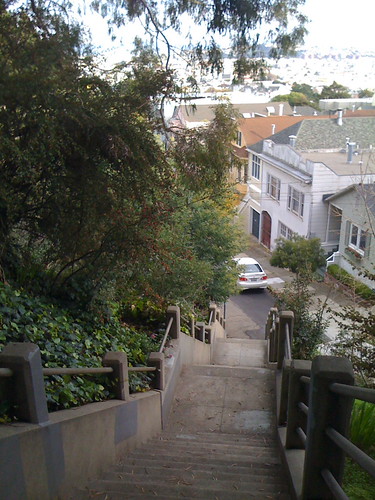
The Roosevelt-Henry Steps
It is rare to have as much free time as I did yesterday, but even when it’s hard to scrape together time it’s always worth remembering to walk a little. Walk alone, or walk with a friend, walk for miles or walk a few blocks, and walk to remind yourself how a city breathes and feels. And let’s ditch the term “pedestrian” - it is so pejorative, an unfortunate surrogate for “bland”, and remember to all be flâneurs instead.
Cataloging Cocktails
This Friday night, my wife and I will be hosting some thirty-odd current and alumni students from San Jose State’s School of Library and Information Science for a graduation party in honor of all those who’ve completed their degrees this Fall (which, yes, includes me).
I’ve always been amused by the defensiveness I see from some quarters when it comes to “stereotypes” about librarians. Of course I understand the argument about how changing technology and information needs are altering the nature of the MLIS degree, and I know the core skills of the librarian are constantly in evolutionary flux. My own skillset, interests and education are all reflective of a 21st century librarian. But since when did a good argyle sweater become something to be ashamed of? Heck, even pop stars are mimicking librarian style these days (and I rock a good argyle whenever I can).
So for this party, we’re organizing a bit of a throwback: we’ll give a special doorprize to the best librarian “drag” worn by an attendee - sweater vests, lead-pencil hair buns, the works. And I borrowed a typewriter, bought some index cards, and pulled out the hole punch to create a cocktail menu on a set of catalog cards:
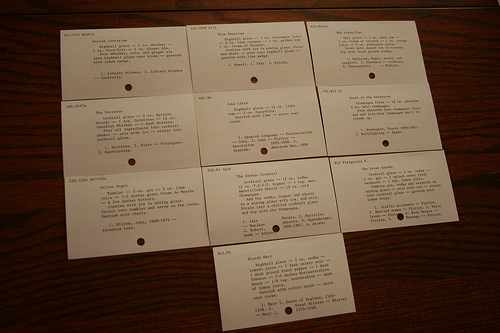
Of course, cocktails aren’t something you’d typically catalog for a library. So I used a little creative license: “The Great Gatsby” has been cataloged under its namesake novel’s Dewey Decimal call number, and the Library of Congress Subject Headings for the “Bloody Mary” have more to do with an English monarch than they do tomato juice. Here’s the complete set (10, one for each class under the DDC):
Digitizing Museums
There’s been a lot of talk in the bibliocentric world about the oncoming digitization of libraries, from Google’s ongoing endeavor to digitize “every” book (recently in the news due to the recent settlement of a major copyright lawsuit) to established libraries moving to an “all digital” format. However, another trend is interesting: the coming of the digital museum.
I admit I’m skeptical that either concept will replace their brick and mortar counterparts. While I think online resources, including digitized books, are a great boon to readers and researchers, and e-books, be they on a Kindle, an iPhone, or other device, will continue to gain market share, print will remain a key method for disseminating written materials. It remains at once both familiar and practical, and still the most accessible form of information given the exclusivity (ie, price) of most e-Readers.
But these emerging “digital museums” still provide a great value, in much the same way digital archives can - digitized materials can be safeguarded when their physical counterparts cannot. Google recently announced an endeavor to digitize the complete contents of the National Museum of Iraq, famously looted in 2003 after the fall of Baghdad. To date the National Museum - home to thousands of years of archeological treasures, spanning from the dawn of civilization - has not been reopened to the public, and most of its surviving collections remain in storage. Google’s digitizing will provide (hopefully high-resolution) imagery of this priceless collection, making it available to the world for free and reminding everyone that Iraq was and remains one of the great cradles of civilization, the birthplace of art, writing, and law.
Even more ambitious is the planned “Museum of Afghan Civilization” currently in design stages and set to debut in January, 2010. This is a digital museum built from the ground up, using a website to emulate a physical institution that does not exist - designed not by a graphic artist but in fact by an architect, France’s Yona Friedman. “Patrons” will enter the museum from a portal designed to replicate the ancient Buddhist statues of Bamiyan, destroyed by the Taliban in 2002, and navigate their way through “pavilions” thematically or chronologically arranged to display artifacts of Afghanistan’s influential history.
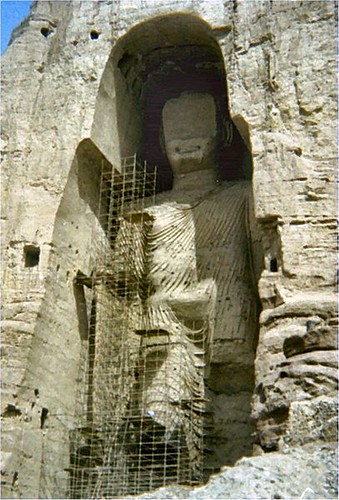
One of the two Buddha statues that inspired the “architecture” of the Museum of Afghan Civilization.
Traditional museums are likely in even less danger from digitization than libraries (no on-screen image can recreate the personal experience of viewing a fully dimensional artifact), but this is an interesting trend that will hopefully provide a wider audience for some of the world’s most forgotten treasures. And unlike physical museums that have to deal with ongoing issues of cultural ownership - Greece wants the Elgin Marbles back from the British Museum, for example, and the Getty got embroiled in an ownership dispute over Italian artifacts - digital museums can sidestep this issue.
And while we await the debut of the Museum of Afghan Civilization and Google’s version of the Iraqi National Museum, we can preview a digital museum through an Italian-created portal that covers a portion of the Iraqi National Museum’s collections: the Virtual Museum of Iraq. Take a look and let me know what you think. How well does this recreate a museum experience for you as a viewer? Does it engage and hold your interest?
Banned Books Week
Born in 1982, the American Library Association’s “Banned Books Week” is an annual opportunity for libraries to focus on freedom of information, anti-censorship policies, and defense of a patron’s freedom to read. Rather than sitting back and defending library materials when under attack, the Banned Books Week event becomes an offensive tool, deployed by the ALA and by librarians across the country to emphasize the importance of literary freedom.
It’s a tactic that has drawn fire - the Wall Street Journal recently published a critical piece on the concept. In it, writer Mitchell Muncy criticizes the ALA for including legal challenges to books whether or not they successfully lead to the removal of a book in their banned book statistics. He states that 90% of book challenges do not lead to the permanent removal of the book in question, and therefore the low rate of successful challenges is evidence that an event like Banned Books Week is unnecessary and “overblown”.
In refutation: the fact that 90% of challenges fail is a credit to Banned Books Week and the substantial advocacy the librarian profession engages in. It is evidence that the event and the activism it represents is successful and should continue. I would also contest his assertion that censorship only exists when directed by the state:
“To examine in order to suppress or delete anything considered objectionable.” – Merriam-Webster Dictionary
The very definition of the word fails to mention government. It’s my understanding that censorship can come in many forms, not only from the state, but from community groups, teachers, individual parents, or neighborhood gadflys. Anytime pressure is applied to remove information (be it a book, film, or even the forced retraction of a public statement) in such a way that it would deny access to others, it veers into the dangerous territory of censorship.
Muncy’s too casual assumption that it’s only censorship if it’s driven by the state, and that the success of the ALA in defending controversial materials is somehow an argument against its continued activism are faulty premises.
Long live Banned Books Week. If nothing else, it’s a great chance to celebrate the controversial, confrontational, and vital books that change our world one reader at a time.
Living on the Fringe
There are three days left of the 2009 San Francisco Fringe Festival, an annual bacchanal of uncensored, unjuried short-form theater presented in an affordable, rotating environment. The San Francisco Fringe is just one outpost of a theater movement born in Edinburgh, Scotland with tendrils in many American and Canadian cities. The purpose is to provide professional stage space and an audience for individuals and theater companies that regularly lack either.
The first edition of the Edinburgh Festival Fringe ran in 1947, when companies left out of the Edinburgh International Festival staged their own celebration. The idea has both evolved and spread in the decades since, though the Edinburgh Festival Fringe remains not only the world’s largest Fringe Festival, it has in fact become one of the world’s largest annual performing arts festivals of any kind. The San Francisco Fringe is a more humble affair, but 18 years in, it provides one of the city’s most endearing and enduring theatrical spectacles (in the interest of full disclosure, I have been on the SF Fringe staff for seven years now).
The concept sounds simple, but the execution requires a hard working staff and a very large volunteer base: 40-50 hour-long productions are mounted, all with 4-6 performances in the space of 11 days across a half-dozen stages around the City. Eddy Street’s Exit Theater produces the festival, provides the central meeting place (the Exit Cafe, 156 Eddy), and three of the stages. The shows are short, staggered, and inexpensive, allowing audience members to “fringe” their way through multiple offerings in a night.
Companies enter a lottery (with separate drawings for local and traveling acts) and the winners are offered a shot in the festival, which comes with a stage, technical assistance, and performance slots. Each company has complete, uncensored freedom to produce any stage spectacle they want. Many of the performers are traveling solo acts, but some more ambitious companies take part - the then little-known Banana, Bag & Bodice gained notice with the shows Gulag Ha Ha and Sandwich at the San Francisco Fringe, and have since gone on to high-profile runs of their songplay Beowulf: A Thousand Years of Baggage at Berkeley’s Ashby Stage and in Manhattan (which brought about a feature in the New York Times).
My personal history with the Fringe goes back into my drama-class youth. When I was in high school I helped a family friend with his one-man show as his sole run crew; the following year I went “fringing” with a buddy and saw three shows. Two of them I liked, but the third I remember as the worst piece of theater I’ve ever seen: it was called “Water Closet” and tried to combine incest, neo-Nazism and bad plumbing into a family dramedy. It was dreck. But that is the risk of the Fringe: since any company can win a show slot, you never know what you will get unless you carefully peruse the reviews and chat up the volunteers. It can be easy to steer clear of the duds if you talk to a few people, but I didn’t know that yet in high school. I started working for the Festival a couple years out of college, hoping to keep involved in theater. In the years since, it has been the source of some of my closest friends and favorite memories. I have also seen some incredible theater in the process (taking in as many as 30+ shows in some seasons).
While this year’s festival is drawing towards a close, the final weekend is always the best - the biggest crowds, the most polished performances, and plenty of talk in the Exit Cafe about which are the best and most worthwhile shows. From what I’ve heard so far, Poste Restante, A (Bearded) Lady, and The Surprise are all top picks. The two shows I’m working on - Break-Upocalypse and Inside Private Lives - are both entertaining, funny romps. Come out to the Exit Theater this weekend, fringe your way through 2-3 performances, and have a memorable experience.
