Tag: digitizing
Preserving the Born-Digital: Lessons from a Decade of Web Archiving
When Daniel invited me to contribute a guest post to The Pinakes, I knew exactly which subject I wanted to raise: the strange, slippery problem of preserving things that were never printed. We have centuries of practice keeping paper alive. We have barely two decades of practice keeping a website alive, and the website is winning.
Callimachus could walk the stacks of Alexandria and point to a scroll. Our born-digital collections have no stacks. A single blog like this one is really a tangle of a database, a theme, a dozen plugins and a hosting account that renews, or does not. Lose any one piece and the whole thing can vanish between one capture and the next. The crawler that visits today may find a healthy page; the crawler that visits next spring may find a parked domain.
Three lessons from the trenches
First, capture early and capture often. The best preservation decision is the one made while the material still exists. Second, keep the context, not just the file. A PDF without its catalog record is an orphan; a web page without its stylesheet is a ransom note. Third, assume formats will rot. Plan for migration the way a gardener plans for winter, because the Flash players and proprietary readers of one decade are the dead links of the next.
None of this is glamorous. It is closer to plumbing than to scholarship. But it is the plumbing that lets the scholarship survive, and I think the old librarians of Alexandria would have recognised the instinct immediately. You index what you have, you copy what you love, and you hope the next generation is paying attention.
Continue reading Preserving the Born-Digital: Lessons from a Decade of Web Archiving »
Digitizing Museums
There’s been a lot of talk in the bibliocentric world about the oncoming digitization of libraries, from Google’s ongoing endeavor to digitize “every” book (recently in the news due to the recent settlement of a major copyright lawsuit) to established libraries moving to an “all digital” format. However, another trend is interesting: the coming of the digital museum.
I admit I’m skeptical that either concept will replace their brick and mortar counterparts. While I think online resources, including digitized books, are a great boon to readers and researchers, and e-books, be they on a Kindle, an iPhone, or other device, will continue to gain market share, print will remain a key method for disseminating written materials. It remains at once both familiar and practical, and still the most accessible form of information given the exclusivity (ie, price) of most e-Readers.
But these emerging “digital museums” still provide a great value, in much the same way digital archives can - digitized materials can be safeguarded when their physical counterparts cannot. Google recently announced an endeavor to digitize the complete contents of the National Museum of Iraq, famously looted in 2003 after the fall of Baghdad. To date the National Museum - home to thousands of years of archeological treasures, spanning from the dawn of civilization - has not been reopened to the public, and most of its surviving collections remain in storage. Google’s digitizing will provide (hopefully high-resolution) imagery of this priceless collection, making it available to the world for free and reminding everyone that Iraq was and remains one of the great cradles of civilization, the birthplace of art, writing, and law.
Even more ambitious is the planned “Museum of Afghan Civilization” currently in design stages and set to debut in January, 2010. This is a digital museum built from the ground up, using a website to emulate a physical institution that does not exist - designed not by a graphic artist but in fact by an architect, France’s Yona Friedman. “Patrons” will enter the museum from a portal designed to replicate the ancient Buddhist statues of Bamiyan, destroyed by the Taliban in 2002, and navigate their way through “pavilions” thematically or chronologically arranged to display artifacts of Afghanistan’s influential history.
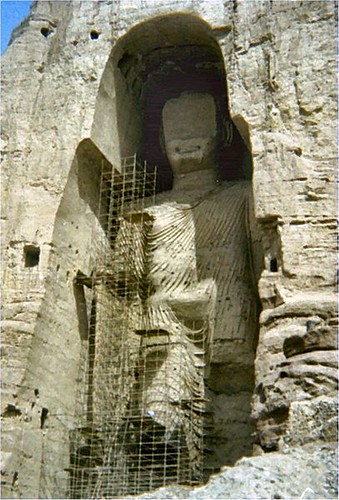
One of the two Buddha statues that inspired the “architecture” of the Museum of Afghan Civilization.
Traditional museums are likely in even less danger from digitization than libraries (no on-screen image can recreate the personal experience of viewing a fully dimensional artifact), but this is an interesting trend that will hopefully provide a wider audience for some of the world’s most forgotten treasures. And unlike physical museums that have to deal with ongoing issues of cultural ownership - Greece wants the Elgin Marbles back from the British Museum, for example, and the Getty got embroiled in an ownership dispute over Italian artifacts - digital museums can sidestep this issue.
And while we await the debut of the Museum of Afghan Civilization and Google’s version of the Iraqi National Museum, we can preview a digital museum through an Italian-created portal that covers a portion of the Iraqi National Museum’s collections: the Virtual Museum of Iraq. Take a look and let me know what you think. How well does this recreate a museum experience for you as a viewer? Does it engage and hold your interest?
