Public Service Announcement
Since last summer I’ve been using tumblr exclusively for my blogging. Generally speaking, it is easier to post to, and I have a wider readership on that platform than I did here. However, because tumblr is a mix of long and short posts, original content and “reblogs,” my longer posts can disappear quickly off of my front page.
Therefore, I am going to re-post some of my longer content onto this site over the next few days, and going forward, I will mirror my more substantive blog posts on both platforms.
Trip Report: CARL Conference 2012
In April of 2012 I attended the biennial conference of California Academic and Research Libraries, the state affiliate of ACRL. The conference theme was “Creativity & Sustainability: Fostering User-Centered Innovation in Difficult Times.” The focus of the keynote presentations was the promotion of innovative leadership (or, in the cases of some institutions, how to overcome a lack of innovative leadership). The conference proceedings have now been published online: http://www.carl-acrl.org/conference2012/2012ConferenceProceedings.html
The opening keynote presentation was from Jenica Rogers, a library director at a university in upstate New York and a blogger at Attempting Elegance. In her presentation, she quoted some disturbing figures about how few library directors felt they had an innovative plan for the future. If institutional directors don’t feel they have a plan for the future, how must their staff feel? What does that say about the future of their libraries on campus? Rogers emphasized the easiest thing a director can do to foster innovation is to say “yes.” If you’ve hired a staff of motivated, creative librarians, saying “yes” will be the ticket to innovation and change.
Another keynote was from co-presenters Char Booth, coordinator of instruction at Claremont Colleges, and Brian Mathews, an Assistant Dean of Library Services at Virgina Tech. There presentation focused on threshold concepts in education and using curriculum mapping to refine and improve campus-wide information literacy programs. Their invited paper is available online and I highly recommend reading it.
I highlighted the following extract on tumblr:
“How does threshold concept theory apply to academic librarians? It can be argued that incorporating knowledge of threshold concepts into our instructional strategy enables us to be more effective and empathic – anticipating the challenges our learners face and intervening with insight into their disciplinary experience. This can impact not only what and how we teach, but also when is the right time to cover particular topics and skills. In short, it enables us to survey the entire learning landscape within a discipline and optimize the libraryʼs interaction. By understanding the common stumbling blocks, knowledge gaps, and frustration points within a given subject domain, as well as with particular courses and assignments, we can better position the library to become a strong instructional partner.”
As a liaison to my university’s nursing program, I feel it is incumbent upon me - even if the depth of my nursing expertise is limited - to investigate the relevant threshold concepts are in nursing practice so that I can deepen my work with the nursing students. I feel inadvertently stumbled into a threshold when I made a recent presentation on evidence-based nursing, a highly specific, clinical practice that involves using research to provide answers to clinical questions. Presenting on that specific a subject pushed me beyond the usual approach of ‘access the database here, use these search terms and limiters’ type of workshop. I had to get knowledgeable on realms beyond my experience - things like PICO questions, meta-analysis and systematic reviews - and relay the importance of these concepts to students who are still sometimes new to scholarly research. I came away from that presentation feeling like the formal process of creating a PICO question - and using that question to derive strong keyword search terms - transformed the students’ approach to scholarly search in ways that will benefit them beyond evidence-based practice. If they can master a high-level concept like PICO, the rest of their information seeking-skills will come to them more easily.
A few other highlights from the conference:
Predicting Innovation in Library Environments
Michael Germano, CSU Los Angeles.
CSU’s Michael Germano became a librarian after a career in tech entrepreneurship, and compared and contrasted elements of successful leadership with some of the bureaucratic elements he believes hinder libraries. One of his major points was that your internal culture affects your users. It has a significant impact, especially on existing, ongoing users and customer retention and loyalty.
He described innovative climates as possessing the following traits:
- Accountability
- Assessment/Evidence Based
- Change tolerant
- Confident
- Competitive
- Fearless
- Positive/Supportive
- Reward Oriented
- Vision Driven
He asked how many of these traits are embodied by libraries?
He described the following as values that drive innovative environments:
- Risk tolerance
- Flexibility
- Boundarylessness
- Customer Focus
- Shared purpose
- Value/Empower people
- Results oriented
- Sense of urgency
- Low tolerance of repetition
In contrast, he used the following attributes to describe existing library culture:
- Organized and predictable
- Permanency
- Shared values
He emphasized how leadership qualities can create an innovative environment. He characterized leadership as the process of influencing others to engage in a shared task or purpose - leading is not managing.
Library instruction: information visualization and keyword searching
Matt Conner & Melissa Browne, University of California, Davis
This presentation was the culmination of a CARL-funded research study on the keyword searching techniques of college students and the effect of visual literacy tools on search success.
The basic idea is that vision and cognition are fundamentally related. Representations of data with visual designs assist comprehension and insight. A popular example is the red state/blue state map that makes political affiliation so much easier to grasp than a series of charts that conveys the same information. Their survey used information-seeking tools that emphasize visual elements to see how it affected user behavior and success. Some of the tools they used were the now-defunct Google Wonder Wheel and EBSCOhost’s Visual Search.
Known patterns in student search strategies are either single-word searches or long strings of natural language. Students tend to only skim search results. Students will give up quickly and assume there is nothing on their topic. These strategies don’t largely work using library resources. The researchers suggested that instructional librarians are not always giving students the best guidance for their topic searches. It’s really important to turn topic ideas into search keywords in a way that affects and strengthens search outcomes.
The question the researchers tried to answer was whether visualization would help students formulate more systematic searches. Could it improve efficiency and increase satisfaction? Results were inconclusive, though users did have some success improving their keywords after using EBSCOhost’s Visual Search.
The research provided one surprise outcome: student behavior isn’t exclusively about searching and terms. There was a strong tendency towards link-following. They may start with one search in Google, but ultimately follow a series of links until satisfied, which partially explains the popularity of the hyperlink-rich Wikipedia.
Transforming Research into Practice: Using Project Information Literacy Findings to Revitalize Instruction and Outreach
Michele Van Hoeck, CSU Maritime; Ann Roselle, Phoenix College; Catherine Palmer, UC Irvine
Each presenter gave a specific example of using Project Information Literacy (PIL) findings at their institutions. Each of the research reports referenced below can be found on the PIL Publications Page.
First, some of the basics of PIL; it is an ongoing research project guided by Dr. Alison Head and Dr. Michael Eisenberg at University of Washington’s iSchool. It has surveyed 11,000 college students from 52 campuses across five studies.
Michele Van Hoeck focused on incorporating ideas from 2010 PIL survey, “Truth be told: How college students evaluate and use information in the digital age.” The survey involved 8,353 students on asked about their course-related and everyday life research. It was an online survey with 22 questions.
The first major finding of the survey was that students reported the most difficulty with getting started (84%), finding a topic (66%), and narrowing a topic (61%) – described as “failure to launch.” PIL conducted follow-up interviews with certain students. Students said it wasn’t a lack of ideas that made it hard to start, it was a fear of their idea failing them, and an inability to vet their topic. They were desperate for context and background, hence using Wikipedia very heavily.
Based on these PIL findings, Van Hoeck developed new learning outcomes for her LIB100 course at CSU Maritime:
- Develop methods for exploring and vetting new topics.
- Gain awareness of sources for context & background.
She suggested a couple methods of addressing these learning outcomes in a one-shot instructional session.
- Infolit icebreaker: using Poll Everywhere to ask “What’s the worst thing about a research paper?”
- Creating a Getting Started tab on a LibGuide (or other model of institutional research guide or pathfinder.)
- Focus first session on getting started, devoted to sources for starting research.
- Only demonstrating electronic sources and explicitly comparing them to Wikipedia.
- Van Hoeck used libguide stats for assessment, looking at Fall 2010 vs. Fall 2011 usage. Paired with a new lesson plan, the LibGuide saw a tripling of link usage.
Ann Roselle of Phoenix College looked at the 3rd PIL report, “Assigning inquiry: How handouts for research assignments guide today’s college students.” The survey looked at 191 research assignment handouts from 28 different institutions across disciplines. 83% of the surveyed handouts could be described as a “standard research handout” - that is to say, unexceptional and including several common weaknesses.
The study compared the majority of research assignment handouts to city roadmaps with no street names included (because they did not specific which databases students should use.) Only 13% of handouts mentioned consulting librarians (or faculty). Only 18% mentioned plagiarism.
The PIL report described these assignments as paying “more attention on the mechanics of preparing a research assignment” rather than getting started, defining the topic, or evaluating the information.
As a response to these PIL findings, Ann Roselle hosted a workshop for faculty to give them a better idea of how to create a research assignment handout. She had faculty work in small groups. They worked through sources slowly and were given handouts to analyze. The selected handouts were a balanced mix good and bad to see how faculty would analyze them.
Time was given at the end of the workshop to provide faculty a chance to consider how their own handouts work. When asked to describe one common pitfall of research handouts, faculty identified that “librarian not included” comes up a lot. Faculty were also advised also include actual links to specific databases.
Feedback from faculty who have worked on improving their handouts includes, “I have noticed that students have less questions about how to do the assignment, and I am generally getting more college-approved sources.”
Catherine Palmer adapted a St. Olaf College Research Practice survey into a PIL-inspired pre- and post-test assessment model for UC Irvine. One advantage of the open-source St. Olaf assessment was the ability to include open-ended questions on research practices. UC Irvine replaced Project SAILS with this approach.
English Composition Students: How Are They Using Their Sources?
Sharon Radcliff & Elise Wong, Saint Mary’s College Library
This was an interesting presentation on a research project librarians at St. Mary’s conducted on the bibliographies of their freshmen composition papers. The pilot study included 25 papers in 2008. In 2010 they expanded the study to approximately 80 papers. 20 papers were not included in the 2010 study findings because they didn’t have bibliographies at all.
Some of their findings from the second survey were on the types of sources used:
- 44% websites
- 30% magazines and journals
- 22% books
Regarding the citations, 58% were direct quotes, 42% were paraphrased. The faculty would prefer to see a higher percentage of paraphrasing in order to synthesize ideas, which is considered a stronger form of writing than a heavy reliance on direct quotations. About half of the quotes were introduced and analyzed. 20% had an introduction but no analysis. 14% analyzed afterwards with no introduction. 13% of quotes had no introduction and no analysis.
As a outcome of this survey, faculty & librarians revisited their instructional design to account for shortcomings with the hope that composition faculty could consult with librarians in course design and embed library tutorials in class materials.
There were some limitations of study. It was not a random sampling - the papers volunteered by English faculty. There was no discussion on the quality of the sources, and no association between un-cited information in the papers and plagiarism.
For the future, the librarians would like to implement multiple instructional strategies, design a study to test these strategies, in order to compare their modified practices to a control group. They would like to add specialized instruction on citations to sections of first semester in English comp. They would also like to compare results with sections not receiving instruction at all, and determine means to track the progress of students over four years of education.
One element the St. Mary’s librarians are adding to their freshmen year instruction is having the students actually find an article and identify the parts of a citation. They make sure the students at least write out one citation in class - have them have the experience of doing it themselves.
Trip Report: SCELC Vendor Day
I flew to Los Angeles a couple weeks ago to attend the second half of the Statewide California Electronic Libraries Consortium’s (SCELC) annual Colloquium & Vendor Day hosted at Loyola Marymount University (I was unable to attend the first day because I was leading a four-hour intensive information literacy workshop for Biology students; I should post about that someday, too).
The first night, my colleague N.G. and I got to meet up with some Southern California information all-stars: Young Lee, law librarian and bon vivant* from the University of La Verne; John Jackson, the dapper, bow-tie wearing ALA Emerging Leader and Grand Cataloger at USC; and Loyola Marymount’s librarian-in-residence Cynthia Orozco. Our conversation was exactly what you’d expect with a table full of librarians (bar the unexpected interloping business-traveling New Zealander who butted into our conversation to regale us with his personal philosophy - think: people are either sheep or wolves - he was the wolf, we were the sheep?): it was a mix of excellent professional observations and ideas, a wealth of outstanding verbal sorties and quips, and a healthy debate on the proper composition of a Manhattan.
Another perk of going to SCELC was I finally got to meet my long-time internet friend Sherry Youssef and her colleague Shawna, who are librarians at a specialized psychology graduate school. Since I recently became our liaison librarian to our Psychology Department, this was a useful chance to pick their brains about products, collections, and other things relating to a field I still need to learn about. Sometimes professional networking isn’t just about getting jobs; it’s about getting good ideas from smart people (and good dinner conversation is just the bonus).
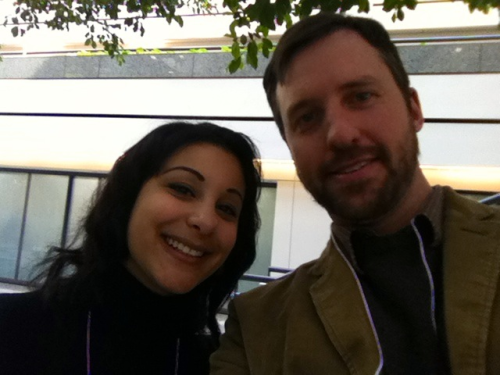
Hanging out with Sherry
SCELC’s Vendor Day followed the next day. Here’s a brief rundown of some of the product demonstrations I saw and my first impressions**:
APA
The first presentation I saw was from the publishing & electronic content arm of the American Psychology Association (APA; shhhh…I didn’t tell them that I’ll soon be staging a protest). They are debuting a few new products:
- PsycBOOKS, which can be purchased by title-by-title or leased as a 44,000-chapter full-text collection. This collection will grow with newly published materials (after a 1-yr embargo) and also contains various “classics” in the psychology field.
- PsycTHERAPY, apparently a competitor to Alexander Street Press’s existing Counseling & Therapy Video Collection. This contains 300 therapy demo videos featuring actual clients and practicing professionals.
- PsycTESTS, a database of testing instruments (including non-commercial permissions) as described and culled from various journal articles and other sources. Their long-term goal is to have 20,000 tests in the database. Currently 75% of content is full-text (remainder have either been published as commercial tests or authors have not provided permission – in those cases, only a citation and contact information is available).
Credo
Credo provides DRM-free reference eBooks; generally speaking, they are one of my favorite vendors both for the quality of their content and the ease of using their UX on both the user and administrator side. The depth of the Credo reference collection is what allowed my library to move almost entirely away from print reference collections (this is a ubiquitous trend in libraries and elsewhere; note the recently announced death of the print edition Encyclopædia Britannica). Our Credo collection contains over 500 different sets of encyclopedias, dictionaries, and other reference items running the gamut of arts, humanities, social science, health, education and science disciplines.
Credo was at Vendor Day to demonstrate their new product, Literati. Literati is a spiffed-up interface for content from Credo’s Reference Database that includes customized videos, a stylish navigation screen and built-in hyperlinks designed to make information-seeking more intuitive for millennial students. However, since the content beneath the splashy screens largely remains the same, I’m unsure how much of an upgrade over the simpler Credo experience this is. Is it just adding more clicks into the information retrieval process? That’s counter to what we want. Until I get a chance to try it myself and see what the benefits might be, the jury (ie, the jury of me) is out on Literati.
Copyright Clearance Center
The non-profit organization Copyright Clearance Center was at Vendor Day to demonstrate the usefulness of their Get It Now automated electronic article inter-library loan (ILL) sharing system, first designed and implemented by the CSU system but now spread to many institutions. The patron-driven, automatic delivery of electronic scholarly articles is absolutely the way ILL should work in the 21st century and it’s pretty cool to see it taking off - a la carte article publishing could save libraries a lot as opposed to big bundles of unused electronic journal subscriptions. The service bills libraries monthly for the number of articles acquired.
There is a fairly large group of contributing publishers including many of the major names. Currently, 120 colleges have adopted the service. Along with receiving a copy of the articles requested, libraries are also provided the copyright clearances they need for most academic uses (not surprisingly, since the Copyright Clearance Center is behind all this).
Gale
Gale Cengage was demonstrating two products – Business Insights: Global and the newest iteration of the Gale Virtual Reference Library. I was pretty pleased with what I saw from Business Insights: Global - clean, simple interface; you can use it to create quick, easy-to-design charts based on financial and statistical data; and it prominently features hyperlinks to promote the proximal curiosity effect that drives so much of Wikipedia usage. As for GVRL, it looked like a sharper interface; I believe many libraries are already using it. I’ll check it out more thoroughly before I implement it, however (interface changes mid-semester aren’t usually a good idea).
All in all, it was a good trip to SCELC - whatever you think of the world of library vendors and journal publishers (and there are issues with them all, to varying degrees), it’s useful to know what they are offering. It’s just too bad I had to miss the librarians vs. vendors bowling night.
Future Travel
My trip to SCELC marked the start of my travel season; I’ll be heading to the California Academic & Research Libraries (CARL) Conference in San Diego in April and I’ve been accepted into ACRL Immersion in Vermont in July (I know, I just buried the lede in the 12th paragraph). I’ll post more about both of those soon. I will not, however, make it to ALA this year; there will be no reprising my surprise Battledecks performance, at least not in 2012.
*My spellchecker wanted to correct this to ‘Bob Vivaldi.’ Perhaps I should have let it; that’s kind of awesome.
**I’d like to emphasize these are my initial judgments based on what I saw in demonstration; I have not gotten hands on with these products yet and my opinions - poorly developed as they are - are purely my own and do not reflect those of my employer (or anyone else for that matter).
Riding the Long Tail
I’ll be a participant in a panel during the Library 2.011 Worldwide Virtual Conference. Our program, Riding the “Long Tail”: Leveraging a Niche to Build a Network, focuses on the niche professional networks and interests enabled and encouraged by the use of social media tools. It will be moderated by USC’s John Jackson & the University of La Verne’s Young Lee and feature panelists Nicole Pagowsky of the entertaining Librarian Wardrobe and Micah Vandegrift of the HackLibSchool Blog. I am quite honored to be included in their company to discuss the Information Amateurs Social Club, the informal networking organization my friend Greg Borman and I created after graduating from library school in 2009.
Participation in the virtual conference is free - and highly encouraged! Our panel will speak at 10am Pacific Time on Thursday, November 3.
Jumping on board a presentation like this required me - for the first time - to write a professional bio, a decidedly odd thing to compose (particularly since custom dictates writing it in the third person). Here it is:
Daniel Ransom is the Librarian for Research and Electronic Resources at Holy Names University in Oakland, California. Daniel provides reference and research services and co-coordinates the university’s information literacy program. Daniel also serves on the committee for the California Academic and Research Libraries’ Ilene F. Rockman Scholarship, an annual award for library school students. He co-founded the Information Amateurs Social Club with Greg Borman after graduating from San José State University’s School of Library and Information Science in December of 2009. The goal was to create an informal online and in-person venue for early-career information professionals to stay in contact with their peers and share job-seeking skills and ideas.
I also had to submit a profile photo; I took this shot the morning of my very first day as a professional librarian 15 months ago and have used it as my professional profile ever since (that’s right, I like to rock the argyle sweater vest).
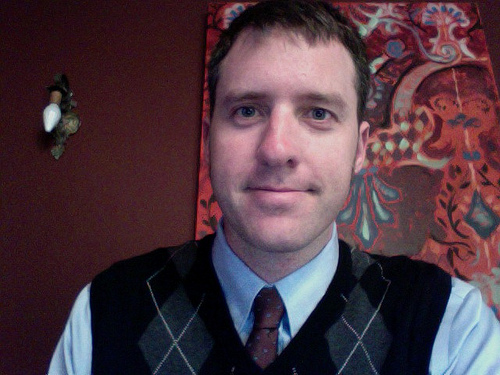
At some point soon I’m going to have to admit that I’m a grown-up.
Tapping into information
Saturday night, the Information Amateurs Social Club gathered at the special pour-your-own-beer keg table at San Francisco’s Mad Dog in the Fog, a Lower Haight pub. I never got an exact count of attendees as it ebbed and flowed all night (much like the tap!) but it was well over a dozen and possibly as many as twenty. As usual, the crowd contained a mix of backgrounds - academic librarians, archivists, a children’s librarian, public librarians, MLIS students, and the usual but unfortunate smattering of unemployed librarians hoping for a change in the wind.
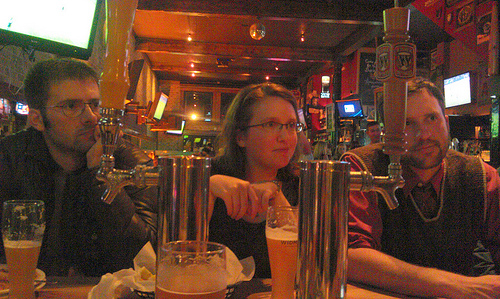
Engrossed in conversation. Photo courtesy @TheLiB.
The beer table was an entertaining gimmick - it was by the window, near the door, and allowed us to pour beers for new arrivals without them having to walk to the bar and wait for service. Conversation was by turns serious and silly (like all good conversations), and any lull could be filled by filling our own glasses. And, by the end, we knew exactly how much beer we had drunk!
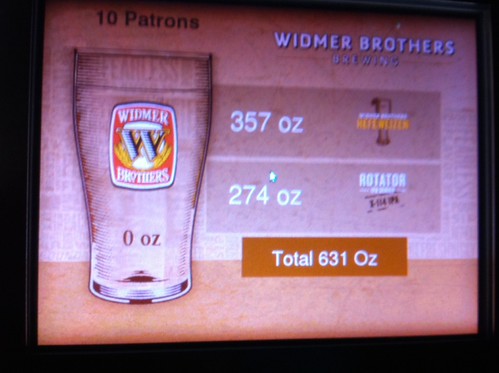 631 ounces! The hefeweizen proved more popular than the IPA.
I’m very proud of our little association. While we have a core group of regulars (some of whom will sadly be leaving the Bay Area shortly), each and every outing has featured at least several new faces. Our group’s name - the Information Amateurs - was born out of our circumstances in April, 2010. Greg Borman and I had both recently graduated with our MLIS degrees (December, ‘09) and were both struggling to find jobs. We couldn’t quite call ourselves professionals without a professional paycheck! So I had the inspiration to call us the Information Amateurs, and stuck with it even though both Greg and I were gainfully employed by that summer. I’ve always kept the tone of messages to the group cheerful and little irreverent in the hopes that it will draw out newcomers, and that seems to work.
The next event is one worth getting excited about: on October 20, USC’s Norris Medical Library’s Megan Curran will be presenting her lecture “Ill-gotten Brains: The Grisly History of Sourcing Bodies for Anatomical Learning” (an appropriately macabre subject for late October) at the Bone Room in Berkeley as part of their ongoing salon series of talks on subjects in natural history. Ms. Curran has already presented this talk in Los Angeles and Brooklyn but this will be her first Bay Area appearance. The recently engaged Ms. Curran has also agreed to join the Information Amateurs for a post-lecture drink at a to-be-determined gathering spot. You can follow her on twitter at @LibraryatNight.
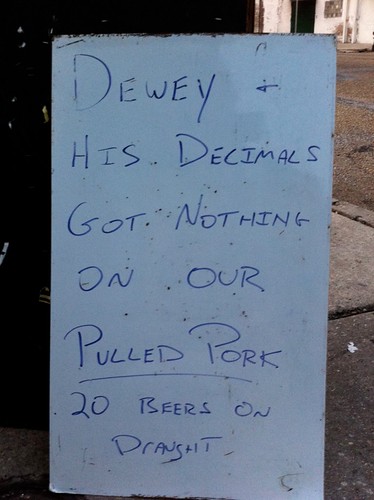
Dewey + His Decimals: ALA in NOLA
This past week I got to attend my very first American Library Association (ALA) Annual Conference, a dizzying gathering of over 20,000 librarians (a far cry from the 1876 inaugural event, with its paltry 103 attendees). I got to attend various professional presentations, meet online contacts and make friends in real life, explore New Orleans by foot, trolley, and ferry, and, much to my surprise, perform in the improvisational slideshow competition Battledecks.
I have organized sessions I attended and events I participated around a couple of the most recurring themes.
Discovery
Cushing Library is currently implementing a new tool for our end users to use for search and retrieval of our items in our collection. This system, called WorldCat Local (WCL), finds and retrieves items be they print or online, and whether they are book, article, journal or other media. WCL and similar products are referred to as “Discovery” systems within the librarian profession.
I attended several programs relating to the implementation of Discovery systems. Two directly related to the implementation of OCLC’s WCL technology, tasks I am involved in right now, and another on the rate of return various libraries have seen since their implementation of Summon, a competing but similar product to WCL offered by ProQuest. There is strong evidence, from both libraries operating WCL and from libraries utilizing Summon, that full-text article retrievals are up, most notably from smaller, more specialized sources. At WCL libraries, print circulation tends to rise post-WCL implementation as well.
For example, the University of Idaho, which has implemented WorldCat Local, has seen usage over print materials rise 20%, interlibrary loan requests rise 34%, and a 78% increase in full text article downloads. Summon libraries, such as the University of Houston, saw a 50% rise in full text article retrieval. They have also found that the Summon search service is pushing users to finding underutilized resources, such as special collections and multimedia items, and that it favors direct journal services (such as Sage) over aggregators such as EBSCO.
Information Literacy
Part of my continuing duties at Holy Names University is my role as an instruction librarian. I provide information literacy education to students via workshops and research help sessions.
One of the best instruction-related programs I attended was Making Information Literacy Instruction Meaningful through Creativity. The three speakers were current or former faculty for ACRL’s highly-regarded Immersion Program, a “boot camp” for instructional librarians, and the session reinforced many themes that are part of Immersion training - creative lesson planning; interactive, motivational presentation styles; and pedagogy grounded in research and assessment.
In addition to these presentations, I also had chances to sit and talk shop with a good mix of other instructional librarians, such as Michelle Millet, Tiffini Travis, Lea Engle, and Nicholas Schiller. In Schiller’s case, I’ve been reading his articles and stealing his classroom ideas for a year so it was great to get a chance to admit that to him. He didn’t seem to mind.
Out and About
New Orleans: what a city. While I admit I’m not such a fan of colorful drinks in plastic cups - I’d rather have one well-crafted cocktail than a half dozen cups of syrup-flavored alcohol - I have to admit that New Orleans knows how to have a good time, and a good time I had, passing from place to place with a gang of roving librarians I befriended. It’s hot in New Orleans in June (that’s not a newsflash, I realize), but the heat and humidity didn’t keep me from walking continuously from the Garden District, to the Warehouse District, along the river and into the French Quarter, and back again throughout the conference. Café Du Monde was naturally a regular destination, both late at night and after lunch, and I was shocked that a plate of three beignets was only two dollars and change - here in San Francisco, our tourist traps won’t sell anything for less than five dollars.
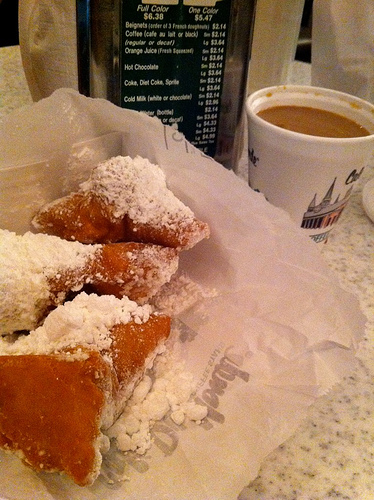
While I expected to meet hip, smart librarians from Brooklyn (and did) (stereotypes for the win!), there were smart, interesting people coming from all corners of the country - Indiana, Texas, Florida, and even Southern California. In between the beignets, coffee and occasional cocktails there was plenty of sharp chatter about information services, instructional technique, and emerging tech. All of it pointed to my original thesis in founding the Information Amateurs Social Club - that the best, most enlightening professional conversation happens in the informal air of casual conversation. Preferably with a drink in hand. Between the ALA Dance Party, the ALA Tweet-up, the ALA Facebook Afterparty, the Radical Reference Social, the HackLibSchool Social, and all of the more informal connecting in between (including a trip to the Voodoo Museum), I met many of my internet heroes and formed some genuine bonds of friendship I’m going to hang onto. And hopefully, someday, all of them will move to San Francisco. It’d be killer.
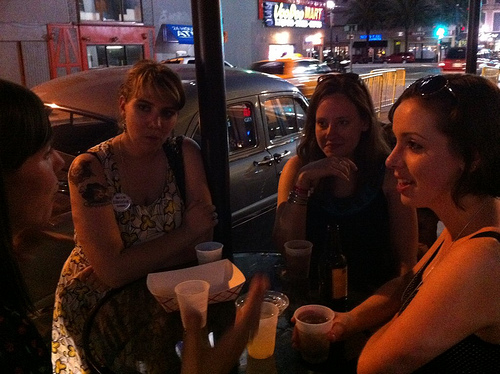 That’s Lauren and Lea in the middle at the Radical Reference Social
Battledecks
No report on the goings-on in New Orleans would be complete without mention of Battledecks, the competitive, improvisational battle of slideshow presentations that concluded the conference Monday night. My participation was not strictly speaking voluntary, but it was thrilling to speak right between Lisa Hinchliffe, President of ACRL, and widely known executive and public speaker Stephen Abram. However, I’m going to save my extended thoughts on that experience for a future post - once the videos have weaseled their way online and I can embed my performance right here on The Pinakes.
Hipsterdelphia
Recently I went to Philadelphia for a four day library conference. This one is about my first day in Philly, before the conference started. The city was not what I expected.
I arrived at the Philadelphia Airport Tuesday evening and hitched a ride into downtown Philly on their commuter rail. It took me directly into a subterranean stop that is now called Market East station, but is built under what had been the vast depot of the Reading Railroad (made famous by Monopoly). The massive pavilion above has now been converted into the Philadelphia Conference Center, where ACRL was to take place, and adjacent to and adjoining the hotel where I was staying. So I arrived at the station, walked up what seemed like two centuries of underground history, and directly into the hotel without feeling a hint of outside air. It was surreal, especially at night.
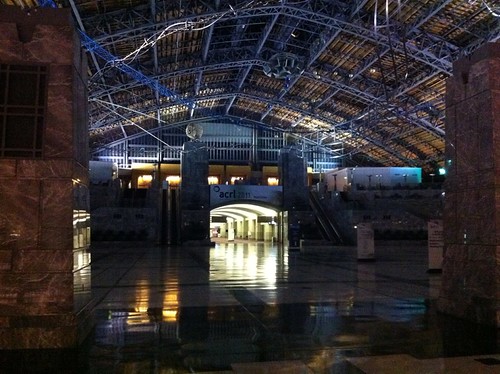 One commenter on twitter called this shot of the conference hall at night a “steampunk wonderland”.
I struck out on foot that night in search of my first Philly cheesesteak sandwich, or as they simply call them locally, a steak. I’d been told by a former Philly local to head to a place called Jim’s Steaks on South Street. It was a good chance to explore the city on foot and see how it actually lives and breathes. Philly was nothing like I expected - all blue collar, Santa-booing meatheads. Instead I saw the quotient of hipsters on fixies I expect to see here at home, plus a community garden, and an anarchist bookstore. Swap the steak shops for taquerías, you’d be in San Francisco’s Mission District; swap them for vegan bakeries, you’d be in Portland, Oregon.
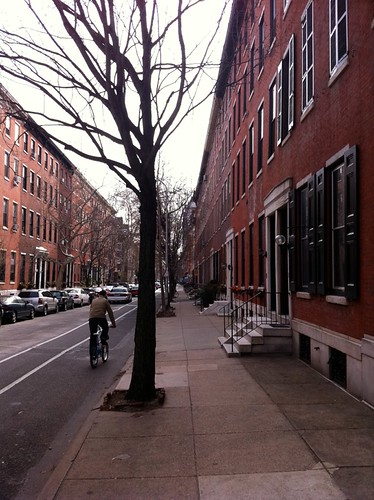 What you get in Philly you don’t get in SF: rowhouses of beautiful brick lining narrow streets.
Jim’s Steaks was the antidote to this Hipsterdelphia. I walked up to the register to order, and the middle-aged local behind the counter (I’ll call him “Jim”) proceeded to ignore me while he finished a conversation with one of the other guys. Or, I thought I was just waiting until he finished what he was saying, but no. He just kept on talking, with me just a couple feet from him on the other side of the counter. Jim wouldn’t even turn his face my direction. He resolutely refused to acknowledge my existence. I should note that I’m the only customer in the store. This went on for more than one full, awkward minute. Now this is the Philly I had arrived expecting! Brusque assholes who wouldn’t give me the time of day. Here was authenticity. Thank you Jim.
Eventually the fry cook took pity on me, and summoned me over with a finger (not that one). I was supposed to order with him, and in their assembly line, I’d get passed down to the drink guy and then to Jim at the register. Didn’t matter that no one else was there - I still had to follow procedure. Once I had done that (note: I was not allowed to touch my beer until I had paid, even though they placed it on my tray), Jim was willing to acknowledge my existence. No mention of the prior awkwardness.
The steak, it should be said, was delish. I’d go back.
The next day I had to myself until the conference started in the late afternoon. Again I set out on foot, first finding a comfy coffeehouse (the negative Yelp reviews are amusing; accusations of hipsterdom abound, as if posting reviews on Yelp about the quality of their vegan goods isn’t an enormously hipster thing to do). It’s in a corner brick Victorian rowhouse in Philly’s gay district (Philly has a gay district? More things I did not know). Here the staff was actually friendly. Probably not natives. They made a solid cappuccino.
From there I was off to the ghastly but utterly fascinating Mütter Museum, a collection of human oddities (think strange skulls, deformed spines, babies in jars…) that was formed from the personal collection of 19th century physician Dr. Thomas Dent Mütter and has grown under the stewardship of The College of Physicians of Philadelphia. I’d entertain you with a collection of gory photographs of leather made from human flesh, a modern mummy, 19th century medical tools and all manner of human parts except the museum strictly forbade photography (not that that has stopped others; there’s plenty on flickr).
My museum trawling was not yet done; after that I walked to the Rosenbach Museum, on an elegant street of handsome rowhouses in the Rittenhouse Square district. The Rosenbachs were brothers engaged in the rare book trade in the first half of the twentieth century; they were extravagant bachelors, who entertained lavishly, enjoyed bourbon, pipes, and books, and made the savvy purchase of James Joyce’s handwritten Ulysses manuscript before the book became the icon it is today (amongst many other great purchases, including Herman Melville’s own bookcase, now filled with 1st edition copies of Moby Dick, on their ground floor). Their shops - in Philly and New York - were the locus of the American rare book trade for decades, and the collection of the Folger Library in Washington, DC and many other great private libraries were built by their acquisitions. The museum hosts hourly tours of their mansion and library, with exhibits on news coverage of the Civil War and Joyce’s years in Paris.
My final Wednesday stop before the conference started was lunch with an internet friend, Molly from yon Falling Molly blog. She’s mutual friends with my pal Jenny and we met up so she could teach me about Philly’s other local sandwich, roast pork with broccoli rabe. Because of legacy Quaker liquor laws, most small shops can’t get a liquor license, so they just let you bring in your own beer. So Molly arrived six-pack in hand and we chowed down on these massive, greasy, vinegary sandwiches. It took a couple hours to polish those monsters off (and the six-pack). Molly is both smart and funny; if you’re looking for an entertaining internet friend, you couldn’t do better.
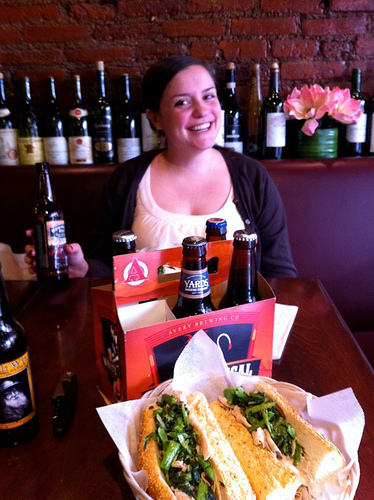 It must be healthy because it’s covered in vegetables. Never mind the other stuff.
After that I headed back to the conference for the opening keynote!
Riding a Century
Last week on my tumblr I posted about how if I had a life list, going to see the complete Ring Cycle would be on it (a goal I will accomplish this spring). There’s another thing that would also be on my life list, if I had one (and I guess two items makes a list, so now I do). I want to complete a Century.
Covering one hundred miles on a bike in a day is an iconic achievement amongst wheelmen. I recommend this article from the New York Times on the topic.
I’m under no illusions as to my speed as a cyclist (or my fitness in general). I’m comfortable on a bike and I enjoy riding; stretching my legs on my road bike along the beautiful rural roads of the Bay Area is a wonderful pursuit, but I’m not built like Andy Schleck and there will always be better riders than me. But I want to test myself, and I want to test my endurance. I don’t mind if it hurts.
Knowing goals are easier to achieve with the help of others, I recruited my friend Jeffrey (a better cyclist than I) into doing a century with me. We’re targeting the famous annual Marin Century. Since that typically takes place the first week of August, we’ve got 7th months to get in good enough shape to do it.
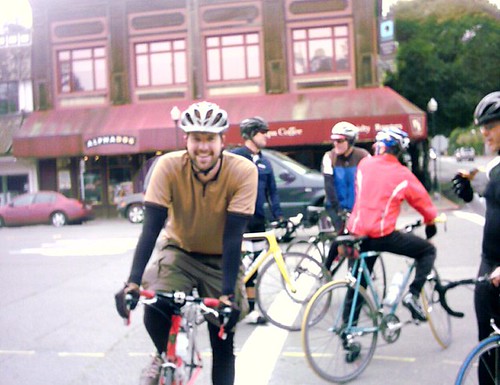 Pausing in Mill Valley, before the real work began.
Yesterday we joined the Sports Basement Sunday Ride for a group challenge, and what a challenge it was; while the group operates on a “no drops” policy (i.e. the group will always wait for the slowest rider at the tops of hills or major junctions), the routes selected can still be a challenge and yesterday’s was hefty. Check out the route map and click on the elevation tool. Look at that climb from around Mile 21 to Mile 25.
Whew.
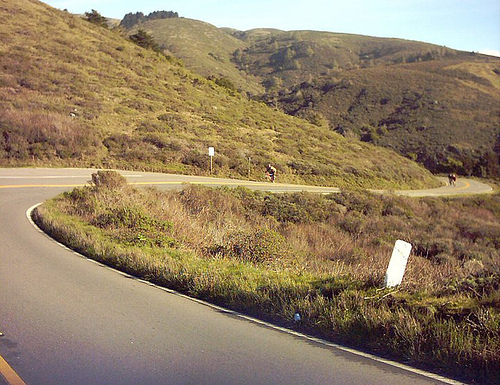 The scenery was stunning, as expected.
I felt broken the rest of yesterday. My legs and back are still pretty sore today. And yesterday was only 40 miles total.
Here’s to goals. They make life a worthwhile challenge.
