LAUC-B CONFERENCE 2013: COUNTING ON LIBRARIES
I spent Friday at the LAUC-B Conference 2013, which UC opened up to the wider librarian community. Titled Making it count: Opportunities and challenges for library assessment, it was tightly focused on the evaluation of library services.
The opening keynote was delivered by Steve Hiller, the Director of Assessment and Planning at the University of Washington Libraries. This served as the lit review of library assessment practices, providing a chronology of how evaluation has changed in the past century+ of academic library services, with case studies and the best practices of today mixed in. The vital takeaway is that the traditional statistics of library work (circulation stats, reference desk interactions, etc.) look backwards instead of forwards. They emphasize prescriptive, numerical measures instead of looking at outcomes, such as whether our customers - the university’s students, faculty, and administration - are achieving success.
“What is easy to measure is not necessarily desirable to measure.” – Martha Kyrillidou, 1998.
That leaves us with an obvious question: how can we measure outcomes, rather than usage? Hiller recommended the book How to Measure Anything by Douglas Hubbard. Hubbard suggests the following:
- Our dilemmas are not unique. Others have struggled with the same issues.
- You need less data/information than you think.
- You have more data/information than you think.
- There are useful measures that are much simpler thank you think.
Hiller has noticed some trends in library assessment: a greater reliance on external (campus-wide) measures aligned with university planning, the demonstration of library impact on individuals and communities, and outcomes-based assessment that make use of multiple measurement tools. Institutions are more interested in student learning outcomes and how the library contributes to overall student learning than in the traditional metrics.
“‘Not how good is this library.’ Rather, ‘How much good does it do?’” – R.H. Orr, 1973.
It is up to our customers to determine the quality of our libraries and library services. Hiller left us with four assessment questions:
- What do we need to know about our communities and customers to make them successful?
- Who are our partners in collaborative assessment?
- How do we measure the effectiveness of our services, programs, and resources and how they contribute to user success?
- What do our stakeholders need to know in order to provide the resources needed for a successful library?
The speakers that followed Hiller did their best to answer these questions.
“What do we want? Incremental change. When do we want it? In due time” – Lyn Paleo.
The next segment featured a trio of speakers on different topics: Joanne Miller of the California Digital Library spoke on what information and data the University of California keeps, Lyn Paleo shared what librarians need to know about the assessment/evaluation process, and OCLC’s Merrilee Proffitt discussed assessing special collections.
Lyn Paleo’s presentation was particularly fascinating. Paleo is not a librarian: she is a program evaluator and member of UC Berkeley’s faculty. She outlined some of the steps involved in assessment:
- Problem or need;
- Intervention (program, policy, service, institution, etc.);
- Outcomes (from the perspective of the beneficiary);
- Impact.
So how does this relate to libraries? Paleo explained that the academic library is a social human-service intervention to solve a problem. The problem libraries are meant to solve?
- The student’s need for information.
- The faculty’s need for research materials.
- The college’s retention and graduation rates.
Paleo laid out how the library attempts to solve the problem. It provides access to information sources for academic work, in the form of books, journals, and online resources (in all their various permutations). It provides reference and instruction services, which teach students how to access and use those information resources. The library provides the space students need to complete both academic work and have downtime relaxation, with (hopefully), proper lighting, amenities, organization, comfortable seating, individual study areas, group study areas, and both noisy and quiet spaces.
All of those solutions are, in their own ways, measurable. Simple methods can be devised for tracking foot traffic in certain areas of the library, whether students are working in groups or alone, and then arranging the furniture in the appropriate ratios. Short surveys, presented in the moment, on a single iPad page, can determine what draws patrons to library events, and why they (sometimes) leave early. Reference services can be assessed through post-interview observations of student search replication skills. These small research projects can lead to incremental improvements of service, even in lean budget times.
Lyn Paleo also had a few tips for data collection and management. Avoid convenience samples, when you only gather information from the most conveniently accessible patrons. That will skew results. A small representative sample is more effective for research than a large sample of convenience. When using Excel to track data, remember that every record requires its own row, and you’re better off putting all of the data on one spreadsheet using multiple tabs than having an endless series of files. You should also include a tab titled “About this data” explaining the contents of the spreadsheet in case it is inherited by future staff.
Above all, Paleo insisted, that when you are surveying a population, always announce what the study is, and what its intended use will be, to the people you are surveying. If they understand a survey’s importance, the answers will be more comprehensive and informative.
“Practitioner research should be messy.” – April Cunningham, Palomar College.
In the afternoon, I attended a breakout session led by Stephanie Rosenblatt of Cerritos College and April Cunningham of Palomar College. They focused on action research, an evolving form of participatory, solution-oriented research that is practitioner-led. In action research, the subject material is informed by real-world concerns (such as the librarian’s professional observations), rather than being dictated by literature review. It moves in a cycle of planning, action, reflection, and sharing, and involves a group of critical participants who help analyze data, discuss related material, and provide feedback to the lead researcher. Many of the details of their presentation are available online, and are worth exploring.
I actually had the opportunity to be a part of a Participatory Action Research group on the campus where I work. The lead researcher brought together participants from across many campus departments, including both staff and faculty, and we discussed whiteness and white privilege in higher education, and the ways in which it can be deconstructed. Taking part was one of the most informative experiences I’ve had as a professional, and I derived many lessons I can apply to my work to make education more inclusive and meaningful.
Rosenblatt and Cunningham encouraged the audience to think of something - anything - that bothers them in their professional experience, any aspect of library work. It got me thinking about the challenge of getting first-year undergraduates to focus and participate in class. I don’t know any instructional librarians who haven’t dealt at some point with uninterested, disconnected students.
Why not work with the students themselves, away from the classroom, in an action research group? Why not ask them what would make a library workshop compelling to them - in a safe environment that would encourage them to talk? If we could pull together a representative sample of undergraduate students, action research could generate some solutions to a problem that is a thorn in the side of instructional librarians everywhere. And by asking them in a non-judgmental forum, we might actually get some good answers.
Rosenblatt and Cunningham also demonstrated some usable data analysis tools, from the simple and free, like Google Forms, to more specialized products like Tableau Public and LIWC. Their website has more comprehensive information on each.
Closing
The closing keynote was Stanford’s David Fetterman, discussing the work he does in empowerment evaluation. He also tipped the audience off on freemium infographics services like infogr.am and visual.ly to create powerful assessment reports. Something to explore further!
Continue reading LAUC-B CONFERENCE 2013: COUNTING ON LIBRARIES »
#ALA2013: Librarians in the Windy City
The ALA Annual Conference of 2013 was a tad different from the 1913 edition chronicled previously on this site. Instead of hundreds of participants, there were tens of thousands. We were in Chicago, since the Catskills can no longer hold us. But we still had a lot in common with our forebears – we discussed the public perception of libraries, how to broaden library appeal, and serve underserved communities just as they did one hundred years ago.
Gamifying Libraries
On Saturday morning I attended a session on gamification in libraries, emceed by Bohyun Kim, writer and editor at ACRL’s TechConnect blog and a librarian at Florida International University. It featured a mixed panel of academic and public librarians, each with a unique take on this emerging practice. “Gamifying” is the adoption of board or video game elements in outreach or instruction. Most of the examples incorporated digital badges, something Char Booth recently wrote about.
Different libraries are applying these concepts in radically different ways, from a children’s reading program in a Michigan public library to using it as an orientation and instruction tool at a California law school library.
One of the most fully developed examples is at the University of Huddersfield, in the UK. They have an interactive game that students can opt-in to called “Lemontree” (https://library.hud.ac.uk/lemontree/), which awards them digital badges and points based on their use of the library. Walking in after midnight earns them the “night owl” badge, while checking out ten or more books at once earns a “strongman” badge. Each of these badges are worth a certain amount of points, and as they climb a leaderboard, the more their eponymous tree grows from seed to sapling to mature lemontree. It’s fun and cute and even pits the different academic schools against each other.
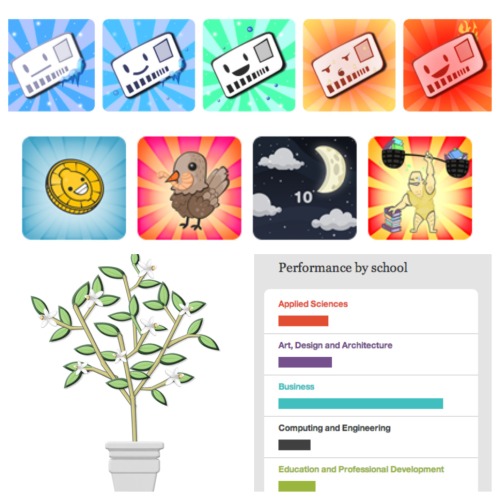
Screenshots from Lemontree at the University of Huddersfield
Information Literacy Standards
Saturday featured a forum on revising the ACRL Information Literacy Standards. An ACRL committee has been formed and was reporting out to a very crowded (and opinionated) room of instructional librarians. The forum’s goals were two-fold: provide the attendees a timeline for the committee’s work, and get official feedback on two questions: 1) how libraries are currently using the existing ACRL standards in their work, and 2) what librarians feel is missing from the current standards.
There were various opinions offered on the latter: teaching guidelines for the different standards; detailing a picture of an information literate student; a request that we embody practices rather than “standards;” etc.
There was also discussion of the “-literacy” lexicon: pan-literacy, media-literacy, meta-literacy, and other terms that I am rather suspicious of (though I like and use the term “information literacy,” it sows enough confusion amongst non-academics, and I’m not sure we need to add more).
SpringShare’s New LibGuide Interface
I visited the SpringShare booth on the Exhibitor Floor to get a preview of the LibGuide design. I appreciate the ease of use when designing LibGuides, but their look is quite dated and design options are limited. Without completely changing the core concept, the new interface and design possibilities are a notable improvement: instead of set, fixed columns per page, box width can vary (e.g., you could place a horizontal box along the top of a page and place columns below it); boxes are no longer restricted to a single content type (e.g. you could mix images, mirrored database links, and highlighted books in a single box); new visually appealing tools such as lightboxes allow for more creative image use; and you can create tabbed boxes. The general look is improved, too: corners and edges are more rounded, and the default appearance is smoother and more pleasing to the eye.
There are also new administrative features. They have an automatically updating A-Z list (powered by SerialsSolutions), easier ways to reuse content (not just reusing links and boxes), and the ability to edit HTML templates.
SpringShare is not forcing an adoption date on client libraries. The new system will be available starting this fall and libraries can migrate when they elect to. Existing LibGuides should move seamlessly into the new system, gaining more appealing curves but otherwise remaining the same. The SpringShare representative also said they’d be willing to provide clients with a sandbox account to experiment with before migrating to the new system.
Overall I was pretty impressed, not only with the look of the new product but their method of roll-out and information sharing.
- SpringShare on the “next generation” of LibGuides: http://support.springshare.com/2013/06/26/libguides-the-next-generation/
MakerSpace at Chicago Public Library
“#makerspaces” in libraries seems to be the new “thing.” I took a tour of Chicago Public Library’s new Innovation Lab, which is currently hosting a MakerSpace. The tour was followed by a panel talk featuring representatives of several public library systems each with their own take on MakerSpace. Briefly, a MakerSpace features tools that help people create and craft; this can run the gamut between sewing supples to 3D printers, paper for zines to soldering equipment. Detroit Public Library’s MakerSpace is geared towards teens and has numerous workshops (e.g. bike maintenance, fashion design). Chicago’s is officially adults only and is heavy on the 3D printers and modeling software. It’ll be interesting watching this moving forward, and I wonder which academic libraries will find a way in on this trend.
Digital Public Library of America
Have you seen the Digital Public Library of America? Executive director Dan Cohen spoke at ALA to introduce the DPLA and how it operates to the attendees. It’s an online platform that brings together digital objects and collections from over a dozen partners (with more to come) searchable from a single interface. Contributors include the Smithsonian, the NYPL, the Internet Archive, and a number of universities. In addition to search functionality, content is curated into browsable exhibitions, and the DPLA makes its API available to creative app developers.
Tumblarian 101
Librarians on tumblr: officially a thing. Four of my favorite people, Molly McArdle (formerly of LibraryJournal), Erin Shea (adult services librarian, Darien, CT), Kate Tkacik (corporate research librarian) and Rachel Fershleiser (Tumblr lit outreach guru) spoke about how and why libraries and librarians are using tumblr in increasing numbers (including me).
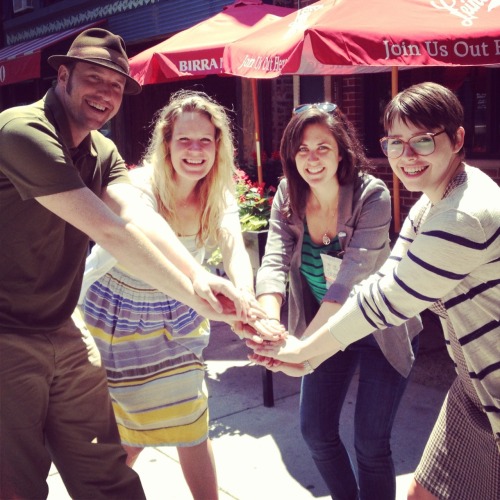 Tumblarians assemble! I joined up with Erin, Kate, and Molly for brunch.
Why tumbl? More characters than twitter. More social than Wordpress. More flexibility in posting, and the ease of reblogging. But best of all is the community, the vibrant, active, and positive librarian community that shares ideas, offers advice, and supports one another.
For those of you not already a part of that community, you can sign up in seconds. Tag your posts with “libraries” and “librarians” and we will find you!
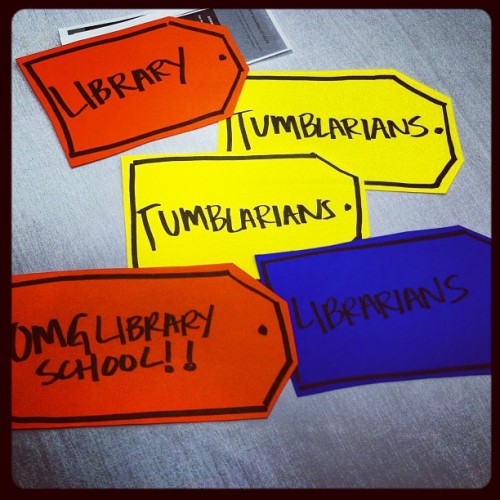
Tumblr tags: metadata is your friend (photo courtesy @sophiebiblio)
EveryLibrary
I was asked to serve as a guest judge for the Librarian Wardrobe Walkoff, a fundraising party for EveryLibrary, the pro-library political action committee (PAC) founded by John Chrastka. Joining me on the judging panel were Courtney Young, Trevor Dawes, Celia Perez, and Patrick Sweeney (I felt like a minor leaguer called up to pitch in the majors). It was a fun gathering and helped spread the word about EveryLibrary, which already has three electoral victories under its belt and is turning towards California for a fall campaign. Chrastka’s mantra is that he wants to corner the market on “smart + fun” librarians, and channel their enthusiasm and energy into the ideas and momentum EveryLibrary needs to be an effective advocacy force. If this party was any indicator, there was smart + fun in spades.
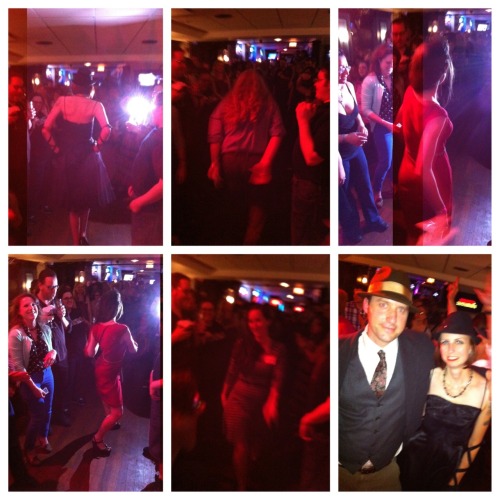
Librarian Wardrobe Walkoff contenders strutting their stuff; myself with Sarah Houghton.
EveryLibrary is bringing the smart + fun to California with a fundraising brunch on August 18th – if you’re nearby, get your tickets and come out to support this great cause.
Wrap Up
The ALA Annual Conference has a universality no other library conference can match. There is tremendous value in learning from our peers in different branches of the profession, something that doesn’t happen at specialized conferences. It’s important to see what else is happening outside of our individual niches: what issues are of concern in special libraries, or what new marketing ideas are working well for publics. If you get out of your own specialized silo, you come away with a lot of new and exciting ideas, and a better sense of what’s going on in the profession as a whole.
I enjoyed the positive kinetic energy. At both the sessions and at the social events there was a tremendous enthusiasm for what’s going right and what’s working well in the field. There is something very affirming about spending a weekend with colleagues and peers who love what they are doing. You go back to your day job full of energy and ideas, and the confidence that comes from connecting with the people you admire. I’m already looking forward to 2014 and what I’ll learn next.
#ALA1913: Librarians in the Catskills
The ALA Annual Conference of 2013 is bearing down on us. Tens of thousands of librarians – myself included – will descend on Chicago this Friday. The modern iteration of ALA Annual, for better and for worse, is the very model of a modern major conference, with an exhibitor floor, professional presentations, vendor parties, dubious swag, and, hopefully, learning and growth experiences for the assembled librarians.
I was inspired by a passing comment on Facebook last week to look up the 1913 Papers and Proceedings of the American Library Association Annual Conference, exactly one century ago. The older Proceedings are in the public domain and most are scanned in Google Books (though some wonky metadata can sometimes make specific ones hard to find).
In 1913, the librarians gathered in Kaaterskill, in upstate New York’s Hudson River Valley – a far cry from the recent history of Chicago, Anaheim, and New Orleans, and next year’s Las Vegas. The 1913 conference featured 892 participants, with the host state leading the way with 316 attendees, while my home state of California only sent four on the cross-country trek. One can only imagine the scene in the Catskill resort town. Did any flock of librarians choose to take a moonlit walk to the Kaaterskill Falls with a bottle of wine or two under their arms? The Proceedings close by chronicling a post-conference librarian trip by train, steamer, and automobile through the Adirondacks, including a group swim in a mountain lake.
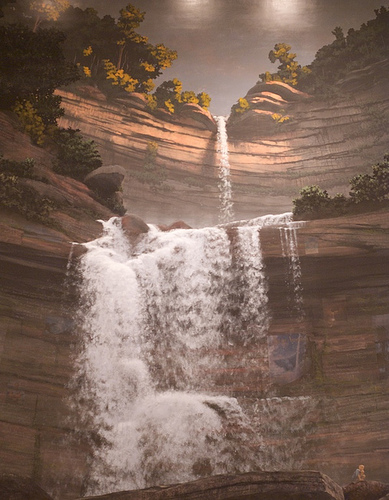
Kaaterskill Falls for Frank Moore and Dan Hodermarsky by Stephen Hannock, photographed by flickr user p_a_h.
“As Others See Us”
One of the most intriguing portions of the Proceedings is under the heading “As Others See Us.” The ALA President of the time, Henry Legler (chief librarian of the Chicago Public Library), sent a letter to the “eminent men and women in the United States and Great Britain” requesting “brief expressions touching our own work.” Accompanying the letter was a question relevant to the individual recipient, which included Andrew Carnegie, Winston Churchill, W.E.B. Du Bois, John F. Fitzgerald (JFK’s prominent maternal grandfather), and various other leaders in society, business, and the arts. Noteworthy answers were read aloud at the conference.
Most of the questions asked are as illuminating, if not more so, than the answers. The questions that librarians saw fit to ask society’s leaders tells us a lot of what they thought of their own profession at the time. Here are ten of the 22 original 1913 questions (language unaltered):
- Should our public expect the library to supply all the “best sellers” hot from the press?
- Is the negro being helped by our public libraries?
- Is cooperation between the public school and the public library developing in the right direction?
- Should the public library exercise censorship over the books it circulates?
- What rank should the library have in the scale of the community’s social assets?
- What is your conception of the ideal librarian?
- Is it wicked for our libraries to amuse people?
- Are our libraries helping to make better citizens of those from over-seas?
- Is the modern city library engaging in activities outside its proper sphere, e.g. lectures, story-telling, art exhibits, victrola concerts, loan of pianola rolls, etc.?
- Need librarians apologize for circulating a large percentage of contemporary fiction?
“The Color Line in Literature is Silly”
W.E.B. Du Bois, the civil rights activist and co-founder of the NAACP, answered the second question above pointedly. It is not a surprise that libraries operated under systematized racist policies in 1913 and were not welcoming to blacks and other cultural minorities. Du Bois stated clearly that while libraries could be a great benefit, those in the north often intentionally made blacks feel unwelcome and those in the south systematically barred blacks from entering (“rigorously excluded”). His closing comment was that “it would seem a statement from the American Library Association to the effect that the color line in literature is silly, is much needed at present.”
It seems as if Du Bois’ words largely went unheaded; in a report on services to black patrons that occurred on the second day of the conference, Rochester public library director William F. Yust condemned the dismal state of library services to blacks in the south, but insisted that blacks were universally welcome in northern public libraries, in direct conflict with Du Bois’ observation. Yust also advocated for segregated blacks-only libraries in the south (with white leadership). The ALA was not, unfortunately, ahead of its time.
The conference record is a little better when discussing immigrant services. Prominent author and immigrant-rights activist Mary Antin delivered a rousing speech (it still reads well today) on the value and importance of immigrants to the American economy, and the importance of library services to those communities. The Proceedings notes that her oratory was hailed with a standing ovation. After Antin spoke, librarian Adelaide Maltby, who was the director of the Tompkins Square Branch on New York’s Lower East Side, added nuts, bolts and statistics to strengthen Mary Antin’s argument, and specifically argued in favor of collecting library materials in the native languages of their immigrant patrons. For 1913, this strikes me as forward thinking. However, a third presentation on the subject of immigrant services was startling for its xenophobia and bias against immigrants. One can only hope that the speaker, St. Joseph public librarian Charles Rush, was not greeted with the same acclaim and ovation as Mary Antin.
“Yet to answer a single question”
After I posted the original “As They See Us” questions to Facebook, my friend Patrick Sweeney, a public librarian, wrote that he was discouraged – “it almost seems like we have yet to answer a single question after 100 years.” While I understand his point, I would argue the opposite. I see tremendous positives in some of the questions the 1913 ALA saw fit to ask. It’s true that we still grapple now with questions of censorship (although, fortunately, the ALA’s stance on the subject is quite clear), what types of materials and services we should supply to our patrons, and what our core mission is (as hinted at in the 1913 questions about the “ideal librarian” and “proper sphere”).
However, the fact that these questions were asked suggests that the librarians of 1913 were already looking to expand our services beyond book circulation. Some of the creative programs going on in modern libraries – Patrick’s guitar lending program, Chicago Public Library’s exciting new Maker Space – are echoes of these questions. Would the ALA have asked about hosting lectures and victrola concerts, lending player piano rolls, and exhibiting art, if some libraries weren’t already doing just that? Would the ALA asked about the partnerships between public schools and public libraries if such partnerships weren’t already forming? Would they have wondered at the propriety of lending immoral “modern fiction” if many libraries didn’t already do just that?
The 1913 Proceedings make it clear that libraries have been pushing against the limits of our “proper sphere” for over a century now. Innovative library programs are building on a century-old legacy. Our professional forebears were already looking to provide new services to their communities. When a critic derides libraries as obsolete in the Age of Google, it’s worth remembering that libraries are not only more than just books today, but that they’ve been more than just books for at least a hundred years. We are building on the innovations of the past, not tearing history down – it’s an evolution, not a revolution – and we would do well to remember that as we engage in the latest debates.
Unfortunately, there will be no train or steamer to take us to the Adirondacks when ALA 2013 wraps up, and I doubt Kaaterskill could handle 20,000 of us for a conference. But a look back at our past (warts and all) helps us as we move forward into the future.
THE INDIANAPOLIS 300: WRAPPING UP ACRL 2013
Indianapolis, home of the legendary Indianapolis 500, recently hosted the 300 presentations,workshops, and poster sessions that made up ACRL 2013, the biennial conference of academic librarians. Here are just a few of those sessions worth highlighting.

Libraries in the Age of Wikipedia
Before the start of the official conference, I participated in a free pre-conference workshop entitled Libraries in the Age of Wikipedia hosted by the IUPUI Library. IUPUI is the joint Indianapolis campus for Indiana University and Purdue. Presenters included IUPUI archivist Brenda Burke, librarians Chanitra Bishop and Phoebe Ayers, and Lori Philips of the Indianapolis Children’s Museum. The morning covered many of the basic principles of Wikipedia: its mission statement, and history, and the various programs it has initiated, such as the fall event “Wikipedia loves libraries” and the ongoing Galleries-Libraries-Archives-Museums (GLAM) project, which seeks to elevate the visibility institutional collections as information sources on Wikipedia. They also discussed the “Wikipedian-in-residence” programs at the Indianapolis Children’s Museum and elsewhere. The presentation also featured mentions of Wikimedia Commons, an open license, royalty-free image archive, and Wikidata, a new project to bring together sources of open-access research data.
Wikipedia is one of the top ten websites in the world, it is an important resource for librarians to understand and help students make the best use of. No matter what library-specific resources we promote, or services we offer, chances are most students will start their information search by browsing Wikipedia. It has strengths, and it has weaknesses, and we must have a clear understanding of it to be of use to our patrons.
ACRL Battledecks! Imagine, improvise, inflict: Get inspired or die trying.
The opening night social event was ACRL Battledecks, an improvisational competition featuring six librarians presenting six random slidedecks to an audience of nearly five hundred. I rolled up my cardigan sleeves and jumped into battle, and emerged victorious. You can check out the whole ACRL Battledecks competition on YouTube. My thanks to John Jackson for inviting me to participate and organizing the well attended event - nearly five hundred screaming, hooting, hollering, and laughing librarians. It made for a great, entertaining evening and conference kick-off. My victory prize? The Ice King’s crown, complete with beard.
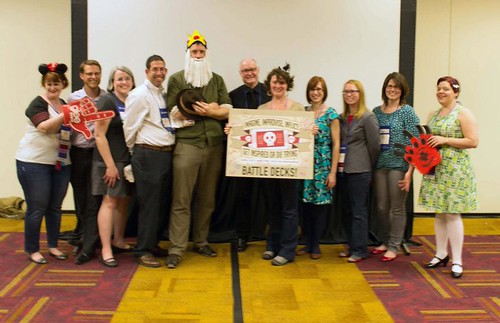
Photo courtesy Kate K.
The One-shot Mixtape: Lessons for Planning, Delivering, and Integrating Instruction.
This presentation featured a large panel and was based on an article published in the LIS journal Communications in Information Literacy 6(1). Panelists included ACRL Immersion presenters Beth Woodard, Randey Hensley, Deb Gilchrist, and Michelle Millet, as well as Steven Hoover, Jennifer Corbin, Diana Wakimoto, Christopher Hollister, and Patty Iannuzzi. As the paper’s main author, Megan Oakleaf, was not available, Hollister acted as MC.
Panelists limited their comments to one point or two points each:
- limit your lesson-plan instead of trying to cover “everything;”
- vary your instructional approach in order to accommodate different learning styles (concrete experience, reflective observation, abstract conceptualization; active experimentation);
- assessment doesn’t go last, assessment isn’t an afterthought, assessment = good teaching;
- don’t wing it in the classroom; work from a lesson plan;
- enthusiasm in a teach is authentic and humanizing, and shows that we care;
- at the beginning of a class, take evidence of what they already know (how many have used the library and in what ways, how many already use a major database, etc.) and adjust your lesson plan to fit the level of your students;
- incorporate case studies into your lesson plans; using a narrative to drive group work and debriefing encourages engagement;
- faculty are your friends; find ways to plan instruction around their syllabus;
- think product, not process; an active exercise could include annotated bibliographies where they not only explain why they used a source, but how they found it;
- it’s about the institution, not your classroom; think big-picture issues when crafting your lessons. Retention, completion, graduation rate – what is your library’s role in the students complete educational experience? Are we playing the role of a partner and a leader? Are we contributing to the collection of data and evidence so that we can show the value we play on campus?
Original article: Notes from the Field: 10 Short Lessons on One-Shot Instruction.
Making Information Literacy Relevant: Inspiring Student Engagement through Faculty-Librarian Collaboration
Two librarians, one faculty member, and one student from Gettysburg College in Pennsylvania reported on a partnership they developed for a public health course taught for upperclassmen.
The librarians and faculty consulted before the start of the semester and planned three workshops timed to specific course assignments. Each workshop was built around the tools the students would need to accomplish the next assignment - evaluating quality sources, using internet-derived public health data, etc. This presentation contained a number of useful details: exact exercises, assessment strategies, what worked and didn’t work and how they’ll change it in future iterations. Some of the specific workshop activities could be easily adapted to any number of different courses. Each lesson plan was hosted and shared with students via libguide, with on-screen polling for immediate student feedback.
Riding the RAILS of Rubric Assessment to Keep Information Literacy Learning on Track
ACRL workshops are three hours and require advanced sign-up due to their limited capacity, and are one of the best aspects of the conference. They get hands-on and practical the way a shorter presentation with a larger audience cannot. I attended this one focused on rubric assessment, and specifically the RAILS methodology developed by Megan Oakleaf. The workshop was excellent – it was very practical, and gave me a perspective on rubrics and how we could use them to analyze many different facets of our information literacy instruction. While I have seen these concepts discussed before, this was the first time someone placed actual student work in my hands, gave me a rubric to judge it by, and then forced me to discuss and defend my scoring (in order to normalize the various personal biases each individual brought to what is supposed to be objective scoring). It made me realize how much work must go into standardizing evaluations, and the ways in which the ideas could be successfully implemented at my place of work - and which ways they might not.
Keynote Presentation: Henry Rollins, political activist and punk icon
What can I say about keynote presenter Henry Rollins? If you seen him speak, you have an idea of what happened: he came on stage, gripped the mic in his hand, and didn’t slow down or seemingly take a breath for over 80 minutes. His first line? “I have no librarian jokes.” Highlights included his personal experience touring the National Archives with the equally iconic Ian MacKaye (Minor Threat, Fugazi), his articulation of the Constitution and Bill of Rights, and anecdotes about collecting and preserving band fliers, zines, and other punk-related ephemera.
His core message was simple but powerfully relayed: information organization, dissemination and access is the cornerstone of freedom, and as core principles, they must be retained and defended in order for this country to survive in the 21st century. There’s a snippet on YouTube; get a taste.
CARL-ACRL Ilene F. Rockman Scholarship Award Dinner
I had the privilege of organizing a dinner to honor the 2013 Rockman Scholarship recipient Brittany Austin. Ms. Austin is a current SJSU SLIS student and member of the FIDM-San Francisco library staff. We were joined by six California academic librarians at The Libertine, a restaurant and cocktail bar that, by the end of the night, was turning people away at the door because they were packed wall-to-wall by librarians. It was a good thing we had a table reservation. Librarians know where to find the best cocktails, it seems.
The Art of Problem Discovery
ACRL president Trevor Dawes introduced Virginia Tech’s Associate University Librarian Brian Mathews, author of the Chronicle of Higher Ed blog the Ubiquitous Librarian, to present his invited paper on the concept of problem-seeking in library management.
Mathews opened with a dictionary-derived definition of “problems:”
- unwelcome or harmful, to be dealt with and overcome.
- questions raised for inquiry, consideration, or solution.
He made the point that sometimes we jump too quickly into problem solving mode before fully exploring the wide range of possibilities. When dealing with library issues, we have to consider what the problem actually is; for example, patrons don’t want to use your catalog; they just want the book that will help them write their paper. Mathews referenced the quote from Harvard Business School’s Clayton Christensen: “Don’t sell products and services to customers, but rather try to help people address their jobs-to-be-done.” Libraries should invest in other people’s problems.
Things for libraries to consider:
- What three things do students struggle with the most? (and how can we help them overcome them?)
- What challenges do researchers face when applying for grants?
- What information would help academic deans make decisions?
As can be expected from a Brian Mathews presentations, there were quite a few quotable bon mots:
- a job ad should include “proficient listening skills;”
- librarians should be problem developers, not just problem solvers. You can only solve the problems you discover or identify;
- instead of “thinking outside the box,” let’s reach into other people’s boxes.
Through the art of problem discovery we can design and develop the capacities, service models, etc. of the future. We need to decide what business are we in. Is it the book business, the reference desk business, the catalog business, or none of the above? Rather, we should be in the problem solving business for our campus. How do we help you with your data needs? That’s our business.
Love Your Library: Building Goodwill from the Inside Out
Four librarians from different institutions (Char Booth, Adrienne Lai, Lia Friedman, and Alice Whiteside) shared their ideas for interesting, weird, and creative outreach programs to develop library love on campus in what was a fun, morale-boosting presentation. They threw out dozens of ideas in less than an hour. Here are just a few examples:
- “re:book: take a book. remake it. win,” remixing weeded books into book art as a student contest exhibited in the library;
- “exCITING FOOD,” a citation event in the library with food to eat and the recipes for that food displayed as citation examples. Students snack and mingle with librarians and discuss their citation challenges.
- “Library on Wheels” and “Pop Up Libraries” in different places on campus, with fun materials and costumed librarians, to generate conversation with students.
- “Wikipedia Edit-a-thon” organized by campus archivist at a women’s college in response to a report that 9 out of 10 Wikipedia editors are men.
- Student photo contests around the library.
The presenters made all the materials related to their outreach programs available, and the slideshow is online.
Conclusion
Altogether, ACRL 2013 was a worthwhile conference with many compelling presenters and actionable ideas. Over the length of the conference, I had conversations with dozens of librarians I admire, many of whom I connect with electronically during the year but only get the chance to meet at a conference like ACRL. In those social moments - whether it’s the downtime between presentations, at an event like Battledecks, or at an evening gathering, we’re talking about our jobs, our careers, our ideas for instruction, and what we think we can bring back to our libraries. There is tremendous value and inspiration derived from those conversations, and the ongoing conversation that will happen moving forward.
The final evening of the conference saw a couple dozen librarians out for a night at a neighborhood dive, killing it at karaoke (I must admit, I was an observer, not a singer). We had duets, we had disco, we had the Big Bopper. And, naturally, a librarian sang that one hit by the Cardigans. It was a good way to wrap it up.
Continue reading THE INDIANAPOLIS 300: WRAPPING UP ACRL 2013 »
Question from a MLIS student
Last week a tumblr user asked the following question:
Question from a soon-to-be-graduating MLIS student, if you don’t mind: did you have any publications under your belt before being hired as an academic reference librarian? Also, how active were you in professional associations/organizations? With graduation so soon and the market still so saturated, I am worried that I don’t have the on-paper qualifications to land an academic library job (can you tell?).
I replied on tumblr, but thought I would expand on my response here.
I’m in my third year as an academic librarian, and I still have never published. I’d certainly like to; I have a couple ideas bouncing around my head. The degree to which it matters depends on the institution you are applying to. An academic institution with tenure-track or faculty-status librarians will generally have higher expectations regarding professional publishing, but many academic libraries don’t expect their librarians to publish. Read the job ad closely and look at the librarians on staff. If they have extensive CVs, it’s a good bet that institution has publishing expectations. If you haven’t published and you are applying to an institution that expects librarian-led research, address your interest in participating in research and publishing in your cover letter.
But you can definitely get a job without having published. I’d recommend having another outlet for your writing - a professionally-focused blog, for example. The pressure of updating a blog can feel like a burden (see the frequency of posts here). However, it can be a venue to practice and improve your writing (an essential skill for both unemployed and employed librarians, from cover letters to grant applications), engage with the professional community, and think more deeply about pressing industry issues. It doesn’t necessarily matter how many people do or don’t read your blog. It’s the fact that it is there when you apply for a job; it is essentially the special extended edition of your résumé & cover letter - it shows the hiring manager just how connected you are to issues within the profession.
In terms of other professional activities, coming out of library school I was already active in my local professional organization (in my case, CARL). Through a mentor librarian, I was offered a position on a CARL committee around the time I was graduating from SJSU SLIS. I also attended the CARL Conference in that year, and the conference of another local organization, CCLI. Attending those conferences at the tail end of my education was transformative; I went from speaking the theoretical language of my graduate program to speaking the practical language of working professionals based on the quality content of their presentations.
Being able to show professional involvement by attending conferences and joining a committee did my otherwise limited résumé a world of good. It made it clear that I was committed to academic librarianship, and what I learned in the conference presentations and workshops gave me the language I used writing my cover letter and during interviews. Major national conferences like ALA and ACRL are incredibly expensive once you factor in conference registration, travel, and lodging. But those local conferences are often much more affordable, and you’ll be meeting local people - the same people who might be advertising a position in their library shortly thereafter (or at the conference itself).
The other thing I did before landing a permanent gig was co-found a meet-up group for local librarians. Right around the time we were graduating, a library school friend and I were lamenting the end of library-school organized activities, so we just decided to start organizing our own. We’ve since held a couple dozen gatherings and have nearly 200 members. People meet people at these kinds of events; it can lead to jobs, or just good conversations that keep you talking about libraries even when you’re not working in one. Above all, it’s fun, and there is always something to be said for that.
To sum up my recommendations:
- apply your writing skills to a professionally-focused blog;
- volunteer for local professional organizations;
- attend whatever local conferences you can afford to, and;
- seek out (or create!) a social group of librarians in your area.
That sounds like a lot, especially if you have other professional or family commitments. But you don’t have to update the blog every day, there are volunteer positions that don’t take too much time, conferences are infrequent, and a social group can start with just a few local friends. It’s doable, and it will make you a stronger candidate.
Further reading:
- Becoming a more thoughtful library job seeker: Look beyond the bullet points | Veronica Arellano Douglas, College & Research Libraries News (coincidentally posted the same day as my post above, with very thoughtful advice for job seekers; h/t to laura-in-libraryland).
THE RESIGNATION OF THE EDITORIAL BOARD OF THE JLA
There’s a breaking story in the world of scholarly journals and library science that’s worth tuning into. It kicked off with a post by Brian Mathews on his Chronicle of Higher Education blog The Ubiquitous Librarian, in which he revealed that the entire editorial board of the prestigious Journal of Library Administration (or JLA) had resigned due to the publisher’s onerous author requirements regarding copyright and access.
Mathews is the Associate Dean for the Virginia Tech Libraries, and had been asked to serve as guest editor for a special, speculative issue of the journal on the academic library in fifteen years. This is how he described it:
- “This special issue explores the possibilities of what libraries might become or cease to be. Experts from different sectors of academia, publishing, technology, and design will share their thoughts, dreams, fears, and hopes about the future. The intention is to produce insights that ignite the imagination - to leapfrog the adjacencies of the coming years and land on a strategic plateau of the near future. This is an opportunity to speculate on the arriving advances as well as to warn of potential loss due to these changes.”
Invited authors included not only academic librarians such as Kelly Miller (UCLA), Michael Levine-Clark (University of Denver), and Steven Bell (Temple), but also Google engineer and search educator Dan Russell, Lennie Scott-Webber, an educational environment expert at Steelcase Furniture, and two authors affiliated with electronic resource vendors. It’s a compelling mix, but with the resignation of the JLA’s board, it’s not going to happen - at least in that venue.
Mathews had also invited Jason Griffey to contribute, but in a move that anticipated the decision made by the editorial board, he declined participation due to the publisher’s restrictions. After Mathews broke the news, Griffey posted on the subject himself:
- “On Feb 14, I got an intriguing email from Brian Matthews [sic] about a special edition of the Journal of Library Administration he was editing. It was a request for a chapter for an edition of the journal called Imagining the Future of Libraries, and the Brian’s pitch to me was enough to make me very interested: [Brian]: ‘I’d love for you to contribute an essay around the topic of technology. Beyond most digital collections. Beyond everyone and everything mobile - what unfolds then?’ I mean, if I have a specialty, this is it. I love nothing more than I love a good dose of futurism, and told him so. My one concern was the Journal’s publisher, Taylor & Francis, and the fact that I refuse to sign over my copyright on work I create. I’m happy to license it in any number of ways that gives the publisher the rights they need to distribute the work, but I won’t write something for someone else to own.”
The final post covering the story (so far; there will be more, I’m sure) is from Chris Bourg, who had recently joined the editorial board of the Journal of Academic Librarianship and resigned along with her colleagues. She describes the lengths editor Damon Jaggars had gone to convince the publisher to change its practices:
- “In the meantime, Damon continued to try to convince Taylor & Francis (on behalf of the entire Editorial Board, and with our full support), that their licensing terms were too confusing and too restrictive. A big part of the argument is that the Taylor & Francis author agreement is a real turn-off for authors and was handicapping the Editorial Board’s ability to attract quality content to the journal. The best Taylor & Francis could come up with was a less restrictive license that would cost authors nearly $3000 per article. The Board agreed that this alternative was simply not tenable, so we collectively resigned.”
Look for more to emerge on this subject, as librarians start to assert their demand for change in the world of scholarly publishing. And hopefully, somewhere, Brian Mathews’ special issue will find a home - since it sounded fantastic.
Sources:
- So I’m editing this journal issue and… | Brian Mathews, The Ubiquitous Librarian
- The Journal of Library Administration | Jason Griffey, Pattern Recognition
- My short stint on the JLA editorial board | Chris Bourg, Feral Librarian
This post has also been mirrored on my tumblr.
Continue reading THE RESIGNATION OF THE EDITORIAL BOARD OF THE JLA »
INVESTIGATING JOURNALS: AN INFORMATION LITERACY WORKSHOP FOR SCIENCE STUDENTS
Earlier this month I orchestrated an information literacy workshop for our senior capstone Biology colloquium. The students in this course are conducting field research on a local urban freshwater stream, and their professor hopes that the students will submit the data they are collecting to a scholarly journal. She mentioned that ambition when we discussed having a library workshop for her students, and it planted an idea that sprouted into a unique (to me) lesson plan that I felt was very successful.
Since these students were seniors, they had already experienced at least some level of database interface instruction. I decided to skip that entirely. Instead, I wanted them to focus on journals, and the process a researcher might embark on individually if they were looking to publish in one.
Investigating Journals
After I launched the presentation with a short introduction, I broke the eleven students into three groups, and had each group research one (pre-selected) journal in freshwater biology (which, sadly, did not lead to a wave of hashtag enthusiasm. I was looking forward to #teamamericanmidlandnaturalist, #teamjournaloffreshwaterecology, and #teamfreshwaterbiology tweets). My institution subscribes to two of the three journals, and each of the journals is hosted on a different platform, published by a different organization, and they collectively span different levels of prestige - a perfect mix to show off the spectrum of published content.
The teams had worksheets that directed them to look up certain things on their assigned journal’s author submission page (they looked for citation format, directions regarding headings, whether the author should supply keywords, whether there was a standardized dictionary, etc.) Directing the students to the journal’s webpage led to some interesting questions that have never come up in other workshops I’ve led. One student asked what an “impact factor” was, which sparked an interesting discussion of citations, notability, and other related metrics (and quickly got one group bragging about how their assigned journal had the highest of the three); the need for authors to submit keywords led to a discussion about database-driven article retrieval. Both of these are hard points to make as an instructor talking about database interfaces, but once these students saw the author submission pages, it really seemed to click for them - they could see the raw materials from which article databases are built.
Investigating Articles
After a short discussion period, where the groups announced their findings to the other students, we went into the next segment. The teams had to determine if our institution subscribes to their assigned journal, and download one article of their choice (I knew the one journal we didn’t subscribe to made a sample issue available on their website). This exercise got our students to use the journal finder feature on our website, another tool that students don’t always understand (undergrads frequently confuse article titles for journal titles, and using the former doesn’t work in a journal finder).
Once each team had an article in hand, I had them outline their article’s section headings (to see to what degree they matched the posted author instructions, and hopefully give them some guidance for their proposed journal submission) and count the list of references (to give them a sense of the depth of research on published articles, and again, a better sense of the expectations for them). They also looked up their articles in Google Scholar to investigate the “cited by” feature - which circled back to our earlier conversation about impact factor and the notability of articles. The team whose journal had the lowest Impact Factor turned out to have the most cited article, which gave them a chance to brag in return (the camaraderie between the students was a lot of fun).
We finished off the workshop by using Google Scholar to import their articles into a RefWorks account (our library is an institutional subscriber) and a brief overview of RefWorks use.
Crossing the Threshold
What struck me about the workshop - and part of why I felt it was so successful - was the curiosity it generated in the students. Students asked unprompted questions about not only Impact Factors, but open access journals, pay-to-publish journals, journal subscription fees, author reimbursement (or lack thereof), and tenure in academia. These are subjects that have almost never come up in my experience as an instructional librarian (with undergrads); the fact that these were student questions driven by their own investigative experience felt like a breakthrough, as if we crossed a threshold point in their understanding of scholarly resources. I feel like the minutiae of database search will now come more naturally to them despite the lack of any direct discussion of the subject - a win-win if there ever was one.
Now, if this colloquium does indeed get published, I hope I get included in their acknowledgements - another subject that came up through student questions!
Continue reading INVESTIGATING JOURNALS: AN INFORMATION LITERACY WORKSHOP FOR SCIENCE STUDENTS »
How to write the perfect cover letter
Originally posted to tumblr, Sept. 2012.
I was giving a friend cover letter advice for a librarian position and she suggested I go public with it.
My admittedly limited credentials: I have written cover letters that were ignored, I’ve written cover letters that got me interviews, and I wrote the cover letter that got me my job. I’ve been on hiring committees where I have read dozens of cover letters for both full time and part time librarian positions, and I remember what made some stand out while others headed straight to the circular file. I’m not an expert; the following are just my own opinions. Feel free to agree, disagree, or add your own perspective in the comments.
My headline suggests an unobtainable goal. It is absolutely impossible to write the perfect cover letter. The fact is, every hiring manager, library director, potential boss, or hiring committee will have different criteria and a different perspective. Some institutions have an expectation of formality, while others have a preference for informality, and unless you know personally the person who will read your cover letter, you’ll never know which is the perfect approach.
However, you can do a bit of research to improve your odds. Read the job ad. Read any ancillary posts about the position (such as the library director’s blog, if s/he has one). Try and get a sense of the library’s personality from their website and current outreach methods: are they formal and fussy? Are they casual and fun? Try and match your style to what you can tell about their institutional personality.
Once you’ve done your research, focus on the objectives of your letter. First up, and I feel this is the most important point:
- Your cover letter is not a recitation of your experiences.
That’s what your résumé is for.
- The goal of your cover letter is to paint a picture: you want to the reader to envision you, in their available position, solving their problems.
The cover letter is a narrative. You are telling a story in which you are the protagonist - a problem-solving, enthusiasm-generating, can-do person who has the skills they are looking for and directly addresses all the areas in which they need help. They should get a sense of who you are and your personality, because that is what sets you apart.
The side benefit of conveying your personality in your cover letter is that if they don’t hire you because of your personality, then they were unlikely to be a good fit for you!
Now for a hail of bulleted advice:
- Instead of listing your experiences, you are relating your experiences to their job.
- If their job ad mentions three main areas of responsibilities for their new position, you better mention all three in your cover letter, and how your skills, attitude or experiences specifically prepare you to fulfill those responsibilities.
- If you’ve been working in a different type of library than the one for which you’re applying, address that in your cover letter. Make it clear that the type of position they are offering is genuinely your career goal, and your experience at other types of institutions just brings you perspective from (x) field that will help you in (y) field.
- If you live far away, make it clear you are willing (and in fact excited!) to move.
- If you’ve had a gap in employment or other red flag, address it.
- This might sound obvious, but…no typos, no grammatical errors, and no spelling mistakes.
- Formatting matters. Put together a clean, attractive page, not just a standard Word template (also true for your résumé).
- Have a responsible friend read it and give you unfettered criticism.
- Always throw away your first draft.
Another question that comes up a lot when discussing library applications: yes, both your cover letter and your résumé can be over a page. This is a professional-level position you are applying for. There are different standards!
Questions? Thoughts? Replies? Rebuttals?
