On CCLI: A personal story of why to attend
Registration is now open for the California Conference on Library Instruction, the best little conference that could. It’s an annual, one-day conference focused on librarian-led instruction and information literacy.
CCLI played a critical role in my career. A couple months after graduating library school, while working part time in a temporary position, I attended CCLI. The keynote presenters that year were Nicholas Schiller, Char Booth, and Karen G. Schneider. I had (once) previously met Karen, but it was my first time seeing any of them speak.
Nicholas Schiller presented about engaging students by teaching Google search strategies, SEO, and how Google Search works under the hood. Char Booth presented topics from her (then) new book, Reflective Teaching, Effective Learning, including how to be a self-aware, reflective teacher. Karen Schneider spoke about incrementally transforming a small academic library. In addition to the keynote speakers, there was also a panel that featured Nicole Greenland discussing faculty outreach through technology training.
Nicholas’ presentation formed the nucleus of a freshman workshop I developed later that year, a workshop that has evolved but is still in use for our first-year English students. Char’s presentation gave me confidence and inspiration in finding my voice as a teacher, something that at the time I had very little experience with. Four years later, I’m happy that I can now say I am friends with both of them. But equally importantly, Nicholas and Char gave me ideas to use when discussing library instruction and librarianship during a job interview I had a month later. I was a green, inexperienced librarian, but I approached that interview like I knew what I was talking about. Thanks to CCLI.
That interview was with Karen and Nicole. They hired me into my first (and current) librarian position.
CCLI is small, and compared to national conferences, affordable. It’s only a one-day commitment, and I guarantee you will learn new things and come away with practical ideas. If you’re a northern California instruction librarian or MLIS student, it’s a great place to be.
Also: I’m also quite happy to say that this year I’ll be one of the panelists (alongside my great colleague and frequent co-presenter Nicole Branch.)
Continue reading On CCLI: A personal story of why to attend »
Now trending: Staying on top of current trends
I got an anonymous question on Tumblr:
I’m really trying to stay on top of current trends in the academic library field without having a ton of money to go to national conferences…what are your favorite blogs, listservs, tumblarians, etc. to follow or even websites to get news from our community? I feel like I’m always behind…or following things that are more just noise than good sources of trends. When I was in library school it was easier but now not as much. Thank you so much!
This question may have been inspired by my last post, where I wrote “be able to name trends! Be able to discuss trends! I’ve seen candidates be confused about this question. How does that happen?”
So - staying on top of trends. First, two pieces of advice before I recommend a few blogs:
- There may be local conferences in your area that are more affordable than national conferences. For example, where I live, there’s an annual one-day conference on library instruction called CCLI. These types of local conferences - with no travel costs, hotel costs, and a lower registration fee - are more feasible for those with a limited budget, but still supply a ton of value. They connect you with local professionals, help you learn trends relevant to your area, and you often learn about forthcoming jobs before they hit national listservs. I don’t know if I’d have my present job if I hadn’t attended CCLI four years ago, when my (then-future, now-present) boss was a keynote speaker.
- Find a local mentor you can sit down with, hopefully someone who doesn’t work at your institution (if you’re employed). Getting the perspective of someone who works in a different environment is a good way to learn what’s happening beyond your local silo. I had lunch yesterday with the librarian who mentored me when I was an intern and it was tremendous, and made me realize I should do that more often.
Reading is free
If you can’t afford conference travel (without the workplace support I get, I wouldn’t be able to either), the most affordable way to keep up on the profession is following smart, interesting bloggers (whether or not you always agree with their viewpoint). I’ve seen a few folks out there bemoaning the current state of library blogging, but I still find a lot of good ideas and information out there. Here are a few (not all) of the blogs that I follow:
- Char Booth, info-mational.
- Meredith Farkas, Information wants to be Free.
- Jessica Olin & guest contributors, Letters to a Young Librarian.
- Brian Mathews, The Ubiquitous Librarian.
- Jacob Berg, Beerbrarian.
- Chris Bourg, Feral Librarian.
- Karen G. Schneider, Free Range Librarian.
Full disclosure: one of these is my boss. Some of the others are my friends. I am not bias-free. Who is?
Tumblr division
(again, partial - I follow well over 500 total tumblrs):
- The Lifeguard Librarian
- Library Journal
- kellymce
- Laura-in-libraryland
- Libral Thinking
- John X Libris
- papersquared
- Danielle Westbrook
- libraryspaces
- metadata princess
Some of these are professionally focused, some are not, but I enjoy following them all. I enjoy the mix of personal and professional on tumblr.
I also follow a lot of public librarians (you can good ideas to port over!), institutions, and submission blogs like Librarian Wardrobe. You can browse the tumblarian list for both institutions and individuals to follow.
You should also check in on C&RL, the open access journal of the ACRL, and C&RL News, its non-peer reviewed outlet. I also like the OA Communications in Information Literacy. I prefer to support open access LIS journals, which are accessible to those who don’t have the advantage of institutional access.
This post originally appeared in shorter form on tumblr.
Continue reading Now trending: Staying on top of current trends »
Hitting the softballs: Academic librarian job interview advice

I’ve got an interview Friday for an academic librarian position (electronic serials). What was your hiring experience? Any interview prep you would suggest that is unique to the academic environment? Thanks!
Hi! First of all, good luck!
Going into an interview, comfort and familiarity are your friends, from wardrobe choices to the topics that will be discussed. Look professional but don’t make yourself so uncomfortable that you squirm and sweat.
While there can be some unique questions and concerns that come up in an academic environment, you’ll also get many of the same boilerplate questions asked in every job interview everywhere. For me, when I’ve been on an interview panel and a candidate flubs one of these questions - which I consider softballs - they’re out.
- “Describe [x]# of trends in [electronic serials/ERM/digitization/technical services/academic libraries/etc.]
Be able to name trends! Be able to discuss trends! I’ve seen candidates be confused about this question. How does that happen? If you asked me about trends in academic libraries, I could name 20 before I have to take a breath.
Yet I’ve seen candidates fumble around, mumble a short response, and look up hoping the question is over and we can move on. That was the softball! Hit it out of the park. If electronic serials aren’t actually your specialty, get to looking in a few journals, or find blogs written by electronic serials librarians. Get up to speed before the interview.
- “Describe an situation in which you [did the wrong thing/failed/could not complete a project] and what you learned from it? Be specific.”
There’s always a question like this, and others that ask you to describe specific scenarios, positive or negative, from your past work life. Have a few anecdotes in mind going into the interview so you’re prepared for this. Candidates who don’t have examples in mind before the interview starts always get flustered at this point. Don’t be that candidate.
- What makes you want to work at [University/College]?
This is the slowest pitch softball in the game. Heck, this is a swing at a t-ball. And yet…I’ve seen some of the vaguest answers to this question (which often comes first - and first impressions are important).
If you’re asked why you want to work there, and all you can say is that you need a job and your skills matched the job description, that’s not going to cut it.
Talk about the institution - why that particular institution is a perfect fit for you. That means doing a little research in advance. Know what that school is proud of. Look in every corner of their website. Walk around the campus if you can. Read the school’s mission statement, and if the library has one, read that too. Incorporate that vibe into your response. If nothing else, even the cynical panelist will respect that you did your research.
Doing your research
Speaking of doing research, use your investigative skills and go in knowing what types of library systems they use. If you’re savvy, you should be able to figure out what ILS they use, what ERM product they use, and whether they focus on “big deal” journal package purchases from publishers or on aggregation databases, just from looking at their website. That familiarity can then come in handy when you are talking to them (it’s always odd to me when a candidate doesn’t come in with a sense of how we operate).
Also be ready to talk about how the work of the electronic serials librarians can influence other aspects of the library’s work - this, of course, can apply to other specialties as well.
Finally, does the library director or any of the librarians at the institution blog about their work? That’s another way to come in with a sense of how they operate (although don’t spend the whole interview saying, “Well, I saw on your blog [this] and [that]” - use the blog as background research, don’t keep citing it in the interview! That comes off sycophantic.)
There will probably be some very specific technical discussions. But those revolve around things that can be learned. It’s when the candidates can’t even hit the softballs that I get worried.
Originally posted on tumblr, February 26, 2014. Comments are closed here but open on tumblr.
Continue reading Hitting the softballs: Academic librarian job interview advice »
Midwinter’s night dream: My plan for ALA Midwinter 2014
Updated Jan. 22, 4:30 PST
I’m heading to the American Library Association’s Midwinter Conference 2014. I’ve been to two ALA Annual Conferences, but never to the Midwinter edition. This conference is largely focused on committee work, and less on public presentations, but I have been combing the scheduler to find the most interesting (to me) action going on. Here’s my plan.
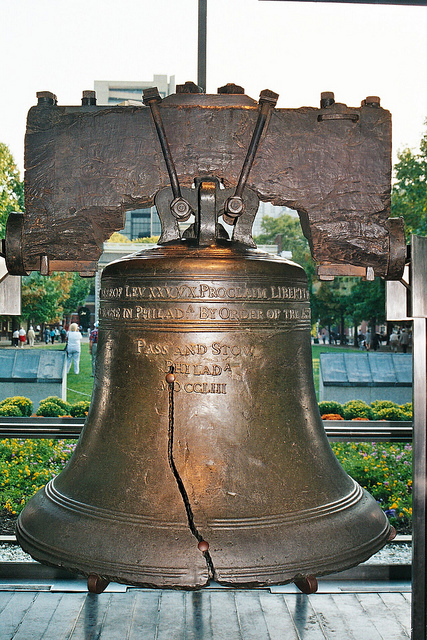
Philadelphia’s Liberty Bell, courtesy Flickr user Lee Bennett
Thursday, January 23
I’ll get to Philly on Thursday afternoon, with time to check-in to the Holiday Inn and head directly to the ALATT’s “Council Meeting” at a local establishment called the Tattooed Mom. It’s open to everyone and many of the 2014 Emerging Leaders are planning to meet up there. You’ll find it on this handy map, along with all the other socials and conference hotels.
Friday, January 24
Why would I head to Philadelphia in the depth of winter, in the midst of a polar vortex? I’m a part of the 2014 edition of ALA’s Emerging Leaders program. I’m in “Team C.” Our task is to deliver a plan to ALCTS to amplify their social media outreach. Consequently, my first full day of the conference, Friday, will be taken up with Emerging Leaders activities: meeting from 8:15 to 4:00pm, followed by a Presidential Reception for this year’s class from 4-5:30pm, and a 7:00 social for EL participants and alums at the Field House. To top it off, Urban Librarians Unite is organizing a 9pm gathering in the same venue - perfect - I won’t have to head out into the cold.
Saturday, January 25
By Saturday, I get a little more Philadelphia freedom to pick my spots. My current plan (of course, all subject to change):
- 8:30-10am: NMRT Conference Orientation, PCC 307B. Getting the lay of the land from the New Member’s Round Table is always a good way to get a handle on a conference, meet a few people, and get ready for the days ahead.
- 10:30-11:30am: Open Forum on Revised Information Literacy Competency Standards, Loews Hotel Commonwealth A-D. As an instructional librarian, these standards are my bread-and-butter.
- 1:00-2:00: I will serve as a volunteer résumé reviewer in the NMRT’s Placement Center.
- 2:00-3:00: Ever seen a seven-headed monster? The ALATT is sponsoring Ignite Sessions in the Networking Uncommons. Seven presenters, five minutes each, with 20 fast-moving slides. I’m one of the seven. My topic? Community building from the ground-up. But don’t come for me: it’s the other six I want to see.
- 3:00-4:00pm: Making Learning & Research Fun: The World of Digital Badging, PCC 201C. There’s a joint effort of major federal agencies/organizations (Smithsonian, NPS, Library of Congress, etc.) to create a digital learning platform open to librarians and educators to use with our students. I’m going to learn a little more.
- 4:30-5:30pm: Challenges of Gender Issues in Technology Librarianship, PCC 201C. Andromeda Yelton is going to lead a panel discussion on the gender-related challenges faced by library technologists. Some of the recent controversy surrounding the ALA Code of Conduct is clear evidence that conversations like this need to exist, and I’m looking forward to it.
- 7:00-9:00pm: I might drop by the Newbie/Veteran Librarian Tweet-up, but I am sworn to the Tumblarian Party.
- 9:00pm-onward: The EveryLibrary | Mango Midwinter After-Hours Benefit and Party. Because of course. By the way: support EveryLibrary.
Sunday, January 26
- 10:30-11:30am: New Members Discussion Group, PCC 121A. It sounds like a good conversation about how early-career librarians can #makeithappen. I’m in.
- 1:00-2:30pm: OITP – Google Book Search: What impact will the GBS saga have on copyright reform?, PCC 114 Lecture Hall. Google’s Fred von Lohmann will give his perspective on copyright and the Google Book Search lawsuit, with responses from Amherst and Emory librarians.
- 3:00-4:00: Library Family Feud! They pit authors vs. librarians. By this point, I’m pretty sure I’ll need something silly. I attended this at ALA 2013 and it was fun.
- 4:30-5:30: Digital Humanities Discussion Group. A subject I find interesting but need to learn more about. Here’s where I’ll start.
Monday, January 27
- 10:30-11:30am: ALCTS Forum: How my library was energized by ALCTS publications, PCC 204A. Now that I’m part of the ALCTS social media squad, it’s time to build a propaganda treasure chest. Hearing how librarians are using ALCTS to accomplish their goals should help me learn how to promote ALCTS, yes?
- 11:45-12:30pm: ALA Masters Series – The library as a catalyst for innovation: Case studies of library entrepreneurship centers and programming, PCC 203B. Pima County Public Library’s Catalyst Café apparently has something going as an idea incubator. I am intrigued, so I’ll go see what they’re talking about, but I’m also reminded of Chris Bourg’s warning about the Neo-liberal Library. We’ll see.
After that, I’ll fly home in time to sleep in my own bed Monday night.
If we’ve never met, and you want to know how to recognize me, I’m 6′5″, bearded, and look a lot like this fellow. I’ll also be live-tweeting during the conference on the #alamw14 hashtag.
Let me know if I’m missing out on a Must-Do in the comments.
Continue reading Midwinter’s night dream: My plan for ALA Midwinter 2014 »
Speculative Cataloging
It all started as a side joke by my boss during a meeting, and then turned into this tweet:
In chatting with @ThePinakes I came up with a new serial: The Journal of Speculative Cataloging. Volunteers for inaugural editors?
- K.G. Schneider (@kgs) December 19, 2013
Which, in turn, sparked my natural librarian’s curiosity. There is no Journal of Speculative Cataloging, of course, but a journal of speculative … something? An intriguing name. A simple search of my library’s journal finder turned up the very real Journal of Speculative Philosophy, a venerable periodical first published in 1867.
Thanks to the open access to early journal content provided by JSTOR, I made a quick search of the early issues to see if questions about libraries were posed, and lo and behold, not only was there a library science focused article (probably from before the term “library science” was bandied about), it was very much a piece of speculative cataloging. Published in 1870, and nestled between articles titled “Göthe’s Social Romances,” “The Settlement for All Philosophical Disputes,” (that one sounds ambitious), and “The Immortality of the Soul,” (equally so), it is a humble submission titled “Book Classification,” uncredited to an author (the only identifying clues are that he refers to himself in the masculine, and mentions that his system of cataloging is being implemented at the Public School Library of St. Louis, a subscription library that was the forerunner to St. Louis’s public library).
It should be noted that this 1870 article predates both the Library of Congress (1897) and Dewey Decimal (1876) systems of cataloging and classification. As the public library movement swept the nation, developing systems of organization were likely the most vexing and complex issues facing this early generation of public librarians - as big a controversy as anything facing us today.
And what does our anonymous author propose? Why, naturally, something clear and easy to understand. Under the heading “The Scheme,” he explains:
It uses Bacon’s fundamental distinction (developed in De Augmentis Scientiarum, Book II. chap. I.) of the different faculties of the soul into Memory, Imagination, and Reason, from which proceed the three grand departments of human learning, to wit: History, Poetry, and Philosophy. Without particularly intending to classify books as such, Lord Bacon attempted rather to map out “human learning,” as he called it, and show its unity and the principle of development in the same. But his deep glance seized the formative idea which distinguishes different species of books (Book Classification, p. 115).
Most librarians have faced awkward small talk with folks from outside the profession: the half-hearted Dewey joke, the semi-earnest request for us to explain why libraries aren’t rendered obsolete by internet search, and so on. Imagine if this classification scheme had won out over Dewey’s…could you handle having to explain Francis Bacon, faculties of the soul, and the three grand departments of human learning to someone at a party? “Dewey Decimal” might have a funny ring to it, but I think we have it lucky.
From there our author argues against himself, detailing why Bacon’s work is an impractical system of classification (not surprisingly, since Sir Francis Bacon wasn’t writing about libraries at all). He reorders Bacon’s grand departments into a trio of classes: Science, Art (or Aesthetics), and History - although the 1870 definition of science is quite different from ours: “philosophy is the highest type of Science, and hence begins the catalogue” (p. 120); surely this pleased the publishers of the Journal of Speculative Philosophy.
Since he wants each class to segue into the next (he uses the term “unfolds”), the author places the “useful arts” at the end of the Sciences, so it transitions the browser from Science into Art, Fine Arts, and ultimately Poetry. Geography begins the History classification, which is ultimately not too far of from modern the Library of Congress system: Class C includes Geography, and therefore those works precede World History, Class D.
Just how influential this system was, and how long it persisted in St. Louis, I do not know. But while we modern librarians come to grips with change and grapple with technology, it’s worth remembering that change is nothing new to our profession. In the 1870s, they didn’t even have an agreed upon method for putting the books on the shelves (nor an expectation that every community even have a public library). We have answered hugely fundamental questions and challenges throughout our professional history: the one and only constant in our line of work is the constant change.
This anonymous article from the past is a reminder of those questions we’ve had to speculate upon…and the cataloging and classification system we might have ended up with, in an alternate universe.
- Book classification. (1870). Journal of Speculative Philosophy, 4(2). 114-129. Retrieved from http://www.jstor.org/stable/25665714
Update
Librarian Nicolette Warisse Sosulski has identified the author as St. Louis-based educator, philosopher, and all-around rockstar William Torrey Harris, founder of the Journal of Speculative Philosophy (which would explain why he didn’t credit himself as the author; as publisher, it must have been assumed.)
With his name, researching the influence of Harris’s system became a little easier: according to a 1945 article in the journal Library Quarterly, Dewey was directly influenced by Harris. Dewey once wrote that when developing his own classification system, “the inverted Baconian arrangement of the St. Louis Library has been followed.” Dewey even sent a letter to Harris asking for more details, referencing the article he had read in the Journal of Speculative Philosophy.
- Leidecker, K.F. (1945). The Library Quarterly: Information, Community, Policy, 15(2). 139-142. Retrieved from http://www.jstor.org/stable/4303322
Nicolette passed along further links of interest: the Classified Catalog of the St. Louis Mercantile Library (Harris’s Inverted Baconian Classification in action) and a reposting of a 1959 article from Libri by Eugene Graziano that makes all the direct comparisons between Harris and Dewey, showing how the former clearly influenced the latter (and explains some of Dewey’s oddities).
The “Inverted Baconian Model” was not a failed experiment: it was the direct ancestor of our contemporary classification and cataloging.
- Graziano, E.E. (1959). Hegel’s philosophy as basis for the Dewey Classification Schedule. Libri 9(1). 45‑52. Retrieved from http://www.autodidactproject.org/other/hegelddc.html
An Atlas for Higher Ed: Curriculum Mapping and Library Instruction
When I was a kid, I was obsessed with maps. I had maps on the walls of my bedroom and I would browse an atlas for fun (nerd alert!). When I started reading, I liked the books with maps in the front (still do). By middle school, I had descended into roleplaying games and would spend hours (poorly) drawing maps of my own fictitious world, a habit that lasted longer than I care to admit.
So it shouldn’t be a surprise when professional peers started talking about curriculum mapping, I got interested. My first exposure to the concept came during the CARL Conference 2012 during a keynote presented by Char Booth and Brian Mathews. Char was presenting the curriculum mapping work she was doing at Claremont Colleges through an IMLS grant.
Meanwhile, my colleague Nicole Branch was investigating curriculum mapping as well. She attended a curriculum mapping workshop at ACRL 2013, and brought back a number of templates and materials we could incorporate into our work.
The Scaffold
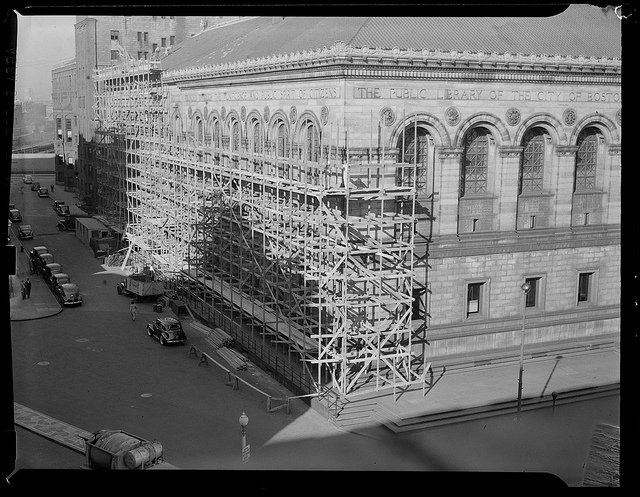
Scaffolding on the side of the Boston Public Library, used via Creative Commons license, courtesy Boston Public Library.
Nicole and I co-coordinate library instruction at our place of work. We are a small, private liberal arts university. We do not have a semester-long library skills course as some institutions do; information literacy instruction is a part of university learning outcomes and is intended to be integrated with regular course curriculum. Librarian-led instruction takes place in one-shot workshops, either initiated by the faculty or in conjunction with partnered academic programs.
As our program expanded and we received more faculty requests, Nicole and I ran into a problem that will be familiar to other instructional librarians: students who think (rightly or not) that they’ve “already had this workshop before.” As a small school, we do often see the same students in many of our different workshops. We needed to ensure we were delivering different presentations each time, not only to maintain student interest, but to actually address all five ACRL standards for information literacy instruction over the course of a student’s matriculation (which is plainly impossible in any single workshop).
Before we were “mapping,” we were already starting this coordination: sharing lesson plans with each other, identifying skills we wanted to address in one course vs. another, and working with academic departments to ensure that our instruction would be regular parts of course curriculum (our primary partners were our school’s freshmen composition classes and an interdisciplinary general education program attended by all undergraduates.) This “scaffolded” program of information literacy was the foundation of our curriculum map: the landmarks, as it were, to which we’d apply a roadmap.
Charting Our Program
The next phase in the development of our curriculum map was a response to an opportunity: our campus administration was starting to think about curriculum mapping as it relates to graduate and undergraduate programs, and our University Librarian suggested Nicole and I could present on the subject to our annual Dean’s Conference, an end-of-academic-year faculty meeting. Most faculty had only seen the portions of our information literacy instruction that related to their courses; this was a chance to unveil the comprehensiveness of our program and use it as an example when explaining how curriculum mapping worked.
One of the features of curriculum mapping is that it can be adapted to any level of instruction, whether it’s an individual workshop, a semester-long course, or an academic program, and the micro components can roll into the macro. You can start the process from scratch, or you can adapt existing learning outcomes and assessment models into the curriculum mapping format. It’s flexible.
Nicole Branch put together the backbone of our presentation. She adapted the materials distributed at the ACRL workshop, and also incorporated the approach developed at University of Hawaii, Manoa’s office of assessment. Our scaffolded series of workshops became this chart, showing which ACRL standards and university learning outcomes each of our workshops addressed. We didn’t input every detail of our workshop into this form; those existed in our detailed lesson plans, and didn’t need replication.
As the cherry on top, I adapted that chart into a mind map, which makes for a splashy visual presentation that faculty really responded to - the map in “curriculum mapping.”
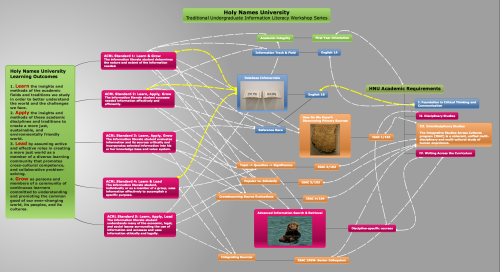
For us, the completed curriculum map was transformative: we could see the big picture of how our program worked and the pedagogy we employed; it forced us to ask tough questions about our own assessment techniques; it allowed us to communicate our goals better with faculty; and we could identify which information literacy standards were inadequately addressed. It encouraged us to be reflective and we revised a number of our workshops as a result, a process that is still continuing as we strive to improve our program.
An Atlas for Higher Ed
The next chapter is unfolding right now. As a follow-up to the Dean’s Conference presentation, the administration has asked the library to work with various academic programs on their own curriculum mapping efforts. Nicole and I have developed a new presentation we’ve been delivering to different departments to assist them in their process. I am curious how each department will approach this differently, and what we will learn from them as a result. Together, we can produce a series of maps that intersect across university learning outcomes, academic majors, and general education requirements: an atlas for our model of higher education.
Continue reading An Atlas for Higher Ed: Curriculum Mapping and Library Instruction »
What to do with “databases and research options:” Making library instruction meaningful
I recently posted an anecdote on tumblr about the impact library instruction can have on a student. The post was well-received, but there was one commenter who made this very relevant point, that I wanted to address in full:
I get requests from teachers pretty frequently to talk about “databases and research options” without their students having anything specific and looming in mind to research. Maybe, *maybe*, those are students that will remember, weeks months years down the line, that the library offers something they need. That’s what I question the worth of.
That is the essential challenge of “one-shot” information literacy instruction. What is the best approach to this scenario? Remember that when you get a vague request like “databases and research options,” you have a lot of leeway: there’s a lot to information literacy outside database demonstrations, and “research options” gives you some freedom. It’s your responsibility as an instructional librarian to turn this vague premise into something meaningful for the students. Going through the motions of demonstrating a couple different scholarly article databases isn’t going to be enough (or even the right track at all).
The Information Need
I interned in the reference and instruction department at the University of San Francisco five years ago. Gleeson Library’s coordinator of instruction, the wonderful Joe Garity, made the point to me that a research workshop that’s not grounded in an information need - an assignment the students are working on - will rarely have a meaningful impact.
One of the workshops he brought me in to co-teach with him was a freshman year composition & rhetoric course. This was an archetypal example of a class where we were asked to present “databases and research options,” despite the fact that the students were not going to be writing research papers.
The year was 2008, a presidential election year (Obama vs. McCain) as well as the year California’s Prop 8 was on the ballot. Joe talked to the instructor and discovered that the students’ next assignment was to make persuasive, debate-style speeches on electoral ballot issues. We focused on that. No student - especially a freshman - was going to trawl Academic Search Premier for research studies in order to make a political argument (even our actual politicians don’t do that level of research!).
So what were the students likely to actually do instead? Turn to the internet. Searching the internet for political information is risky: is there a topic more rife with heavily biased, unsourced websites and faux-journalism than American politics? We started where the students were likely to start: Wikipedia and its strengths, weaknesses, and edit wars. Then we moved on to navigating California’s state electoral webpage, and then searching for reliable fact-checking political websites. Sometimes information literacy instruction isn’t about driving traffic to the library’s licensed content; if those resources aren’t the right tool to solve a student’s real-life information need, then the workshop won’t be productive.
Of course, sometimes the library’s licensed content is the right tool, and those resources are rightfully the focus. But the lesson plan should always be centered around solving a student need (represented in the form of an assessable learning outcome) that relates to a student’s academic assignments. Figuring out which classes call for which approach starts with working with your faculty. Hopefully, you have a constructive relationship with the teacher or professor. Start a dialogue with the instructor about their student’s information need. If the instructor isn’t forthcoming (remember, they are busy, just like you), you can ask for a syllabus, or look at the course description to get a better sense.
Curriculum Mapping
Ultimately, no one 50-minute workshop can hope to cover all five ACRL standards for information literacy. If you are trying to build an information literacy program, you will want to look at your school’s curriculum and the way students progress (which it should be noted can vary dramatically by major or program). If you can map that curriculum to your information literacy learning outcomes, so that each librarian interaction with a student (whether that’s in a workshop, embedded in a class, or in a librarian-led credit course) builds on previous interactions and on student coursework, you can ensure your institution is covering the full spectrum of information literacy skills. More on curriculum mapping, a project we’re working on right now at my place of work, in my next post.
On Emerging Leaders 2014
What I’ve known for a couple weeks now is finally official. I will be a part of the American Library Association’s 2014 class of Emerging Leaders. I’m very excited to take part in this program; some of the librarians I admire most are alums, and I count several friends among the 2014 class.
I’m also excited about the number of names I don’t recognize. There are a lot of great people doing great work around the country, and I look forward to making new connections and learning from what they’re doing, starting with the ALA Midwinter Conference in Philadelphia, a city I’m happy to go back to (although as a Californian I’m not quite sure how to deal with being back east in January. I literally have no “winter” clothes).
One of the exciting aspects of Emerging Leaders is that it takes a cross-section of the profession - public librarians, academic librarians, special librarians, and school librarians; information professionals of every stripe. I’m firmly in the academic librarian camp, but there is so much we can learn from what our colleagues from the other divisions are doing in terms of collections, outreach, marketing, and instruction. If we stick to our silo, there’s so much we miss out on.
Onward to Midwinter!
