Trip Report: SCELC Vendor Day
I flew to Los Angeles a couple weeks ago to attend the second half of the Statewide California Electronic Libraries Consortium’s (SCELC) annual Colloquium & Vendor Day hosted at Loyola Marymount University (I was unable to attend the first day because I was leading a four-hour intensive information literacy workshop for Biology students; I should post about that someday, too).
The first night, my colleague N.G. and I got to meet up with some Southern California information all-stars: Young Lee, law librarian and bon vivant* from the University of La Verne; John Jackson, the dapper, bow-tie wearing ALA Emerging Leader and Grand Cataloger at USC; and Loyola Marymount’s librarian-in-residence Cynthia Orozco. Our conversation was exactly what you’d expect with a table full of librarians (bar the unexpected interloping business-traveling New Zealander who butted into our conversation to regale us with his personal philosophy - think: people are either sheep or wolves - he was the wolf, we were the sheep?): it was a mix of excellent professional observations and ideas, a wealth of outstanding verbal sorties and quips, and a healthy debate on the proper composition of a Manhattan.
Another perk of going to SCELC was I finally got to meet my long-time internet friend Sherry Youssef and her colleague Shawna, who are librarians at a specialized psychology graduate school. Since I recently became our liaison librarian to our Psychology Department, this was a useful chance to pick their brains about products, collections, and other things relating to a field I still need to learn about. Sometimes professional networking isn’t just about getting jobs; it’s about getting good ideas from smart people (and good dinner conversation is just the bonus).
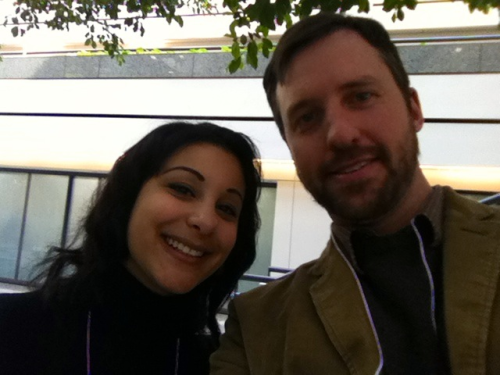
Hanging out with Sherry
SCELC’s Vendor Day followed the next day. Here’s a brief rundown of some of the product demonstrations I saw and my first impressions**:
APA
The first presentation I saw was from the publishing & electronic content arm of the American Psychology Association (APA; shhhh…I didn’t tell them that I’ll soon be staging a protest). They are debuting a few new products:
- PsycBOOKS, which can be purchased by title-by-title or leased as a 44,000-chapter full-text collection. This collection will grow with newly published materials (after a 1-yr embargo) and also contains various “classics” in the psychology field.
- PsycTHERAPY, apparently a competitor to Alexander Street Press’s existing Counseling & Therapy Video Collection. This contains 300 therapy demo videos featuring actual clients and practicing professionals.
- PsycTESTS, a database of testing instruments (including non-commercial permissions) as described and culled from various journal articles and other sources. Their long-term goal is to have 20,000 tests in the database. Currently 75% of content is full-text (remainder have either been published as commercial tests or authors have not provided permission – in those cases, only a citation and contact information is available).
Credo
Credo provides DRM-free reference eBooks; generally speaking, they are one of my favorite vendors both for the quality of their content and the ease of using their UX on both the user and administrator side. The depth of the Credo reference collection is what allowed my library to move almost entirely away from print reference collections (this is a ubiquitous trend in libraries and elsewhere; note the recently announced death of the print edition Encyclopædia Britannica). Our Credo collection contains over 500 different sets of encyclopedias, dictionaries, and other reference items running the gamut of arts, humanities, social science, health, education and science disciplines.
Credo was at Vendor Day to demonstrate their new product, Literati. Literati is a spiffed-up interface for content from Credo’s Reference Database that includes customized videos, a stylish navigation screen and built-in hyperlinks designed to make information-seeking more intuitive for millennial students. However, since the content beneath the splashy screens largely remains the same, I’m unsure how much of an upgrade over the simpler Credo experience this is. Is it just adding more clicks into the information retrieval process? That’s counter to what we want. Until I get a chance to try it myself and see what the benefits might be, the jury (ie, the jury of me) is out on Literati.
Copyright Clearance Center
The non-profit organization Copyright Clearance Center was at Vendor Day to demonstrate the usefulness of their Get It Now automated electronic article inter-library loan (ILL) sharing system, first designed and implemented by the CSU system but now spread to many institutions. The patron-driven, automatic delivery of electronic scholarly articles is absolutely the way ILL should work in the 21st century and it’s pretty cool to see it taking off - a la carte article publishing could save libraries a lot as opposed to big bundles of unused electronic journal subscriptions. The service bills libraries monthly for the number of articles acquired.
There is a fairly large group of contributing publishers including many of the major names. Currently, 120 colleges have adopted the service. Along with receiving a copy of the articles requested, libraries are also provided the copyright clearances they need for most academic uses (not surprisingly, since the Copyright Clearance Center is behind all this).
Gale
Gale Cengage was demonstrating two products – Business Insights: Global and the newest iteration of the Gale Virtual Reference Library. I was pretty pleased with what I saw from Business Insights: Global - clean, simple interface; you can use it to create quick, easy-to-design charts based on financial and statistical data; and it prominently features hyperlinks to promote the proximal curiosity effect that drives so much of Wikipedia usage. As for GVRL, it looked like a sharper interface; I believe many libraries are already using it. I’ll check it out more thoroughly before I implement it, however (interface changes mid-semester aren’t usually a good idea).
All in all, it was a good trip to SCELC - whatever you think of the world of library vendors and journal publishers (and there are issues with them all, to varying degrees), it’s useful to know what they are offering. It’s just too bad I had to miss the librarians vs. vendors bowling night.
Future Travel
My trip to SCELC marked the start of my travel season; I’ll be heading to the California Academic & Research Libraries (CARL) Conference in San Diego in April and I’ve been accepted into ACRL Immersion in Vermont in July (I know, I just buried the lede in the 12th paragraph). I’ll post more about both of those soon. I will not, however, make it to ALA this year; there will be no reprising my surprise Battledecks performance, at least not in 2012.
*My spellchecker wanted to correct this to ‘Bob Vivaldi.’ Perhaps I should have let it; that’s kind of awesome.
**I’d like to emphasize these are my initial judgments based on what I saw in demonstration; I have not gotten hands on with these products yet and my opinions - poorly developed as they are - are purely my own and do not reflect those of my employer (or anyone else for that matter).
Comments are closed.
