Diptych: Spring
I guess both Nicole and I thought of flowers for springtime. I believe this is the most resemblance our diptych photos have had to each other, and even here I went for a field and she went in close. Miss Grace and Kellee’s version can be seen here. Next week will be “abundant”.
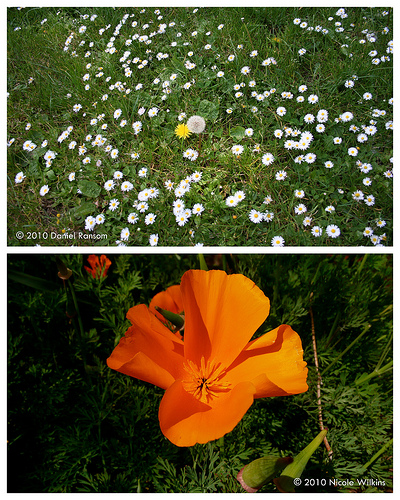
Springtime
Today is Wednesday, so I should be publishing this week’s Diptych right now, on the subject of “Spring”. This being the vernal time of year, I saw plenty of inspiration this morning:
- Blue sky over the City, but dew on the ground;
- My daughter (3, and full of curls) dancing down the street in her sundress;
- Noe Street, shaded by trees and filled with blooming flowers;
- An older gentleman on the corner assembling bouquets, who gave my daughter a branch of lilac buds;
- Walking through a verdant Golden Gate Park on my way to work;
- Seeing Park & Rec prepping a public diamond for high school hardball.
Only catch? No camera! And I decided that my iPhone camera wouldn’t cut it.
Hopefully I’ll find as much inspiration tomorrow. I will also post a recap of my fantastic experience at the CARL Conference shortly.
Information Amateurs Social Club
Back before graduation, my student colleagues and I were invited to occasional student organization sanctioned happy hours or other social events. When I met up with new Stanford metadata specialist (and former SLIS classmate) Greg Borman for a pint last month we realized we were no longer part of that network of current students, and if we wanted to approximate something similar (ie, keep in touch with our peers socially), we’d have to organize it ourselves.
Thus the idea of the Information Amateurs was born. Early career (ish) professionals getting together to swap stories and job seeking hints, all over a libation or perhaps two. This is a non-discriminatory concept; I like breaking down silos, so public, academic or special librarians are all welcome, as are archivists, current students or various other denominations.
The first Information Amateurs Happy Hour is going to be Friday, April 30th at the Latin American Club in San Francisco’s Mission District (22nd Street at Valencia). It’s entirely possible it might be just Greg and I. Or 30 people could show up in a crowded bar. So far the invite list includes people I just met this weekend at CARL, people I haven’t run into since a class a couple years ago, some of my closest friends in the profession, and people I’ve never even met that are connected through Greg.
If you’re reading this and haven’t been invited, you’re invited. If you’re interested, contact me via the options on my “about” tab or just respond to this Facebook invitation.
If we get a big response, the Information Amateurs Social Club will officially be born.
Diptych: Temporary
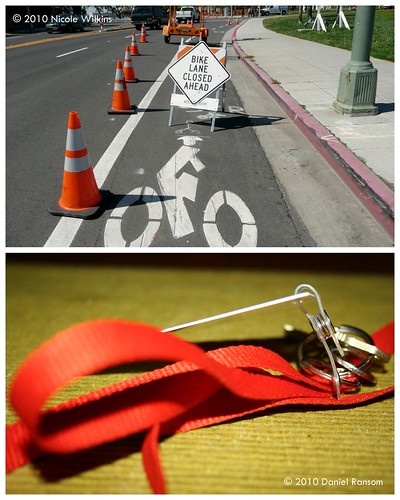
This week’s diptych theme is “temporary”. I have no hand in selecting the themes; that’s up to Grace and Kellee. But this week that term is especially relevant to me, as I am in the final days of my temporary position at the California Academy of Sciences. While I only became a paid employee in December, I first came to the Academy back in June of 2009 as an intern and have been heading in to the gleaming green building in Golden Gate Park continuously ever since. So next Friday, my last day at the Academy, marks the end to a significant period of my professional life.
It’s a bittersweet departure because of the fun I’ve had, the skills I’ve learned, and the connections I’ve made. First, credit for how enjoyable it’s been should be given to the people I work with: Christina, who for my months as an intern was my roommate in the Corsi Digital Lab, and then, when she went on maternity leave, the reason I had a professional opportunity; Becky, who is funny, lively, takes long runs in the rain and taught me a lot about life sciences librarianship (taxonomy!); and most of all, my supervisor, Danielle, who has patiently taught me how to handle the Academy’s historic materials, how to curate an informative archival display, and all sorts of digital asset management details they never get to in library school. I appreciate the patience they’ve shown in teaching me the rigging of the good schooner Academy.
Working in the Academy’s archives is quite an adventure. These aren’t dry and dusty collections; I learned about Alvin Seale, a headstrong turn-of-the-century scientist and adventurer who scoured the South Pacific for feather cloaks and cannibals; the great matriarch of botany Alice Eastwood and how she rescued specimens in the midst of the 1906 disaster; and scientific explorers like Rollo Beck and Templeton Crocker and their high-seas voyages to the Galapagos and beyond. I spent weeks delving into our materials on the arctic north and became an accidental expert on pelagic sealing, the Pribilof Islands, and the strange things that happen in the Bering Sea.
But all this was temporary, and I’ll be moving on. Fortunately, the skills I’ve learned are not.
My image in this week’s “temporary” diptych is the iconic orange band that’s been around my neck since last summer, the one that I’ll soon be giving up.
Dissecting CARL
We’re just a few days away from the 2010 CARL (California Academic and Research Libraries) Conference and I couldn’t be more excited. Last week, my friend and carpool partner Carolyn came over for dinner and discussion of our itinerary and figured out which presentations we most want to attend (subject to change, of course, based on recommendations and momentum once we arrive).
So I thought I’d dissect the schedule and the presentations I’m most interested in seeing. Once the event is underway I’ll tweet my live impressions, and when it’s over I’m sure I’ll post a conference wrap-up.
Thursday, April 8
The conference kicks off with AM and PM “Engage Sessions” for early birds. Since these cost extra and both Carolyn and I are on “underemployed” budgets, we decided to pass on extra out-of-pocket expenses. It’s unfortunate, since several of these presentations sound interesting, particularly “Reference Toolkit Revisited” by Amy Wallace, CARL President. I’ve been doing specialized archival reference at the California Academy of Sciences, so a good refresher on the latest tools and tricks for general reference and instruction would have been worthwhile. Perhaps I can pick Amy’s brain during some of the open conference time.
The main draw for us Thursday is the dinner program from 6-8, which promises to be a great chance to reconnect with librarians we’ve worked with in the past and make new contacts.
Friday, April 9
Friday morning is when the serious presentations begin (and the difficult choices). After an early plenary session with Dr. Peter Hernon, we have to decide between four different presentations to attend late morning, another four after lunch, and a final set of four for the early evening. The three sessions I’m leaning towards attending are as follows (and, of course, subject to change):
- New Directions in Library Instruction: Keywords, Visual Literacy, and Critical Thinking by Matt Conner (of UC Davis). This is appealing because I consider Library Instruction to be one of my strengths as a librarian and this is an opportunity to see another professional’s perspective and deepen my own understanding of information search. My own philosophy of Instruction is pretty heavily based on what I learned working with Joe Garity and his team at USF so I’m very curious what other perspectives are out there.
- People Make Research Guides with Jacqui Grallo, Kathlene Hanson (of CSU Monterey Bay), and Jade Winn (USC). LibGuides and similar software are becoming the dominant medium for dynamic research guides (replacing the static pathfinders of the days of yore) and getting a better understanding of how to use these tools will keep me on the cutting edge of Reference Librarianship.
- Digging into Our “Hidden Collections”: Maximizing Staff Skills and Technology to Enhance Access to Special Collections with Elaine Franco and John Sherlock (UC Davis), Sarah Buchanan (UCLA). I may just be getting suckered into a presentation about a mystery with a fellow named Sherlock, but this sounds very compelling to me. A lot of what I’ve been doing with the California Academy of Sciences has been digging through the back cabinets to find the uncataloged, unheralded and otherwise undiscovered items in our collections. I’d love to learn about Franco, Sherlock and Buchanan’s experiences with similar work on the larger scale of a research university.
Alternatively, there is an compelling sounding presentation on information literacy assessments (AM), library research ethics (PM), and wiki-based research guides (late PM) that could draw me away from my initial choices. The Friday lunch is also exciting: CARL will be introducing the current Rockman Award winners, and it will be my chance to meet the other members of the committee.
Saturday, April 10
The final day of the conference promises to be pretty full, too. I’m less decided on my Saturday “Listen & Learn” sessions, but here is what I’m leaning towards:
- The Library as a Student Research Site by Anna Gold (of Cal Poly-SLO). Library service always starts with the user experience. Whether you’re trying to provide access to materials, assist in locating information, or performing behind-the-scenes technical services, everything we do as librarians has to be about easing the experience of our library patrons as they seek information, a place to study, to work and to collaborate. This presentation promises to be a well-researched look at how university library users are using the tools at their disposal and how libraries can make their research goals easier to accomplish.
- Early Career Issues in Academic Librarianship with Katherine O’Clair (Cal Poly-SLO). Well, I fit the bill. I graduated in December and am currently looking for a full-time, professional position, and this session is all about what to do when you’re in my shoes. From the presentation description, this sounds like it could be a great, open discussion, or fall flat if the audience is light and unresponsive. However, given O’Clair’s impressive curriculum vitae, I’m pretty sure she knows what she’s doing and this session will be worth attending - it has the potential to be the most useful I attend all conference.
- Let’s Try This Again: Redefining the Content of Information Literacy for a Post-Google World by Korey Brunetti (CSU East Bay), Julian Prentice (Chabot College), and Lori Townsend (CSU East Bay). It’s pretty clear that literacy and information literacy have diverged pretty sharply in the Age of the PDF. This collaborative, workshop-style presentation is focused on determining just what the necessary research skills are in our current technology-driven environment and how to ensure university students gain that understanding.
There’s also a snazzy-sounding Saturday late afternoon presentation on LibGuides in case I miss the Thursday research guide session. Saturday lunch is also reserved for brown-bag/Dutch-treat interest groups, and I’ll be joining the Rockman Committee and award winners for lunch at Rio City Café.
All in all, I couldn’t be more excited about my first CARL conference!
The Iconography of Business Cards
Since I’ll be heading to the CARL conference pretty soon - a great place to meet interesting library professionals and make new contacts - I thought it was a good time to get my own set of business cards. In the hopes that I’ll hand a few out, and a few of the recipients might find there way to this website, I thought I’d explain the images on the back of each card.
I used a printing service called Moo to make my cards, and one of the options they offer is to print a photograph on the reverse side (fantastic print quality, by the way - I’m very happy with the results).
I chose six different images, all taken by me.
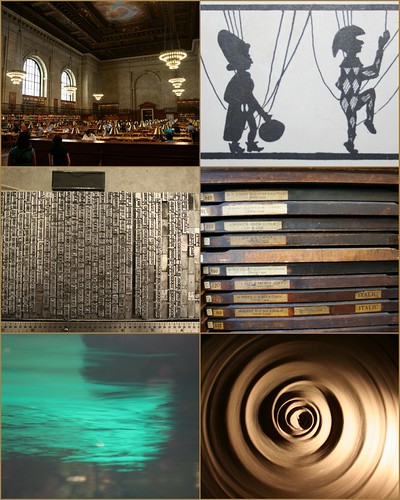
The one in the upper left is a photo of the grand reading room of the New York Public Library, which was one of the first things I posted on this blog and the background image on my twitter feed.
The second image, upper right, is a little more personal to my family. In the late 1920s and early ’30s my grandfather was a marionetteer, and the image is a detail from the letterhead of his company, the Domino Marionettes. The surviving collection of his handcrafted wooden puppets - a mix of billy goats, characters from Greek myths, and Punch and Judy handpuppets - is one of our most treasured family possessions.
The third and fourth photos were both taken in the printing press room of UC-Berkeley’s Bancroft Library. I find the iconography of print - both in its historical context and the newer, digital iterations - fascinating, so I took a few photos during a Lissten-sponsored tour and chose to use these two on my cards. One is the stack of type trays, the other is a page laid out ready for printing.
The fifth photo, on the lower left, is the first image I used in the ongoing Diptych project. It’s actually a photograph of the penguin tank at my erstwhile place of employment, the California Academy of Sciences. Obviously, there are no penguins in the photograph - it’s just an abstract image meant to capture the concept of “water”. The sixth photo, on the lower right, is a spinning sand table at San Francisco’s Exploratorium (I recommend going to their webpage and pressing the button. The one they tell you not to press).
Full size images - plus an uncropped version of my grandfather’s letterhead - are available on flickr.
Diptych: Loud
Today’s diptych is coming out late night because it’s LOUD. Well, actually, because we had Nicole and Carolyn over for dinner (we talked about CARL and Controlled Vocabularies and Georgian wine. It was exciting). But still, here you go – LOUD.
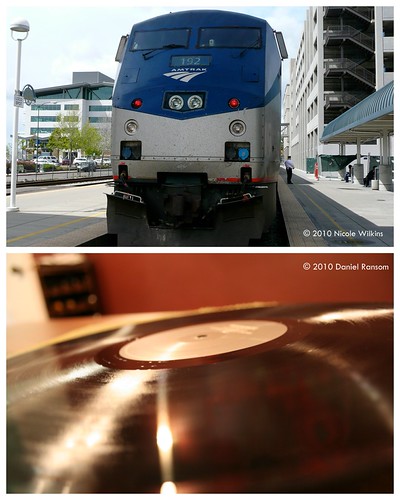
If you’re wondering, the record in the picture is Spencer Krug’s experimental Moonface EP. Download the digital version (for free! legally!) and let it invade your dreams. Oh, and Miss Grace’s “Loud” is just about the loudest photograph in the history of loud photographs. Listen up over here.
On Conferences
In 1891 the annual American Library Association conference ventured to the West Coast for the first time. The ALA came at the behest of the San Francisco Free Public Library and its director, John Vance Cheney. He had spent the greater part of the prior conference lobbying for the privilege of hosting the gathering. While San Francisco was already a sizable city – the self-proclaimed Paris of the West – it was still a far-off frontier to the East Coast American library establishment. After all, much of the region between East Coast and West – Wyoming, Idaho, Montana and the Dakotas – had only gained statehood in the two years prior, and Utah, New Mexico, and Arizona still remained territories. It took a three month round-trip for the caravan of librarians to arrive at the City by the Bay, in what sounds to me must have been a fascinating train ride (for the companionship of so many librarians, for so long, crossing a territory so vast). It must have made for quite the “pre-conference”.
The Papers and Proceedings of the ALA for 1891 and 1892 – available freely on Google Books – are filled with interesting personal and professional notes on the event, including one late night tour of subterranean Chinatown haunts (complete with Chinese opera). Librarians have been writing up accounts of their adventures for far longer than the Age of Blogging!
In 2010, the ALA Conference remains a mainstay event, but with far more than the 50 attendees of 1891 (and developed in ways that Cheney, Dewey and Windsor likely never anticipated). Meanwhile, there is an endless number of focused events a librarian can attend based on specialty, region, and various other factors. Some now take place entirely online (robbing us of the charm of the three month train trip…)
So far I’ve only dipped my toe in one library conference, the 2008 California Library Association (CLA) Conference. I was a San José State SLIS student at the time and was able to attend free of charge in return for volunteer hours at the Infopeople Booth. It was a worthy trade. I found a presentation on Zotero to be quite useful, and greatly enjoyed the keynote speakers Michael Chabon and Ayelet Waldman. The booth time itself turned out to be a great hands-on learning experience with a variety of interesting gadgets and gizmos (with varying degrees of library-related usefulness). However, because of other commitments my time at the conference was limited.
I’ll have a more substantial conference experience with the upcoming California Academic and Research Libraries conference in Sacramento, April 8-10. I plan on attending the entire event (I’ll be commuting in each day with my friend Carolyn in lieu of the cross-country train ride). And while my experience in Sacramento may lack late night adventures in Chinese Opera, I’ll still do my best to write up accounts of my adventures on these digital pages here.
