Hired!
Today I officially signed the offer letter to become the Librarian for Outreach, Digitization and Electronic Resources at Holy Names University in Oakland, California. This marks both a personal and professional milestone; while I have been working part-time since the beginning of the year in temporary positions first at the California Academy of Sciences and then the University of San Francisco, this is my first permanent, full-time role since leaving The Nature Conservancy three years ago to go to graduate school. Moreover, this is my first professional level position requiring the MLIS degree I completed in December.
In simpler language, I’m a librarian now. And not only am I librarian, but this position specifically, and the institution for which I’ll be working, match exactly what I want to be doing and where I want to be. Holy Names is a small but historic institution that has been a part of the fabric of Oakland for well over a century. Founded on the shores of Lake Merritt, first as a convent for girls and eventually developing into a teacher’s college for women, the school moved into the Oakland Hills in the fifties and started to expand its programs into a broad variety of disciplines. It became coed in the 1970s and went from being Holy Names College to Holy Names University in 2004 (with the addition of graduate-level programs).
What do I love about HNU?
- It’s small. Enrollment just tops 1,000, meaning that I’ll get to know students and faculty personally, and work with them in-depth.
- The staff at Cushing Library are energetic and creative. While it is a small team, they are ready to adopt cutting edge ideas, such as trialing OCLC’s Navigator.
- Instead of getting lost in a big department at a large school, I’ll be on the front lines and get to do a little bit of everything: instruction, reference, digitization, and managing online resources.
The details of this position - which my new boss, library director Karen Schneider wrote about on her blog, Free Range Librarian, encapsulates much of my philosophical approach to the profession that I wrote about in my e-Portfolio. I believe strongly that information is information (and a book is a book be it paper or pixels). It is our job as librarians to provide the easiest and most convenient access to that information, be it digital, print, online or off. In this position, I’ll be responsible for the library’s digital assets and ensuring easy, navigable access to information to our patrons.
I also believe in educating our students and faculty about critically judging source materials and improving their searching skills both through the library’s resources and through the internet at large; I will be in charge of building a program to teach exactly that to our University community.
My duties will be substantial and the challenges significant. I can’t wait.
I start July 14.
Die Fliegenden Walküren
This month San Francisco Opera debuted a new production of Die Walküre (The Valkyrie), the second of Richard Wagner’s four-part operatic cycle Der Ring des Nibelungen. The Ring Cycle represents the most ambitious, epic undertaking in the classical canon, seventeen hours of music and elaborate staging featuring gods, heroes, giants and dragons. SF Opera will be performing the entire Ring in June 2011, and last year staged the first opera in the cycle, Das Rheingold.
Alongside the ever-mutating modernized Shakespearean productions you can find from Ashland to Stratford, Wagner’s Ring Cycle does well with ambitious, transformative adaptations. In Wagner’s time, of course, the Ring was always produced with a strict adherence to time and place – the dark-age mythical Northern Europe from which Wagner plumbed legends to invent his story, featuring naturalistic rocks and landscapes, helmeted Valkyries, and the spear-wielding, one-eyed Wotan (Oden to the Norse). It wasn’t until the 1950s when Wagner’s own festspielhaus, Bayreuth, broke the mold (and tried to break away from its tainted Nazi past) with a revolutionary adaptation that took the story out of the dark ages and set it in a minimal, modernist stage set intended to humanize the godly central characters. This opened the doors to various other adaptations – it granted an implicit permission to tweak and change the setting further from Wagner’s specific vision. San Francisco Opera’s new Ring Cycle (produced in partnership with the Washington National Opera) offers a new take, rooted in Americana.
Muddy Gold
Last year’s Rheingold opened with echoes of the California Gold Rush. Alberich, the Ring’s titular nibelung (a Germanic version of a Tolkien-esque dwarf, more cunning, more devious and darker), was portrayed as a prospector, attempting to rob the Rhinemaidens of the gold hidden in the depths of their river. The giants Fasolt and Fafner were depicted as overall-wearing construction workers, invoking the Golden Age of Skyscrapers.
However, inconsistency was the devil (or the Loge?) in the details: after implying for the entire performance that the Valhalla the giants were building for the gods was the Empire State Building, the gods departed the stage at the conclusion of the opera up a gangplank as if they were boarding a cruise ship. It never helped that the gods themselves were attired as preppy Newport, Rhode Island yachters, making them particularly unappealing central characters (Donner, the god of thunder, carried an oversized croquet mallet). Wotan without gravitas leaves a production particularly flat.
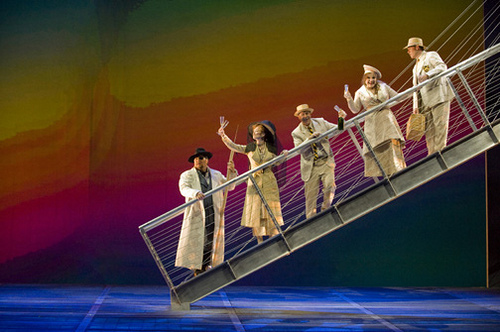 Photo by Terrence McCarthy, courtesy San Francisco Opera
The biggest weakness of Rheingold was inconsistency of vision. The giants in their overalls and Alberich’s mineshaft lair set the tone, but many of the sets in between were generic and failed to create a sense of place. Given the significant use of video projection, a finale featuring a skyscraper-Valhalla would have been both doable and perfect for the staging. Yet the design swung and missed at the climactic moment, leaving me disappointed and unsure I would be enthusiastic about the complete Ring. I felt they applied their concept haphazardly, never really committing fully. I’m all for taking a modernizing concept and applying it to a production (I did work a season for Shakespeare Santa Cruz, after all, famous for their modernized productions), but Rheingold just fell short.
Enter the Valkyrie
My doubts about the direction of the 2011 Ring have been thoroughly eradicated by a stunning, triumphant Walküre. It takes place a generation later, and weaves together images and objects from a 20th century that mixed American triumph with human tragedy into an evocative, powerful presentation.
Hunding’s huntsman’s house, with deerheads and rifles, makes for an appropriate first act setting, and his physical domination of his unloved wife, Sieglinde, makes his villainy plain. Raymond Aceto plays the role with gusto. Eva-Marie Westbroek, singing Sieglinde, was a revelation. Her male counterparts sometimes struggled to match her vocal power (particularly Christopher Ventris’s Siegmund; his voice cracked near the end of Act I the night I saw Walküre; fortunately, he recovered well in Act II) but the first act moved quickly, was well-acted, and set up the action of Act II nicely.
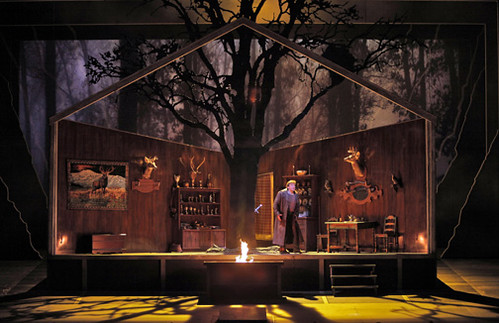 Photo by Cory Weaver, courtesy San Francisco Opera
It was really in Act II that this production began to take off. It opens in Valhalla - which, ahem, was the penthouse of a Skyscraper, looking down on a 30s era Manhattan (I’m glad they got this right in the second opera; I hope they’ll revisit Valhalla’s presentation when they remount Rheingold next year) - with business tycoon Wotan making plans for his secret-son Siegmund to defeat Hunding in battle in order to set off a chain of events that he hopes will return him Alberich’s magic ring, now residing in a dragon’s cave.
Enter Brünnhilde, Wotan’s fiery daughter, leader of his Valkyries, the shieldmaidens who guide deceased heros into Valhalla’s halls. Nina Stemme, an established Wagnerian soprano making her role debut with San Francisco Opera, was a firecracker in tall boots, a pixie haircut and a swirling coat. She was clearly having fun playing up the spunky side of the too-oft staid Brünnhilde, benefiting from the modern costumes that kept her far away from the horn-helmed stereotypes of her character. I’ve seen plenty of opera performers with decent acting chops whose voices leave something to be desired, and far more great singers who can’t act at all. Fortunately, Stemme can both act and sing, and she imbues a tremendous, emotional story arc to Brünnhilde from her entrance in Act II to her final acquiescence and exile at the opera’s end.
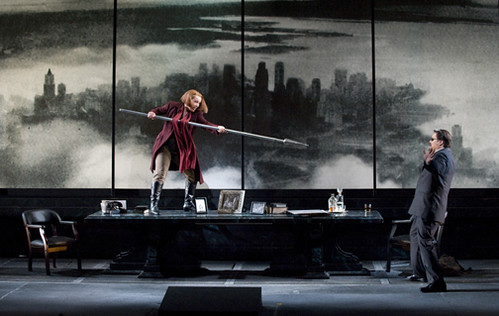 Brünnhilde playfully teasing Wotan in Act II. Photo by Terrence McCarthy, courtesy San Francisco Opera
The Opera’s central twist is set into motion when Wotan’s mind is changed by his betrayed wife Fricka, who demands the marriage-breaking Siegmund be punished. Wotan orders Brünnhilde to carry this out. The ensuing scene is set under a freeway overpass that successfully conveys the failure of 20th century American excess. The parade of dead heroes, garbed in various military uniforms from a century of death and destruction (WWI, WWII, Vietnam etc.), each carrying an enlarged, black and white image of their own face, is particularly stunning in its conception and presentation. Rather than glorifying war and the soldier (as the hawkish Wagner may have intended), this presentation conveys the tragedy and death at the heart of human combat. Brünnhilde, sent to collect Siegmund’s soul and add him to the ranks of dead heroes, is won over by his love for Sieglinde and rejection of Valhalla and agrees to save him in his battle with Hunding. After Wotan discovers Brünnhilde’s betrayal, he is forced to take Siegmund’s life personally by breaking Notung, the sword he had left for his son in the first act. The brief tender moment that the father, wayward though he may be, looks into his son’s eyes for the final time is also stunningly staged.
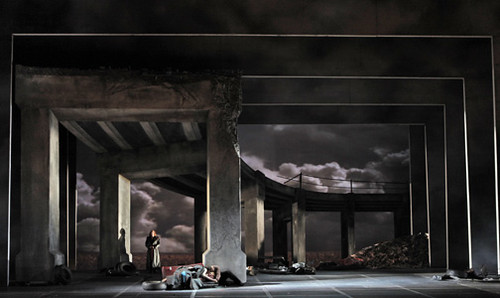 Photo by Cory Weaver, courtesy San Francisco Opera
As evocative as the second act was, the third act was the true triumph of the opera. It opens with the oft-parodied Ride of the Valkyries, and instead of downplaying the sturm und drang, SF Opera embraced the over-the-top music with paratrooping valkyries clad as 30s era aviatrixes (in the mold of Amelia Earhart) landing on a WWII style concrete gun-mount bunker. Despite the usual Wagnerian etiquette of audience silence, there were audible gasps and applause at each Valkyrie’s visceral arrival, each carrying the oversized faces of the dead seen in Act II - the heroes they are escorting to Valhalla. The production elements tie together very nicely.
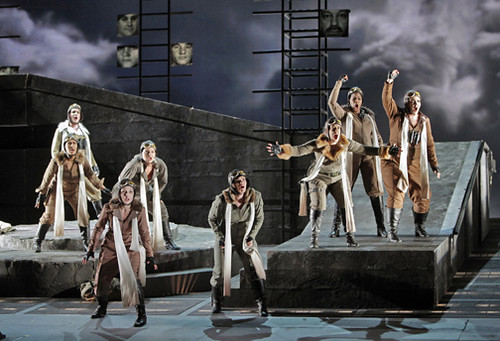 Photo by Cory Weaver, courtesy San Francisco Opera
The bombast turns to a very human-scale tragedy once Wotan arrives to punish Brünnhilde’s treachery and he is forced to condemn his most beloved daughter. Both Mark Delevan, whose strong performance as Wotan helped me move on from the majestic James Morris of past SF Opera Ring Cycles, and Stemme rose to the occasion, as each character goes through the tumultuous emotions involved in turning their backs on one another.
When, at the end, Wotan calls forth Loge’s spirit to encircle the sleeping Brünnhilde in flame, I realized I had just witnessed one of the strongest and important artistic productions I’ve ever enjoyed. The thoughtfulness and comprehensive design I found absent in Das Rheingold was in full force in this production. Combined with strong singers and Wagner’s powerful music, it was epic, human, intricately devised and wonderfully rendered. San Francisco’s 2011 Die Walküre is powerful theater, and promises extraordinary things when SF Opera debuts the complete Ring in 2011. Three performances remain. Standing-room tickets are available for as little as $10 for the strong-legged.
Further reading:
- San Francisco Chronicle review
- SFist review
- The Perfect Wagnerite, G.B. Shaw’s groundbreaking analysis of the Ring Cycle
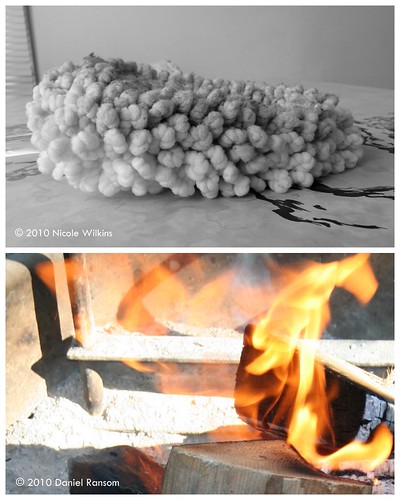
Diptych: Dust
It’s there, through the fire. But it was hard to compete with Nicole’s this week, which looks like so many different things at once but is in fact her duster.
Diptych: Summer
I’ve taken a sabbatical from the diptych series for a little while, for a variety of reasons, but I’m going to try and get back in the swing of things. First off, my partner Nicole submitted photos worth checking out for some of the weeks I skipped (glee and urgent). And here is this week’s offering, “summer”:
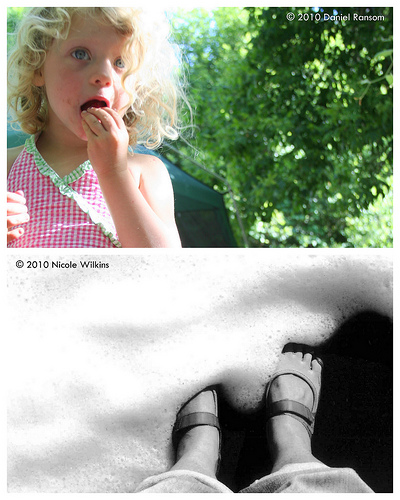 Miss Grace and Kellee’s summer idylls are posted here. Next week we will turn to “dust”.
Information Amateurs are born!
A couple weeks ago (April 30, to be exact), a mix of early career librarians and MLIS students got together at the Latin American Club for a couple drinks, story-swapping and the type of informal networking that is an awful lot of fun (as first advertised here). Some were friends of mine, some were friends of rockstar cataloger Greg Borman, some were people we’d met on facebook or twitter but not yet met face-to-face. Somewhere between a dozen and a dozen and a half made it out.
It was fun.
This is the part of the blog post were I should be putting up a series of photos of our night out (since a handful of pictures are worth thousands of words). But I didn’t bring a camera. Imagine instead a photo of our three tables cobbled together in a gerrymandered conquest of half the bar’s floorspace; a late-night rendezvous at a taquería where we indulged in tacos, burritos and tortas; margaritas the size of a pint; frenzied debates on the worthiness of Oakland versus San Francisco. Oh, and we talked about libraries too.
It was so much fun that we’ll do it again. Join the Information Amateurs Social Club on Facebook if you want to hear about it when we do.
Post-CARL Review, Pt. 2
As an early-career librarian, I went to the CARL Conference hoping to get a glimpse of the latest trends in librarianship, and to come away with a sense of coming shifts in the profession I need to be aware of – a glimpse into my own future. What skills does the modern academic librarian need to have? What do they need to be ready to do? What are library patrons looking for now, and what will they be looking for in the years ahead? How can I shape my career in order to be on the forward edge of coming changes?
Changing the Metrics
The first plenary lecture, by Dr. Peter Hernon of Simmons College, covered a broad span of the issues he sees in the profession and some emerging trends. His shock statistic was that reference desk approaches are down 80% from where they used to be. This confirms what everyone has been saying since the advent of internet search: reference, as a department and core duty of librarianship, is in trouble.
I’ve written about reference before, and made it clear that I don’t believe reference is dead (see There He Sat With An Answer For All and my e-Portfolio Competency I). Still, even as an ardent backer of continued (though diversified) reference service, I have to agree that a MLIS graduate can no longer claim to be solely a reference specialist and expect to find work. These days, a librarian needs to have a wider set of skills; capable of providing reference, yes, but inevitably even a reference department librarian will have responsibilities in library instruction, collection development, electronic resources and so on.
The bigger issue is that many traditional statistics of library usage – reference inquiries, circulation, and so on – often indicate to university administrators that libraries are declining, ergo library budgets get cut. So libraries need to produce research – quantitative evidence – to show administrators all of the benefits of continued library support. It needs to become clear what value libraries are supplying students; what are students getting per tuition dollar provided to the library? New metrics can show just how vital libraries remain (some of the presentations I discussed in the Post-CARL Review, Pt. 1 had examples of just the sorts of quantitative research libraries can be doing).
Early Career Librarians
One of the final-day workshops I attended at the conference was a discussion of issues for early career librarians, hosted by Katherine O’Clair of Cal Poly, SLO. There was a lot of practical advice to be had, both in a general sense, and some for me and my situation specifically. Since it was an open discussion, a lot of the attendees had different points of view; some reiterated the commonly held belief that if you’re a paraprofessional (instead of a librarian) for more than a couple years, you’re stuck being a paraprofessional forever. Others disputed that assumption on the basis of the current economy; hiring managers will be more forgiving of non-professional level work on your résumé given of how few opportunities are out there right now.
The eventual consensus was that getting your first professional level job isn’t a function of how long you have or haven’t worked as a paraprofessional, but rather the relationship you’ve developed with your professional level colleagues, peers and professional organizations. It’s vital to develop connections, attend conferences, and write papers; these activities show a professional-level of interest and can make up for any deficiencies on your curriculum vitae.
Some very good personal advice I received from an established librarian attending the session was that my digitization experience at the California Academy of Sciences, while archival by nature and not at an academic library, still provided me a skill-set a lot of libraries don’t have on staff; he made the point that even if I’m applying for a reference or instructional-heavy academic position, I should promote my digitizing experience. That skill – even if a library hadn’t considered it a priority – could make me a more attractive candidate. I’m capable of stretching a job description (and an FTE) to include new responsibilities, increasing my value.
That concept really holds true to any skill you might have. Don’t discard arrows from your quiver just because they aren’t listed in a posted job description. Make sure a library that is hiring knows all the different things you can do (budgeting experience? supervisory experience? Mention it).
Overall, I feel I came away from the conference with a better idea of current trends in academic libraries and how to better market myself in what is a competitive market. And those are marks of a successful conference-going experience (another mark would be a good time socializing and networking; I did that too!).
Diptych: Abundant
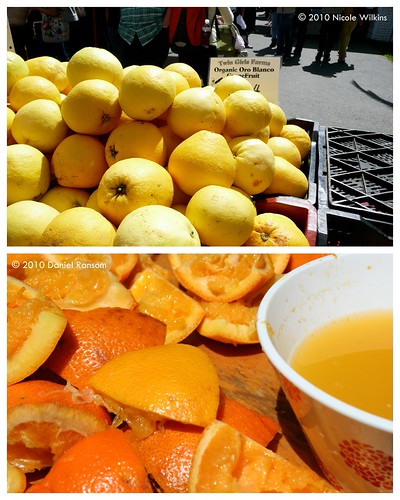
Sometimes, what’s interesting about diptych is how far apart our interpretations of a given word might be; this time, what’s interesting is just how close they are. Nicole and I are both thinking citrus, it seems. Coming soon are “urgent” and then “glee” next. Go here to see Miss Grace and Kellee’s versions of “Abundant” and “Urgent”.
Post-CARL Review, Pt. 1
I had a great time at the CARL Conference over April 8-10 in Sacramento. There was a lot to digest, in terms of insight and inspiration, and I’m hoping to distill at least a little bit of that wisdom here. There was a wide range of topics covered in the various presentations and speeches, but a couple subject areas jump out as being worthy of further discussion. My next couple posts on this blog will tackle these. First up: Library Instruction/Information Literacy.
About ten of the twenty-four official discussion sessions were focused on information literacy and instruction. Of these, I attended several, and came away with a lot of good ideas and an appreciation for the serious research going on in the subject right now.
Longitudinal Research
Three staff librarians from Cal State-Long Beach presented their ongoing, 6-year research endeavor to determine the effectiveness of their library instruction program. Their presentation, “Are They Getting It: Seeking Evidence of Students’ Research Behavior Over Time” described their grant-funded project from its inception to its current state, two years into the study.
I’m impressed with the depth of their research. They started by developing a large sample of freshman students with the intention of following them throughout their education. Their analysis of the students’ research skills extend to studying the students’ research paper bibliographies for source and citation quality. This sort of extensive, longitudinal study is difficult to implement and ties up a lot of staff time and resources, but the results - sure to be published - will be of use to universities and colleges throughout California and beyond (which is why CARL was the main grant-giving body behind the project). It’s easy to suppose how and why information literacy programs are successful or not; it’s another thing to really study what’s happening in a quantitative manner.
One interesting takeaway from their presentation was their use of a statistician to analyze the substantial data their surveys were generating. You can’t merely collect information - it needs to be analyzed in a meaningful way. Sometimes it is best to bring in an outside expert instead of relying on in-house staff. Their statistician was able to model their data in several dimensions and changed their whole perspective on the information they had gathered - and saved the time and energy of the librarians themselves.
The presenters - Susan Jackson, Karin Griffin and Carol Perruso, all of CSULB - also provided extensive survey details in the form of handouts, including a timeline, survey questions, and project budget. While the survey will run for several years yet, I’m looking forward to their eventual results and what it will teach us about what works and what doesn’t, and how research behavior is evolving.
Working With a Campus Assessment Coordinator
Another example of using outsider expertise came from the presentation “Upstairs-Downstairs: Working with a Campus Assessment Coordinator and Other Allies for Effective Information Literacy Assessment” by Golden Gate University librarians Amy Hofer and Margot Hanson. In this case, their outsider was really an insider: the existing GGU Campus Assessment Coordinator. Still, they were reaching outside the lines of library staff to work with someone with a campus-wide responsibility, and more importantly, an understanding of program assessment.
According to their presentation, the advice and administrative approval they got from their use of the Campus Assesment Coordinator was essential for the success of their program study, which involved the startup of a new, embedded library instruction program that moved away from “one shot” instructional sessions in favor of an ongoing, semester-long engagement with a class. Their Assessment Coordinator started by asking what a successful program actually looked like, who was the audience for their study, and suggesting the use of a control group to put the study’s findings in context. They also devised measures to test discernible improvement in actual information use, rather than relying on the students’ self-assessment of their own information literacy (in the form of traditional satisfaction surveys).
Hofer and Hanson narrowed their research by focusing on a specific segment of the GGU student body, a special program for foreign-born students developing their English-language research skills (the PLUS program). Golden Gate University has an unusually high level of international students due to its emphasis on graduate-level business programs and location in the heart of downtown San Francisco. They were able to measure student research skills based on written tests and an analysis of work performed at the beginning and at the end of the school term, and saw marked improvement in two of the three categories they measured (the hardest area to improve was the students’ choice of subject, which is a critical thinking skill that can extend beyond the library’s sphere of influence).
The Golden Gate University study was a well-orchestrated example of research that would be easier to implement than CSULB’s expensive, time-consuming longitudinal study that would still yield relevant institutional results. More information about this study, including some of the test questions and suggested further reading is available here.
The Post-Google World
The final presentation at the conference I attended was an informative workshop built around information literacy program curriculum, and improving lesson content by reverse engineering the process: start with the (desired) results, and work backwards to build your lesson plan. Korey Brunetti and Lori Townsend of CSU-East Bay were joined by Julian Prentice of Chabot College to lead this session (Let’s Try This Again: Redefining the Content of Information Literacy for a Post-Google World) that combined an initial group presentation with a workshop-style open discussion using Prezi to capture the assembled attendees’ ideas.
There were a few big concepts that emerged:
- Keep your goals simple - reduce, reduce, reduce superfluous objectives in favor of imparting a few key, simple ideas on your students.
- Emphasize critical thinking skills across mediums. Ultimately, the source of a citation doesn’t matter (open web vs. subscription database vs. government website etc.), it’s the quality and verifiability of that source.
- Understand how contemporary students work and integrate better tools and critical decision-making into their existing study patterns.
This sessions’ notes and final “Prezi” will appear in the forthcoming CARL Conference Digital Proceedings.
Take-Home Lessons
I found a number of take-home lessons in this focus on information literacy programs. Beyond the simple opportunity to see how different libraries and universities are pursuing information instruction, it was instructive to see the value of both long-term and short-term research for improving existing programs, jump starting expanded programs and ultimately - and perhaps most importantly - proving the library’s enduring value to campus administrations.
Through each of these sessions were also woven excellent ideas for instruction curriculum in the 21st century; how best to capture the students’ attention and impart meaningful lessons that will actually impact their research methods in a positive way.
My next post will cover some of the career-development issues discussed at the conference, including Dr. Peter Hernon’s plenary lecture.
