Digitizing Museums
There’s been a lot of talk in the bibliocentric world about the oncoming digitization of libraries, from Google’s ongoing endeavor to digitize “every” book (recently in the news due to the recent settlement of a major copyright lawsuit) to established libraries moving to an “all digital” format. However, another trend is interesting: the coming of the digital museum.
I admit I’m skeptical that either concept will replace their brick and mortar counterparts. While I think online resources, including digitized books, are a great boon to readers and researchers, and e-books, be they on a Kindle, an iPhone, or other device, will continue to gain market share, print will remain a key method for disseminating written materials. It remains at once both familiar and practical, and still the most accessible form of information given the exclusivity (ie, price) of most e-Readers.
But these emerging “digital museums” still provide a great value, in much the same way digital archives can - digitized materials can be safeguarded when their physical counterparts cannot. Google recently announced an endeavor to digitize the complete contents of the National Museum of Iraq, famously looted in 2003 after the fall of Baghdad. To date the National Museum - home to thousands of years of archeological treasures, spanning from the dawn of civilization - has not been reopened to the public, and most of its surviving collections remain in storage. Google’s digitizing will provide (hopefully high-resolution) imagery of this priceless collection, making it available to the world for free and reminding everyone that Iraq was and remains one of the great cradles of civilization, the birthplace of art, writing, and law.
Even more ambitious is the planned “Museum of Afghan Civilization” currently in design stages and set to debut in January, 2010. This is a digital museum built from the ground up, using a website to emulate a physical institution that does not exist - designed not by a graphic artist but in fact by an architect, France’s Yona Friedman. “Patrons” will enter the museum from a portal designed to replicate the ancient Buddhist statues of Bamiyan, destroyed by the Taliban in 2002, and navigate their way through “pavilions” thematically or chronologically arranged to display artifacts of Afghanistan’s influential history.
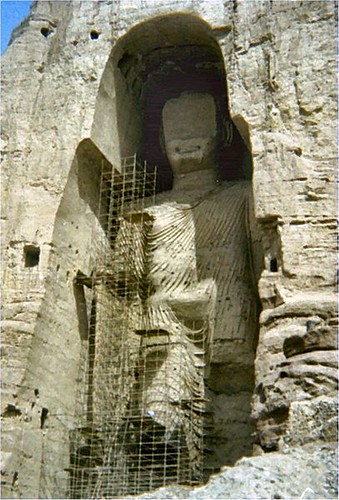
One of the two Buddha statues that inspired the “architecture” of the Museum of Afghan Civilization.
Traditional museums are likely in even less danger from digitization than libraries (no on-screen image can recreate the personal experience of viewing a fully dimensional artifact), but this is an interesting trend that will hopefully provide a wider audience for some of the world’s most forgotten treasures. And unlike physical museums that have to deal with ongoing issues of cultural ownership - Greece wants the Elgin Marbles back from the British Museum, for example, and the Getty got embroiled in an ownership dispute over Italian artifacts - digital museums can sidestep this issue.
And while we await the debut of the Museum of Afghan Civilization and Google’s version of the Iraqi National Museum, we can preview a digital museum through an Italian-created portal that covers a portion of the Iraqi National Museum’s collections: the Virtual Museum of Iraq. Take a look and let me know what you think. How well does this recreate a museum experience for you as a viewer? Does it engage and hold your interest?
e-Portfolio Complete
My academic e-Portfolio, representing my culminating experience with San José State University’s School of Library and Information Science, has been approved. I will graduate with a Master’s Degree in Library and Information Science this December. The complete project is available on this website, either by clicking on the e-Portfolio tab on the top right of this page, or through the navigation links on the left column.
With that project now complete, I will be able to resume blogging on a more frequent basis.
Feedback is most welcome. Thank you.
Banned Books Week
Born in 1982, the American Library Association’s “Banned Books Week” is an annual opportunity for libraries to focus on freedom of information, anti-censorship policies, and defense of a patron’s freedom to read. Rather than sitting back and defending library materials when under attack, the Banned Books Week event becomes an offensive tool, deployed by the ALA and by librarians across the country to emphasize the importance of literary freedom.
It’s a tactic that has drawn fire - the Wall Street Journal recently published a critical piece on the concept. In it, writer Mitchell Muncy criticizes the ALA for including legal challenges to books whether or not they successfully lead to the removal of a book in their banned book statistics. He states that 90% of book challenges do not lead to the permanent removal of the book in question, and therefore the low rate of successful challenges is evidence that an event like Banned Books Week is unnecessary and “overblown”.
In refutation: the fact that 90% of challenges fail is a credit to Banned Books Week and the substantial advocacy the librarian profession engages in. It is evidence that the event and the activism it represents is successful and should continue. I would also contest his assertion that censorship only exists when directed by the state:
“To examine in order to suppress or delete anything considered objectionable.” – Merriam-Webster Dictionary
The very definition of the word fails to mention government. It’s my understanding that censorship can come in many forms, not only from the state, but from community groups, teachers, individual parents, or neighborhood gadflys. Anytime pressure is applied to remove information (be it a book, film, or even the forced retraction of a public statement) in such a way that it would deny access to others, it veers into the dangerous territory of censorship.
Muncy’s too casual assumption that it’s only censorship if it’s driven by the state, and that the success of the ALA in defending controversial materials is somehow an argument against its continued activism are faulty premises.
Long live Banned Books Week. If nothing else, it’s a great chance to celebrate the controversial, confrontational, and vital books that change our world one reader at a time.
Living on the Fringe
There are three days left of the 2009 San Francisco Fringe Festival, an annual bacchanal of uncensored, unjuried short-form theater presented in an affordable, rotating environment. The San Francisco Fringe is just one outpost of a theater movement born in Edinburgh, Scotland with tendrils in many American and Canadian cities. The purpose is to provide professional stage space and an audience for individuals and theater companies that regularly lack either.
The first edition of the Edinburgh Festival Fringe ran in 1947, when companies left out of the Edinburgh International Festival staged their own celebration. The idea has both evolved and spread in the decades since, though the Edinburgh Festival Fringe remains not only the world’s largest Fringe Festival, it has in fact become one of the world’s largest annual performing arts festivals of any kind. The San Francisco Fringe is a more humble affair, but 18 years in, it provides one of the city’s most endearing and enduring theatrical spectacles (in the interest of full disclosure, I have been on the SF Fringe staff for seven years now).
The concept sounds simple, but the execution requires a hard working staff and a very large volunteer base: 40-50 hour-long productions are mounted, all with 4-6 performances in the space of 11 days across a half-dozen stages around the City. Eddy Street’s Exit Theater produces the festival, provides the central meeting place (the Exit Cafe, 156 Eddy), and three of the stages. The shows are short, staggered, and inexpensive, allowing audience members to “fringe” their way through multiple offerings in a night.
Companies enter a lottery (with separate drawings for local and traveling acts) and the winners are offered a shot in the festival, which comes with a stage, technical assistance, and performance slots. Each company has complete, uncensored freedom to produce any stage spectacle they want. Many of the performers are traveling solo acts, but some more ambitious companies take part - the then little-known Banana, Bag & Bodice gained notice with the shows Gulag Ha Ha and Sandwich at the San Francisco Fringe, and have since gone on to high-profile runs of their songplay Beowulf: A Thousand Years of Baggage at Berkeley’s Ashby Stage and in Manhattan (which brought about a feature in the New York Times).
My personal history with the Fringe goes back into my drama-class youth. When I was in high school I helped a family friend with his one-man show as his sole run crew; the following year I went “fringing” with a buddy and saw three shows. Two of them I liked, but the third I remember as the worst piece of theater I’ve ever seen: it was called “Water Closet” and tried to combine incest, neo-Nazism and bad plumbing into a family dramedy. It was dreck. But that is the risk of the Fringe: since any company can win a show slot, you never know what you will get unless you carefully peruse the reviews and chat up the volunteers. It can be easy to steer clear of the duds if you talk to a few people, but I didn’t know that yet in high school. I started working for the Festival a couple years out of college, hoping to keep involved in theater. In the years since, it has been the source of some of my closest friends and favorite memories. I have also seen some incredible theater in the process (taking in as many as 30+ shows in some seasons).
While this year’s festival is drawing towards a close, the final weekend is always the best - the biggest crowds, the most polished performances, and plenty of talk in the Exit Cafe about which are the best and most worthwhile shows. From what I’ve heard so far, Poste Restante, A (Bearded) Lady, and The Surprise are all top picks. The two shows I’m working on - Break-Upocalypse and Inside Private Lives - are both entertaining, funny romps. Come out to the Exit Theater this weekend, fringe your way through 2-3 performances, and have a memorable experience.
First Impressions: The Buried Book
Is it possible to review a book you haven’t even finished yet? I’m not yet halfway through The Buried Book: The Loss and Rediscovery of the Great Epic of Gilgamesh and it’s already among my favorite non-fiction works. Written by David Damrosch, an English professor at Columbia, it is a fascinating account, moving backwards through time, of the discovery and translation of The Epic of Gilgamesh, widely regarded at the world’s oldest known legend.
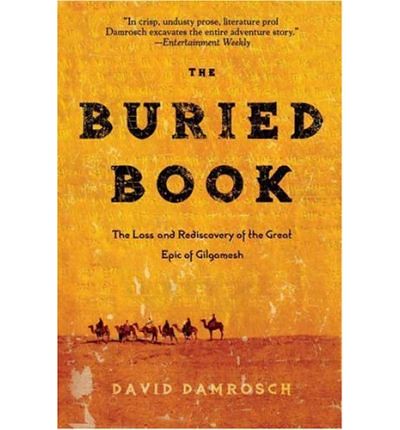
The Gilgamesh myth itself is something I’ve long been attracted to; I first read the Penguin Classics edition as a college freshman and more recently enjoyed the far more poetic (but less literally translated) version by Stephen Mitchell. My interest in Mesopotamia and Assyria extends much further back than my exposure to Gilgamesh, however. As a boy I was riveted by historical accounts of the Sumerian City-States and their successor empires, and I even named a cat Ashurbanipal for Assyria’s greatest King (and early library benefactor).
Thus, I was the perfect “demographic” for Damrosch’s account. But I believe this work could appeal to almost anyone. In describing the sometimes foolhardy efforts of the 19th century British adventurer George Smith, the Iraq-born archeologist Hormuzd Rassam, and the swaggering soldier Sir Henry Rawlinson, Damrosch captures the essence of an important Golden Era of Archeology, reviving names forgotten to all but the experts and revealing their fascinating lives. Each of those men, and others profiled in the book, had important, key achievements in unearthing Mesopotamia’s vital past. Each explorer also had significant faults, in either their attitude or their methodology, but Damrosch addresses these and provides a balanced account that avoids hagiography.
As a student of archival practice and research, the work also serves as an interesting window into my professional world: asides from Damrosch describe his own process of research, such as his exploration into the archives of the British Library.
I’ll continue reading The Buried Book, especially as it promises a literary analysis of the Gilgamesh myth in its later chapters. I’ll report back with my final thoughts.
The Fiske is In
This post originally appeared in “From the Stacks”, the California Academy of Sciences Library Blog. I am interning at the Academy Library this summer and fall and wrote this post after doing some investigative work about two uncatalogued photo prints in their collection. Click here to read the post in its original location, with images of the two photos intact.
~~~
A fascinating aspect of archival work is the story that unfolds when you try and unravel the mysteries of uncatalogued items from the back of the vault. While evaluating a collection of oversized archival items in the Academy’s collection, I came across a pair of large prints of Yosemite photographs - a meandering river under an impressive dome, and a bearded gentleman, in front of an impressive Sequoia. Both photographs were uncatalogued but attributed to a “John Fiske” in little notes on their reverse side. The attributing notes were written in 1919 by the California School of Arts and Crafts, the original owner of the prints. The veracity of the notes was immediately in doubt: archives assistant Christina Fidler immediately recognized that the first photo, described in the note as “South Dome”, was in fact a photo of Yosemite’s North Dome (Yosemite doesn’t even contain a “South Dome”). The notes also named the bearded figure as early Yosemite Guardian Galen Clark, which if true would improve the value and importance of the photograph.
As the Academy had no other archival items relating to a John Fiske, I did a little research about the photographer before entering the prints into the catalog. Unfortunately, I couldn’t find any source material about a photographer named John Fiske. However, there was a prominent early Yosemite photographer named George Fiske (b. 1835, d. 1918). In fact, George Fiske was the first year-round photographer-in-residence of Yosemite Valley, whose winter photographs are rightly prized for their beauty and enduring value (intuitive readers will take note of the surname-only signature on that linked photo sourced from the Bancroft Library’s collection, and its similarity to the signature on the Sequoia photo below…if I had noticed that earlier, I would have saved myself a bit of work!).
This Fiske was a fascinating figure: long before Ansel Adams, he made a living off his photographs of the Valley and the mountains beyond. He’d use mules to take his elaborate camera gear up long arduous trails, and if it was too rough for even his mules, he pulled his gear in a handcart that he nicknamed his “Cloud-chasing Chariot”.
Sadly, George Fiske’s influence as a photographer has waned due to two tragedies: the fiery destruction of his home and laboratory in 1904 that burnt three-quarters of his negatives and prints, and the 1943 fire that burned down Yosemite Valley’s Sawmill (his remaining negatives were stored in the attic). Despite this, Ansel Adams regarded George Fiske as one of his foremost influences.
It seemed likely that George Fiske was the actual photographer behind our two prints. I set about doing a little more sleuthing: without confirmation that George Fiske took these photographs it would be hard to overrule the evidence on the back of the prints for the catalog. The breakthrough moment came from reading Fiske’s heading under Pioneer Photographers of the Far West, available online via Google Books. I discovered that he was a stalwart friend of Galen Clark and that Clark utilized Fiske’s photographs in a number of his own books. Low and behold, three of Clark’s books are in the Academy’s own library collection, including Big Trees of California - a treatise about Sequoias. I hoped that the second print, with the Sequoia and a man who was possibly Galen Clark, would be in that book. I dug our copy out of the stacks.
Bingo! The exact photo was on pg. 87, a full page print. In fact, the book gave us much more detail about the photo than we originally had; not only does it confirm that the figure is in fact Galen Clark, it also explains that the tree in the photograph is the famous “Grizzly Giant” in the Mariposa Grove. Clark calls the tree “the acknowledged patriarch of the Mariposa Grove”, that “has a unique individuality of majestic grandeur all its own, different from any known Sequoia”. Clark claims that the Grizzly Giant is at least six thousand years old, and probably the oldest living thing on Earth (his enthusiasm was slightly misplaced - modern experts name the Grizzly Giant to be “only” 2,700 years old. Still, it remains the largest tree in Yosemite, and one of the five largest on Earth).
There’s only one catch. Clark’s book only credits the photograph to “Fiske”, no first name or initial. So can we know for certain that the photo was taken by Clark’s friend George Fiske, and not a mysterious unknown named John? The only California connection to a John Fiske, and perhaps the source of the 1919 name-mixup, is a Fiske Peak in the Sierra Nevada range named for a philosopher and historian named John Fiske. Perhaps the person who wrote the notes only knew of this John Fiske, and never heard of George?
Final confirmation was back in Pioneer Photographers of the Far West. It states that George Fiske’s photographs “graced two of Clark’s books, The Big Trees of California (1907) and The Yosemite Valley (1910)”. With the print in hand matching the print in the book, and the back-up evidence of the matching handwritten signature in the Bancroft’s George Fiske collection, we know for certain that our two photographs are definitively by George Fiske, not a John.
Archiving can lead to a fun and fascinating tour of our pioneering past. In attempting to catalog a couple unheralded items in our collection, I’ve discovered and learned about a fascinating character who played an important role in chronicling California’s geologic grandeur and helped popularize Yosemite Valley, one of our most famous natural wonders. Today, George Fiske is buried right beside Galen Clark in Yosemite’s Pioneer Cemetery, a fitting resting place for one of Clark’s closest confidants and for Ansel Adams’ spiritual predecessor.
Losing Control of the Wheel
I recently read about the dismantling of the Engineering Library at the Chrysler Technical Center. Stories like that are always sad; what is lost can never be recovered or rebuilt. With the advancements in digital archiving and paperless storage, archives need never be destroyed; even if a company like Chrysler, or its ownership group, blanches at the cost of maintaining a library, historic documents can almost always find a home at a museum or research institution. Was the University of Michigan even contacted before the library was shuttered and its archives given out in piecemeal?
Technology has changed the game for archivists. The destruction of Ashurbanipal’s Library at Nineveh was inevitable with the changing tides of Empire. Locals were still pilfering the stones of Ashurbanipal’s palace thousands of years later when assyriologist and adventurer George Smith arrived to extract the clay cuneiform tablets that make up the majority of our knowledge of the ancient Assyrians. The fiery demise of the Great Library of Alexandria was also inevitable in an age when urban fires were a daily reality in the overcrowded cities of Antiquity. But we live in a different era: the only threat to the record of our past is our own negligence. The cost of preserving that library - or finding a research institution to donate it to, without dismantling the collection - is a pittance compared to the factory costs and other overhead at a corporation like Chrysler.
The history of the automobile is one of the vital stories of American history. While I’ve never been a car aficionado (I’m more seduced by the click and hum of a freewheel and gears - the quiet grace of the bicycle - than by the cough and sputter of the internal combustion engine), you can’t look at the 20th century without an appreciation of the automobile’s influence. It has irrevocably changed and suburbanized American culture and had a powerful jump-start effect on the mid-century American economy (both in the twenties and fifties). To lose documentation of those eras is to lose control of the wheel.
You can never look forward if you can’t look behind. Hopefully Chrysler’s remaining archives, and the comparable archives at General Motors, will be preserved.
Thanks to KB for the tip.
