Category: Photography
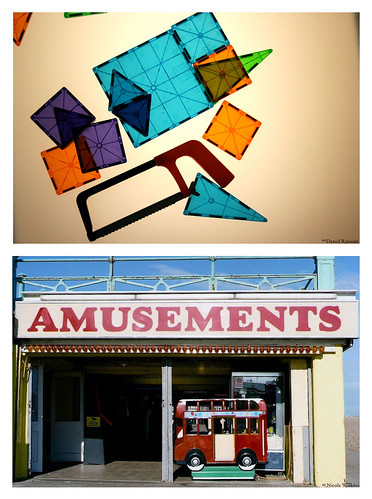
Diptych: Play
Unfortunately the posting of last Wednesday’s “Diptych” was delayed due to some interminable computer hardware issues. But! Here it is in all of its playful(?) glory, thanks to some timely help from my partner in photography @uncola. Enjoy, and peruse other offerings on the subject via Miss Grace.
Hopefully our next offering, on the subject of “Fresh”, will be freshly posted this Wednesday.
Diptych: Water
Diptych:
1. Anything folded, so as to have two leaves; esp. a two-leaved, hinged tablet of metal, ivory or wood, having its inner surfaces covered with wax, used by the ancients for writing with the stylus.
b. spec. (in pl.) Applied to the artistically wrought tablets distributed by the consuls, etc. of the later Empire to commemorate their tenure of office; hence transferred to a list of magistrates.
2. Eccl. (in pl.) Tablets on which were recorded the names of those of the orthodox, living and dead, who were commemorated by the early Church at the celebration of the eucharist. Hence, The list or register of such names; the intercessions in the course of which the names were introduced.
3. An altar-piece or other painting composed of two leaves which close like a book.
–Oxford English Dictionary
In art and photography, the diptych is the juxtaposition of two images or works together, by the same artist, with the hope that one illuminates the other (the triptych is the same concept rendered in threes). Photographers and bloggers Kellee Pigeon and Miss Grace have created a weekly challenge in which they collaborate on the creation of a photographic diptych. Each takes one photo independent of the other but on the the same general theme - light one week, paper another…once it was green. They then post the images paired together on each of their blogs. The original project description can be found on the blog Not So Small Things.
They have invited other bloggers to follow suit, and I am happy to say that @uncola - photographer, archivist, and author of .intense.drama - has agreed to partner with me.
Our first subject is water. Her image is the second one.
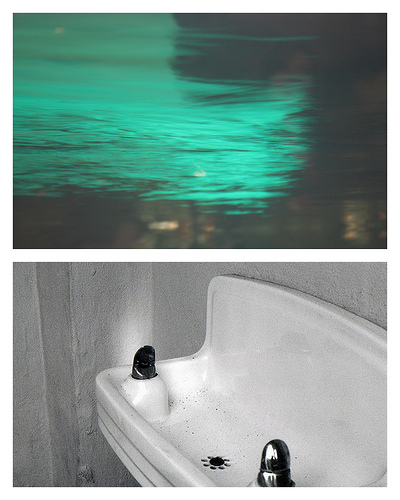
Be sure to visit Miss Grace’s Disgrace to see their take on the same concept, and find links to other bloggers taking part in the challenge.
School of Fish
I got a Flip camera for Christmas. On Monday, my wife and I visited the Monterey Bay Aquarium. Naturally, I couldn’t resist recording a school of fish from the Aquarium’s Outer Bay Tank:
School of Fish from Daniel Ransom on Vimeo.
I also used this as an opportunity to play with Vimeo, a higher-brow alternative to YouTube. I could sign-in via my Facebook account (it’s nice not having to sing up for another online service) and the content is limited to user-created videos. It functions much more like a social-networking site than the barebones (and crude comment riddled) environment of YouTube. So far I’m a fan.
The Fiske is In
This post originally appeared in “From the Stacks”, the California Academy of Sciences Library Blog. I am interning at the Academy Library this summer and fall and wrote this post after doing some investigative work about two uncatalogued photo prints in their collection. Click here to read the post in its original location, with images of the two photos intact.
~~~
A fascinating aspect of archival work is the story that unfolds when you try and unravel the mysteries of uncatalogued items from the back of the vault. While evaluating a collection of oversized archival items in the Academy’s collection, I came across a pair of large prints of Yosemite photographs - a meandering river under an impressive dome, and a bearded gentleman, in front of an impressive Sequoia. Both photographs were uncatalogued but attributed to a “John Fiske” in little notes on their reverse side. The attributing notes were written in 1919 by the California School of Arts and Crafts, the original owner of the prints. The veracity of the notes was immediately in doubt: archives assistant Christina Fidler immediately recognized that the first photo, described in the note as “South Dome”, was in fact a photo of Yosemite’s North Dome (Yosemite doesn’t even contain a “South Dome”). The notes also named the bearded figure as early Yosemite Guardian Galen Clark, which if true would improve the value and importance of the photograph.
As the Academy had no other archival items relating to a John Fiske, I did a little research about the photographer before entering the prints into the catalog. Unfortunately, I couldn’t find any source material about a photographer named John Fiske. However, there was a prominent early Yosemite photographer named George Fiske (b. 1835, d. 1918). In fact, George Fiske was the first year-round photographer-in-residence of Yosemite Valley, whose winter photographs are rightly prized for their beauty and enduring value (intuitive readers will take note of the surname-only signature on that linked photo sourced from the Bancroft Library’s collection, and its similarity to the signature on the Sequoia photo below…if I had noticed that earlier, I would have saved myself a bit of work!).
This Fiske was a fascinating figure: long before Ansel Adams, he made a living off his photographs of the Valley and the mountains beyond. He’d use mules to take his elaborate camera gear up long arduous trails, and if it was too rough for even his mules, he pulled his gear in a handcart that he nicknamed his “Cloud-chasing Chariot”.
Sadly, George Fiske’s influence as a photographer has waned due to two tragedies: the fiery destruction of his home and laboratory in 1904 that burnt three-quarters of his negatives and prints, and the 1943 fire that burned down Yosemite Valley’s Sawmill (his remaining negatives were stored in the attic). Despite this, Ansel Adams regarded George Fiske as one of his foremost influences.
It seemed likely that George Fiske was the actual photographer behind our two prints. I set about doing a little more sleuthing: without confirmation that George Fiske took these photographs it would be hard to overrule the evidence on the back of the prints for the catalog. The breakthrough moment came from reading Fiske’s heading under Pioneer Photographers of the Far West, available online via Google Books. I discovered that he was a stalwart friend of Galen Clark and that Clark utilized Fiske’s photographs in a number of his own books. Low and behold, three of Clark’s books are in the Academy’s own library collection, including Big Trees of California - a treatise about Sequoias. I hoped that the second print, with the Sequoia and a man who was possibly Galen Clark, would be in that book. I dug our copy out of the stacks.
Bingo! The exact photo was on pg. 87, a full page print. In fact, the book gave us much more detail about the photo than we originally had; not only does it confirm that the figure is in fact Galen Clark, it also explains that the tree in the photograph is the famous “Grizzly Giant” in the Mariposa Grove. Clark calls the tree “the acknowledged patriarch of the Mariposa Grove”, that “has a unique individuality of majestic grandeur all its own, different from any known Sequoia”. Clark claims that the Grizzly Giant is at least six thousand years old, and probably the oldest living thing on Earth (his enthusiasm was slightly misplaced - modern experts name the Grizzly Giant to be “only” 2,700 years old. Still, it remains the largest tree in Yosemite, and one of the five largest on Earth).
There’s only one catch. Clark’s book only credits the photograph to “Fiske”, no first name or initial. So can we know for certain that the photo was taken by Clark’s friend George Fiske, and not a mysterious unknown named John? The only California connection to a John Fiske, and perhaps the source of the 1919 name-mixup, is a Fiske Peak in the Sierra Nevada range named for a philosopher and historian named John Fiske. Perhaps the person who wrote the notes only knew of this John Fiske, and never heard of George?
Final confirmation was back in Pioneer Photographers of the Far West. It states that George Fiske’s photographs “graced two of Clark’s books, The Big Trees of California (1907) and The Yosemite Valley (1910)”. With the print in hand matching the print in the book, and the back-up evidence of the matching handwritten signature in the Bancroft’s George Fiske collection, we know for certain that our two photographs are definitively by George Fiske, not a John.
Archiving can lead to a fun and fascinating tour of our pioneering past. In attempting to catalog a couple unheralded items in our collection, I’ve discovered and learned about a fascinating character who played an important role in chronicling California’s geologic grandeur and helped popularize Yosemite Valley, one of our most famous natural wonders. Today, George Fiske is buried right beside Galen Clark in Yosemite’s Pioneer Cemetery, a fitting resting place for one of Clark’s closest confidants and for Ansel Adams’ spiritual predecessor.
A Reading Room
While this blog will largely be devoted to technology, it is always worthwhile to look at the past: there is both beauty and wisdom in the old ideas of our great institutions.
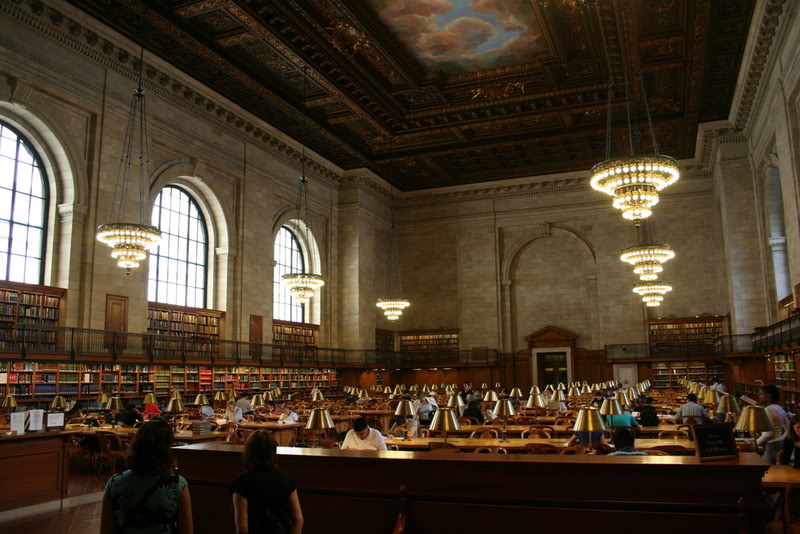
One of my favorite aspects of historic libraries is the grand, classical reading room with its soaring ceilings and walls clad in books. Few modern libraries have a public space so monumental, and so wholly devoted to quiet scholarship. The reader is impressed by his or her surroundings; it elevates their condition. I took this picture in the reading room of the New York Public Library:
Locally, I recommend the Doe Library’s Reference Reading Room, on the campus of the University of California, Berkeley, for similar grandeur. Would you nominate any other grand spaces?
