Category: Musings
Inspecting the Frame: The Draft Information Literacy Framework, Pt. 1
I came out as a supporter of the ACRL’s Framework for Information Literacy in Higher Education’s central and somewhat controversial tenet - threshold concepts - earlier this fall. I promised “more on this soon,” but as is often the case, the fall academic semester was too busy a time for me to write down and publish my thoughts. But Friday, December 12 is the deadline for public comments on the third draft, which has prompted me to reflect more deeply on the Framework.

Threshold Concept Theory
I acknowledge that many of my peers, whose opinions I respect, are concerned about the foundation of threshold concept theory. Threshold concepts are “those ideas in any discipline that are passageways or portals to enlarged understanding or ways of thinking and practicing within that discipline” (ACRL, 2014). According to educational theorists Jan Meyer and Ray Land, threshold concepts exhibit four characteristics within their disciplines: they are transformative, changing the perspective of the learner; integrative, connecting different aspects of the discipline to each other; irreversible, once learned, never unlearned (much like riding a bike); and troublesome, sometimes difficult to grasp for discipline outsiders or the cause of reflection (Meyer, Land, & Baillie, 2008).
I have seen concerns about university faculty responses to the theory of threshold concepts, and the difficulty librarians may have in explaining it. In response I have a suggestion. When presenting these ideas to faculty, use the threshold concepts that have been identified for their own disciplines as examples and analogies for the information literacy threshold concepts identified by ACRL. These examples will resonate much more strongly with their own experience as teachers and learners. There has been substantial research into threshold concepts for a wide range of academic disciplines, both by Meyer and Land themselves, and by other educational theorists exploring the idea. Merinda Kaye Hensley referred me to a useful bibliography that will guide you to many of them.
Connecting the Dots
Part of my growing enthusiasm for the new framework derives from connecting the dots between the identified threshold concepts and the work we already do at my institution. Over the past couple of years my colleague Nicole Branch and I developed a curriculum map for our undergraduate information literacy instruction based on the ACRL Standards. We provide a series of scaffolded one-shot workshops integrated into our university curriculum at different levels in the hopes that students will have the information skills they need at each point in their education.
Shifting the Conversation
However, even if you are a threshold concept skeptic, I suggest the debate about their scientific validity is a distraction from what we should really be focusing on: the content of the frames themselves. How well do they represent the academic discipline of information literacy? If these six frames can successfully inform our practice as educators, whether or not they genuinely represent this wider notion of “threshold concepts” (and whether the theory of threshold concepts itself is valid) is not entirely relevant. We’ve been making do with the existing information literacy standards published in 2000, and I certainly don’t believe that those static, binary descriptors (“the information literate student is…”) are reflective of the students we work with or their learning needs. The Framework is a far more flexible document that comes much closer to capturing the complex and evolving world of information and scholarly communications, whatever you think of threshold concepts as an educational theory.
Climbing off the fence: Threshold concepts for information literacy
I’ve done a lot of fence sitting in my comments about the new framework for information literacy instruction and its central tenet, the threshold concepts for information literacy. That was in part because I was still digesting the new ideas, and in part because some librarians I really respect had strong (and divergent) opinions, and I wasn’t sure yet where I fell.

“Lions-Gate-Mycenae” by Andreas Trepte. Licensed under CC BY-SA 2.5 via Wikimedia Commons.
But I’ve had some time for reflection, I’ve had time to incorporate aspects of the new framework into my practice, and I was able to immerse myself in the ideas behind the new framework while preparing my talk at the Kentucky Library Association.
I do have some concerns about language used in the new framework. I think some of the definitions of the threshold concepts are troublesome and need continued work (I’m looking at you, information has value), while others aren’t quite intuitive as written. I’m still not sure why “metaliteracy” needs to be included at all. I’m also curious how we can create continuity with the ACRL Standards from 2000, and how we’ll get faculty to buy into new ideas that are more challenging to explain.
But. I’m climbing off the fence.
I like the new framework. I especially like the threshold concepts as a pivot point for library instruction. Telling students where to click in the database is not teaching them how to effectively use information, and the new framework pushes us to be better, more engaged instructors. The research that backs it up resonates with me and my personal, professional experience. I think it moves us forward. I’m on board. More on this soon.
Further reading:
- Threshold concepts and information literacy | Brunetti, Hofer, Lu, & Townsend
- Framework for information literacy and higher education | ACRL
- Teaching the new information literacy framework | Fieldnotes from the library
Continue reading Climbing off the fence: Threshold concepts for information literacy »
Blazed Pathways and Skillful Glancing: Bibliography
References for my presentation Blazed Pathways and Skillful Glancing are below, organized topically.
Early Librarians on College Instruction
Adams, H. A. (1887, November). Seminary libraries and university extension. Johns Hopkins University Studies in Historical and Political Science 5. 443-459.
Baker, G. H. (1897, October). Conference of librarians, Philadelphia: The college section of the ALA. Library Journal 22. 168.
Davis, T. K. (1885, May). The college library. Library Journal 10. 100-103.
Little, G. T. (1892, August). Teaching bibliography to college students. Library Journal 17. 87-88.
Lowrey, C. E. (1894, August). The university library, its larger recognition in higher education. Library Journal 19. 264-267.
Morgan, J. H. (1893). College libraries: How best made available for college uses? Proceedings of the Fourth Annual Convention of the College Association of the Middle States and Maryland. New York, NY: Columbia College Educational Review.
Robinson, O. H. (1876). College library administration. In Bureau of Education’s (Ed.) Public Libraries in the United States of America.Washington, D.C.: USGPO.
Robinson, O. H. (1880). College libraries as aids to instruction: Rochester University Library – administration and use. Circulars of Information of the Bureau of Education; No. 1-1880. Washington, D.C.: USGPO.
Robinson, O. H. (1881, April). The relation of libraries to college work. Library Journal 6. 97-104.
Winsor, J. (1880). College libraries as aids to instruction: The college library. Circulars of Information of the Bureau of Education; No. 1-1880. Washington, D.C.: USGPO.
Winsor, J. (1894, November). The development of the library. Library Journal 19. 370-375.
History of Library Instruction
ACRL. (2000). Information literacy standards for higher education. Retrieved from http://www.ala.org/acrl/standards/informationliteracycompetency
Threshold Concepts
ACRL. (2014). Framework for information literacy for higher education [2nd draft]. Retrieved from http://acrl.ala.org/ilstandards/wp-content/uploads/2014/02/Framework-for-IL-for-HE-Draft-2.pdf
Brunetti, K., Hofer, A. R., Lu, S., & Townsend, L. (2014). Threshold concepts & information literacy. Retrieved from http://www.ilthresholdconcepts.com/
Meyer, J., Land, R., & Baillie, C. (2009). Threshold concepts and transformational learning. Rotterdam: Sense Publishers.
Townsend, L., Brunetti, K., & Hofer, A. R. (2011). Threshold concepts and information literacy. portal: Libraries and the Academy, 11(3), 853-869.
Wilkerson, L. (2014). The problem with threshold concepts. Retrieved from https://senseandreference.wordpress.com/2014/06/19/the-problem-with-threshold-concepts/
Continue reading Blazed Pathways and Skillful Glancing: Bibliography »
Emerging projects: My experience as an ALA Emerging Leader
Several people, perhaps considering their own 2015 applications, asked me about my experience as a 2014 American Library Association (ALA) Emerging Leader and how I felt the program helped me develop my leadership skills.
This prompted a bit of reflection on my part. I’d say that the line between the Emerging Leaders program and leadership training is actually an indirect one – but that’s a good thing.
There are other opportunities ALA provides – such as the ALA Leadership Institute – more directly focused on traditional leadership training, if that’s what you are interested in. The structure of Emerging Leaders is more in line with another subject I was interested in this year: project management.
Project Management
[A project is] a temporary group activity designed to produce a unique product, service or result. A project is temporary in that it has a defined beginning and end in time, and therefore defined scope and resources. And a project is unique in that it is not a routine operation, but a specific set of operations designed to accomplish a singular goal. So a project team often includes people who don’t usually work together – sometimes from different organizations and across multiple geographies.
My 2014-2015 professional development goals at my place of work included gaining project management skills. My official vehicle for achieving that goal was attending a wonderful CARL preconference session led by California academic librarians Margot Hanson, Annis Lee Adams, Andrew Tweet, and Kevin Pischke. But the convergence of the preconference session and Emerging Leaders was perfect, as the experiences complimented and built on each other. Emerging Leaders gave me the practical opportunity to work on a project team and implement the concepts I learned at the preconference.
Emerging Leaders is structured as a team-based project that checks off all of the definitions of project management: a temporary group activity, designed to produce a product or service, with a defined beginning and end, and a defined scope and resources. Various divisions and roundtables of ALA propose projects. Four-to-six member teams of Emerging Leaders are assembled around those projects and given a discrete deadline (a poster session at ALA Annual) when they reveal their final products.
I was part of Emerging Leaders “Team C,” along with the wonderful Mari Martínez, Annie Pho, and Kyle Denlinger. We were asked by ALCTS, the ALA division for library collections and technical services, to deliver a white paper on social media practices with recommendations for how they can improve their outreach to early-career professionals. Beyond that straightforward request, we could develop the project as we saw fit.
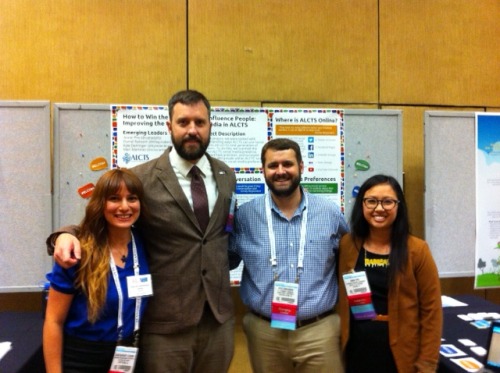
Team C(at) with our project poster. Here we are later with our hair down.
We dealt with several moving parts: we had to investigate social media best practices for professional organizations, analyze how ALCTS is currently using social media, discover how ALCTS members and potential members would like to interact (or not) with ALCTS online, and put everything we learned into a cohesive “white paper” (we actually developed a website) that ALCTS leaders could refer to. The camaraderie we developed kept us accountable to each other, despite not having a traditional “leader” or supervisor. The four of us lived in different areas of the country, and would not actually be in the same room between Midwinter and Annual, making coordination crucial. It made for a perfect little capsule – it was petri dish project management. We had fun and put out a product we believed in.
Emerging Project Managers
I opened with the suggestion that the line between Emerging Leaders and leadership training was indirect, as there is not a special focus on the skills of individual leadership, or advancing into management roles in our professional careers. But I do think project management skills are very applicable to a different kind of leadership needed in our workplaces.
Our work as librarians invariably involves team-oriented, discrete projects: implementing a new service, redesigning a library website, and so on. We often will work on teams with no designated “leader.” To be able to work as a team, with a cohesive plan, without creating unnecessary workplace friction, is a valuable and necessary trait for librarians, and applying the principles of project management can be the key to success. That is the type of leadership we need as a profession moving forward.
I still wouldn’t suggest renaming the program “the ALA Emerging Project Managers.” Emerging Leaders has a better ring to it. And also a ring of truth.
Further reading:
Continue reading Emerging projects: My experience as an ALA Emerging Leader »
Quotes on the internet: Frederick Douglass and Repairing Broken Men
This afternoon a student approach me at the Research Help desk. She wanted to cite the following quote by Frederick Douglass:
It is easier to build strong children than to repair broken men.
Noble sentiment, yes? And the internet is quite certain that he said it. Sites like Brainy Quote, Goodreads and others trumpet this quote. Blog posts refer to it. Nicholas Kristof, writing for the New York Times, attributes this quote to Douglass. It’s on bumper stickers. Even Christian evangelicals have quoted it, to further their own purposes.
But none of them mentioned where Frederick Douglass actually said this. One blog post referenced 1855, but included nothing else.
All of Douglass’s books are in the public domain, so I ventured to Project Gutenberg. Each of his published works can be opened as an HTML document and searched.
It turns out Frederick Douglass frequently uses the word “broken” - it appears 35 times in My Bondage and My Freedom alone. One line in particular, about the violence done to him as an enslaved child, was reminiscent of the famous quote:
Here is the entire passage in which that quote - a verifiably real quote - appears. It’s lengthy, but it’s worth understanding the quote in context:
The mistress of the house was a model of affection and tenderness. Her fervent piety and watchful uprightness made it impossible to see her without thinking and feeling - ”that woman is a Christian.” There was no sorrow nor suffering for which she had not a tear, and there was no innocent joy for which she did not a smile. She had bread for the hungry, clothes for the naked, and comfort for every mourner that came within her reach. Slavery soon proved its ability to divest her of these excellent qualities, and her home of its early happiness. Conscience cannot stand much violence. Once thoroughly broken down, who is he that can repair the damage? It may be broken toward the slave, on Sunday, and toward the master on Monday. It cannot endure such shocks. It must stand entire, or it does not stand at all. If my condition waxed bad, that of the family waxed not better. The first step, in the wrong direction, was the violence done to nature and to conscience, in arresting the benevolence that would have enlightened my young mind. In ceasing to instruct me, she must begin to justify herself to herself; and, once consenting to take sides in such a debate, she was riveted to her position. One needs very little knowledge of moral philosophy, to see where my mistress now landed. She finally became even more violent in her opposition to my learning to read, than was her husband himself. She was not satisfied with simply doing as well as her husband had commanded her, but seemed resolved to better his instruction. Nothing appeared to make my poor mistress - after her turning toward the downward path - more angry, than seeing me, seated in some nook or corner, quietly reading a book or a newspaper. I have had her rush at me, with the utmost fury, and snatch from my hand such newspaper or book, with something of the wrath and consternation which a traitor might be supposed to feel on being discovered in a plot by some dangerous spy.
Frederick Douglass, My Bondage and My Freedom, paragraph 120 | Project Gutenberg
This book was published in 1855, the same year mentioned by the blogger.
Nowhere in his published works does the popular internet quote appear. It is certainly possible it was uttered in a speech, the contents of which were published elsewhere - in a news story of the day, or by a biographer whose work I didn’t find. There’s a series of books from Yale University Press that include his private correspondence and the text of some of his speeches, content not published elsewhere. Perhaps the quote is in there - although I doubt a quote buried in an expensive series of academic texts has become an internet meme.
I think it’s more likely that what Frederick Douglass really said has been whitewashed.
Historical Whitewashing
It’s possible the passage in My Bondage and My Freedom has been paraphrased so often over the years that this popular quote about raising children right has replaced the truth about the violent treatment Douglass received as a child, and how the evils of slavery could break not only the spirits of people who were enslaved but also the souls of the white men and women who felt justified in enslaving others.
Racism and white privilege work in insidious ways. The dark, ugly truth of our white supremacist history can be transformed into positive affirmations, affirmations that then appear unquestioned online, on car bumpers, and in the New York Times.
I can’t prove that the popular quote isn’t real, and I can’t prove that it was the passage in My Bondage and My Freedom that inspired it. But that’s what I suspect.
And what did I tell the student? She wasn’t writing a historical analysis of Frederick Douglass, she was writing a psychology paper. The quote - whether real or false - set up her thesis nicely. I didn’t want to disrupt her process on the day her paper was due. So I advised that she refer to the quote as “widely attributed to” Frederick Douglass, and at least cite the Kristof article rather than Brainy Quote.
But then we also had a good conversation about historical truth (while I helped her clean up her references page - we were multitasking!). This type of work with students - digging into how information is presented, how to present information, understanding context, and closing in on the truth (however that may be defined) - this is what I like about being a librarian.
Many thanks to my fellow librarians who helped me in my quest to verify the quote - @cclibchica, @CarliSpina, @mchris4duke, and @sehovde.
A slightly shorter version of this post was originally published on tumblr.
Continue reading Quotes on the internet: Frederick Douglass and Repairing Broken Men »
My year as a school library volunteer
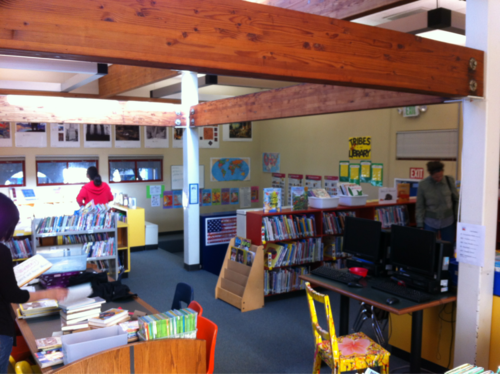
I’ve spent the academic year volunteering in a public elementary school library. My weekly shifts coincided with a regular 4th grade class visit. My last shift of this academic year wrapped up this morning.
A few things I learned:
- Calvin & Hobbes is still incredibly popular, even though Bill Watterson retired almost a decade before these kids were born.
- 4th graders love graphic novels, especially Bone.
- The vast majority of our circulation came from books in bins organized by series, and very little from off of the shelves. Easier to find, easier to grab, easier to beat the other kids to what you want.
- It’s awkward being addressed as Mr. when you’re not used to it.
- 4th grade boys will hit each other over a book.
- Kids do a lot more reading than stereotypes suggest.
- The school librarian teaches an amazing variety of things. I saw her teach using computers for research, understanding literary genres, fun poetry techniques, understanding protagonist point of view, and using reference works for research. Oh, and computer coding.
- The school librarian is also a fabulous reader of stories and great at reader’s advisory for a six-year range of children and reading levels.
- She’s also the point person for getting the students up to speed on the interface of the new, computer-based standardized tests that will be implemented next year as part of Common Core (and directly affect school funding). I wonder what schools without school librarians will do.
- I am very grateful San Francisco voters passed a bond measure funding school librarians in every public school.
- These kids will be more ready for college because of what they are learning right now as nine year olds from their school librarian.
I had fun working with the kids. And I learned a lot from the school librarian.
Midwinter’s night dream: My plan for ALA Midwinter 2014
Updated Jan. 22, 4:30 PST
I’m heading to the American Library Association’s Midwinter Conference 2014. I’ve been to two ALA Annual Conferences, but never to the Midwinter edition. This conference is largely focused on committee work, and less on public presentations, but I have been combing the scheduler to find the most interesting (to me) action going on. Here’s my plan.
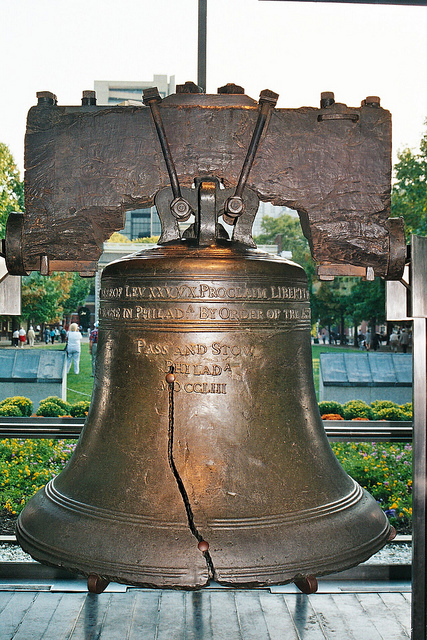
Philadelphia’s Liberty Bell, courtesy Flickr user Lee Bennett
Thursday, January 23
I’ll get to Philly on Thursday afternoon, with time to check-in to the Holiday Inn and head directly to the ALATT’s “Council Meeting” at a local establishment called the Tattooed Mom. It’s open to everyone and many of the 2014 Emerging Leaders are planning to meet up there. You’ll find it on this handy map, along with all the other socials and conference hotels.
Friday, January 24
Why would I head to Philadelphia in the depth of winter, in the midst of a polar vortex? I’m a part of the 2014 edition of ALA’s Emerging Leaders program. I’m in “Team C.” Our task is to deliver a plan to ALCTS to amplify their social media outreach. Consequently, my first full day of the conference, Friday, will be taken up with Emerging Leaders activities: meeting from 8:15 to 4:00pm, followed by a Presidential Reception for this year’s class from 4-5:30pm, and a 7:00 social for EL participants and alums at the Field House. To top it off, Urban Librarians Unite is organizing a 9pm gathering in the same venue - perfect - I won’t have to head out into the cold.
Saturday, January 25
By Saturday, I get a little more Philadelphia freedom to pick my spots. My current plan (of course, all subject to change):
- 8:30-10am: NMRT Conference Orientation, PCC 307B. Getting the lay of the land from the New Member’s Round Table is always a good way to get a handle on a conference, meet a few people, and get ready for the days ahead.
- 10:30-11:30am: Open Forum on Revised Information Literacy Competency Standards, Loews Hotel Commonwealth A-D. As an instructional librarian, these standards are my bread-and-butter.
- 1:00-2:00: I will serve as a volunteer résumé reviewer in the NMRT’s Placement Center.
- 2:00-3:00: Ever seen a seven-headed monster? The ALATT is sponsoring Ignite Sessions in the Networking Uncommons. Seven presenters, five minutes each, with 20 fast-moving slides. I’m one of the seven. My topic? Community building from the ground-up. But don’t come for me: it’s the other six I want to see.
- 3:00-4:00pm: Making Learning & Research Fun: The World of Digital Badging, PCC 201C. There’s a joint effort of major federal agencies/organizations (Smithsonian, NPS, Library of Congress, etc.) to create a digital learning platform open to librarians and educators to use with our students. I’m going to learn a little more.
- 4:30-5:30pm: Challenges of Gender Issues in Technology Librarianship, PCC 201C. Andromeda Yelton is going to lead a panel discussion on the gender-related challenges faced by library technologists. Some of the recent controversy surrounding the ALA Code of Conduct is clear evidence that conversations like this need to exist, and I’m looking forward to it.
- 7:00-9:00pm: I might drop by the Newbie/Veteran Librarian Tweet-up, but I am sworn to the Tumblarian Party.
- 9:00pm-onward: The EveryLibrary | Mango Midwinter After-Hours Benefit and Party. Because of course. By the way: support EveryLibrary.
Sunday, January 26
- 10:30-11:30am: New Members Discussion Group, PCC 121A. It sounds like a good conversation about how early-career librarians can #makeithappen. I’m in.
- 1:00-2:30pm: OITP – Google Book Search: What impact will the GBS saga have on copyright reform?, PCC 114 Lecture Hall. Google’s Fred von Lohmann will give his perspective on copyright and the Google Book Search lawsuit, with responses from Amherst and Emory librarians.
- 3:00-4:00: Library Family Feud! They pit authors vs. librarians. By this point, I’m pretty sure I’ll need something silly. I attended this at ALA 2013 and it was fun.
- 4:30-5:30: Digital Humanities Discussion Group. A subject I find interesting but need to learn more about. Here’s where I’ll start.
Monday, January 27
- 10:30-11:30am: ALCTS Forum: How my library was energized by ALCTS publications, PCC 204A. Now that I’m part of the ALCTS social media squad, it’s time to build a propaganda treasure chest. Hearing how librarians are using ALCTS to accomplish their goals should help me learn how to promote ALCTS, yes?
- 11:45-12:30pm: ALA Masters Series – The library as a catalyst for innovation: Case studies of library entrepreneurship centers and programming, PCC 203B. Pima County Public Library’s Catalyst Café apparently has something going as an idea incubator. I am intrigued, so I’ll go see what they’re talking about, but I’m also reminded of Chris Bourg’s warning about the Neo-liberal Library. We’ll see.
After that, I’ll fly home in time to sleep in my own bed Monday night.
If we’ve never met, and you want to know how to recognize me, I’m 6′5″, bearded, and look a lot like this fellow. I’ll also be live-tweeting during the conference on the #alamw14 hashtag.
Let me know if I’m missing out on a Must-Do in the comments.
Continue reading Midwinter’s night dream: My plan for ALA Midwinter 2014 »
Speculative Cataloging
It all started as a side joke by my boss during a meeting, and then turned into this tweet:
In chatting with @ThePinakes I came up with a new serial: The Journal of Speculative Cataloging. Volunteers for inaugural editors?
- K.G. Schneider (@kgs) December 19, 2013
Which, in turn, sparked my natural librarian’s curiosity. There is no Journal of Speculative Cataloging, of course, but a journal of speculative … something? An intriguing name. A simple search of my library’s journal finder turned up the very real Journal of Speculative Philosophy, a venerable periodical first published in 1867.
Thanks to the open access to early journal content provided by JSTOR, I made a quick search of the early issues to see if questions about libraries were posed, and lo and behold, not only was there a library science focused article (probably from before the term “library science” was bandied about), it was very much a piece of speculative cataloging. Published in 1870, and nestled between articles titled “Göthe’s Social Romances,” “The Settlement for All Philosophical Disputes,” (that one sounds ambitious), and “The Immortality of the Soul,” (equally so), it is a humble submission titled “Book Classification,” uncredited to an author (the only identifying clues are that he refers to himself in the masculine, and mentions that his system of cataloging is being implemented at the Public School Library of St. Louis, a subscription library that was the forerunner to St. Louis’s public library).
It should be noted that this 1870 article predates both the Library of Congress (1897) and Dewey Decimal (1876) systems of cataloging and classification. As the public library movement swept the nation, developing systems of organization were likely the most vexing and complex issues facing this early generation of public librarians - as big a controversy as anything facing us today.
And what does our anonymous author propose? Why, naturally, something clear and easy to understand. Under the heading “The Scheme,” he explains:
It uses Bacon’s fundamental distinction (developed in De Augmentis Scientiarum, Book II. chap. I.) of the different faculties of the soul into Memory, Imagination, and Reason, from which proceed the three grand departments of human learning, to wit: History, Poetry, and Philosophy. Without particularly intending to classify books as such, Lord Bacon attempted rather to map out “human learning,” as he called it, and show its unity and the principle of development in the same. But his deep glance seized the formative idea which distinguishes different species of books (Book Classification, p. 115).
Most librarians have faced awkward small talk with folks from outside the profession: the half-hearted Dewey joke, the semi-earnest request for us to explain why libraries aren’t rendered obsolete by internet search, and so on. Imagine if this classification scheme had won out over Dewey’s…could you handle having to explain Francis Bacon, faculties of the soul, and the three grand departments of human learning to someone at a party? “Dewey Decimal” might have a funny ring to it, but I think we have it lucky.
From there our author argues against himself, detailing why Bacon’s work is an impractical system of classification (not surprisingly, since Sir Francis Bacon wasn’t writing about libraries at all). He reorders Bacon’s grand departments into a trio of classes: Science, Art (or Aesthetics), and History - although the 1870 definition of science is quite different from ours: “philosophy is the highest type of Science, and hence begins the catalogue” (p. 120); surely this pleased the publishers of the Journal of Speculative Philosophy.
Since he wants each class to segue into the next (he uses the term “unfolds”), the author places the “useful arts” at the end of the Sciences, so it transitions the browser from Science into Art, Fine Arts, and ultimately Poetry. Geography begins the History classification, which is ultimately not too far of from modern the Library of Congress system: Class C includes Geography, and therefore those works precede World History, Class D.
Just how influential this system was, and how long it persisted in St. Louis, I do not know. But while we modern librarians come to grips with change and grapple with technology, it’s worth remembering that change is nothing new to our profession. In the 1870s, they didn’t even have an agreed upon method for putting the books on the shelves (nor an expectation that every community even have a public library). We have answered hugely fundamental questions and challenges throughout our professional history: the one and only constant in our line of work is the constant change.
This anonymous article from the past is a reminder of those questions we’ve had to speculate upon…and the cataloging and classification system we might have ended up with, in an alternate universe.
- Book classification. (1870). Journal of Speculative Philosophy, 4(2). 114-129. Retrieved from http://www.jstor.org/stable/25665714
Update
Librarian Nicolette Warisse Sosulski has identified the author as St. Louis-based educator, philosopher, and all-around rockstar William Torrey Harris, founder of the Journal of Speculative Philosophy (which would explain why he didn’t credit himself as the author; as publisher, it must have been assumed.)
With his name, researching the influence of Harris’s system became a little easier: according to a 1945 article in the journal Library Quarterly, Dewey was directly influenced by Harris. Dewey once wrote that when developing his own classification system, “the inverted Baconian arrangement of the St. Louis Library has been followed.” Dewey even sent a letter to Harris asking for more details, referencing the article he had read in the Journal of Speculative Philosophy.
- Leidecker, K.F. (1945). The Library Quarterly: Information, Community, Policy, 15(2). 139-142. Retrieved from http://www.jstor.org/stable/4303322
Nicolette passed along further links of interest: the Classified Catalog of the St. Louis Mercantile Library (Harris’s Inverted Baconian Classification in action) and a reposting of a 1959 article from Libri by Eugene Graziano that makes all the direct comparisons between Harris and Dewey, showing how the former clearly influenced the latter (and explains some of Dewey’s oddities).
The “Inverted Baconian Model” was not a failed experiment: it was the direct ancestor of our contemporary classification and cataloging.
- Graziano, E.E. (1959). Hegel’s philosophy as basis for the Dewey Classification Schedule. Libri 9(1). 45‑52. Retrieved from http://www.autodidactproject.org/other/hegelddc.html
- © 2026 the pinakes · Daniel Ransom
- Design by Black Widow
